Joanna Rogers
Margot Venton’s War Belt, 2026
Contact (eco) printed mercerized cotton thread and japanese kimono cotton using locally grown plants. 22" x 38"
Margot Venton started to volunteer with Ecojustice as a researcher on some of the organization’s earliest cases while still in law school. She went on to work as a summer student and articling student before being called to the bar in 1998. Margot become an Ecojustice staff lawyer that same year. Margot Venton's war belt reflects her commitment to the environment and her work seeking an ecologically healthy future for the flora, fauna and people of British Columbia and Canada. I translated the poem Lake Isle of Innisfree by William Butler Yeats into morse code and knotted it into the threads of the war belt. This poem celebrates the beauty of nature and the poem, in turn, is celebrated by many who read it. However, we are still failing to protect nature itself believing, perhaps, that feeling moved by a poem is enough.
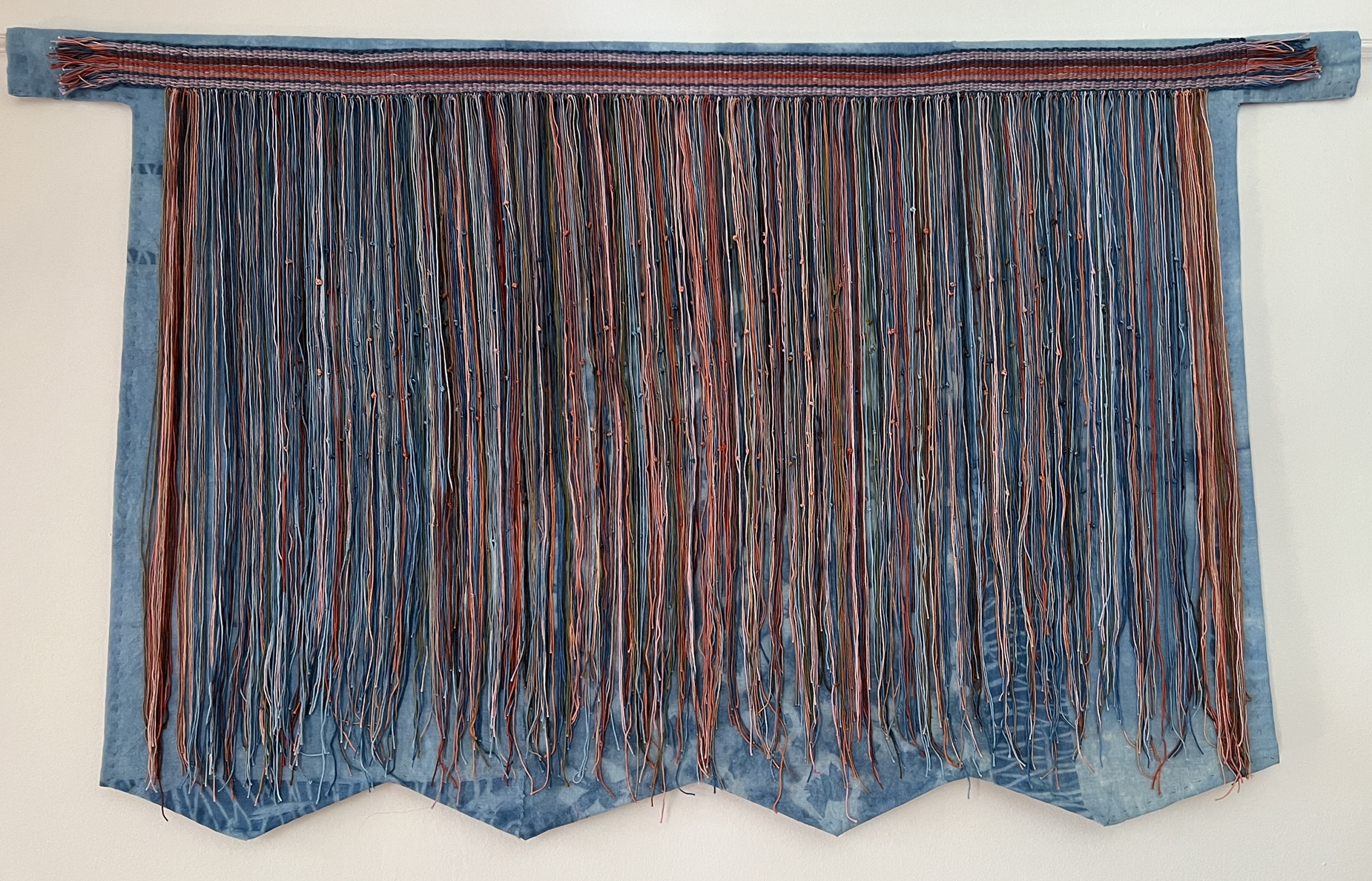
Joanna Rogers
Misty MacDuffee’s War Belt, 2026
Mercerized cotton thread dyed with madder, cochineal, cutch, pomegranate, St. John's Wort, quebracho, iron, indigo on japanese kimono cotton shibori dyed with indigo. 22" x 40"
Misty MacDuffee serves as the Raincoast Conservation Foundation's Wild Salmon Program Director. Misty is a conservation biologist with a focus on fisheries ecology in salmon ecosystems. I have translated Keat's poem On The Sea into morse code and knotted it into the hanging threads. Inspred by paleolithic string skirts and quipus, this war belt recognizes Misty's long term dedication to conservation in the face of various levels of government who consistently place economic gain over environmental protection.
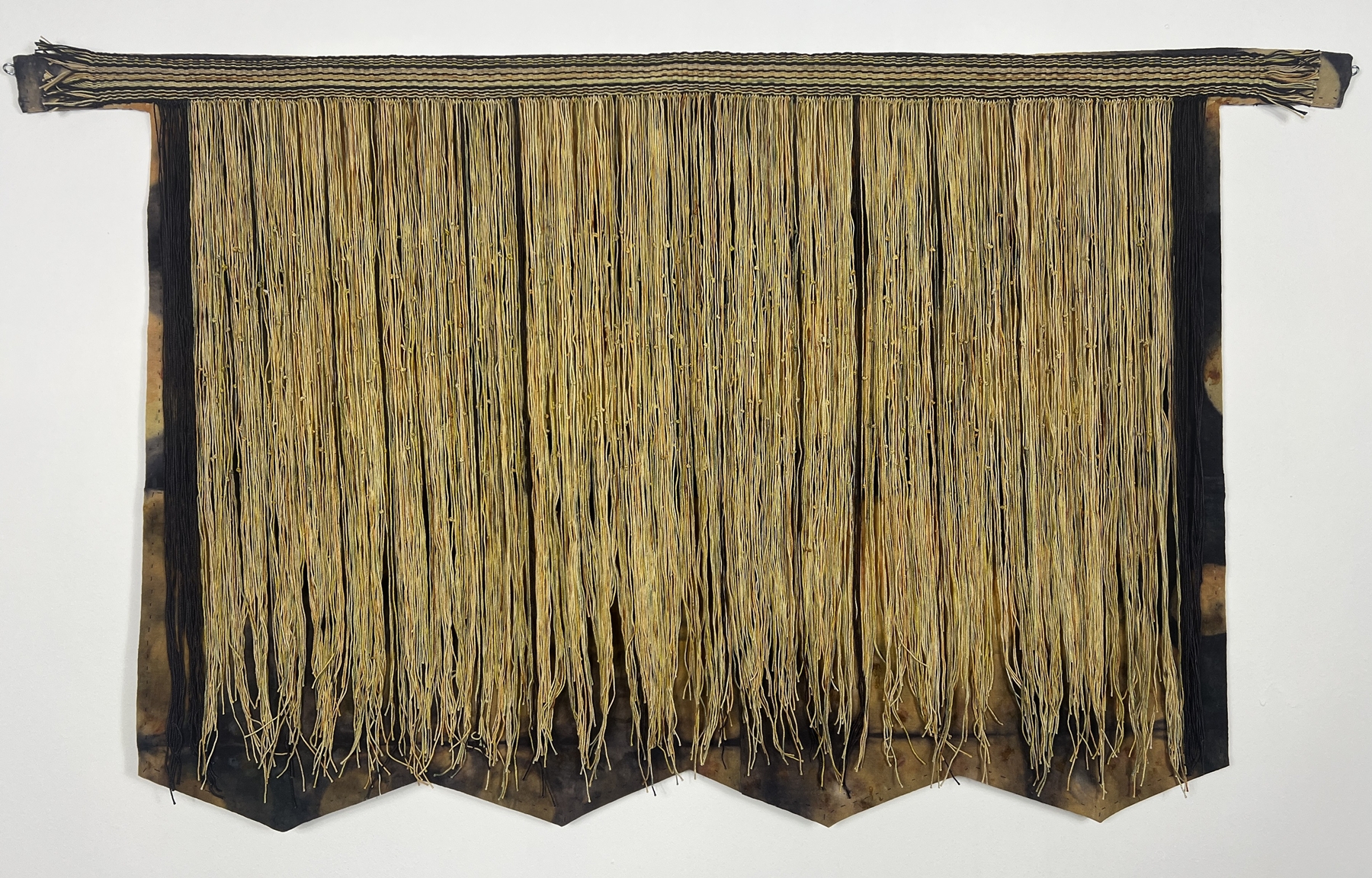
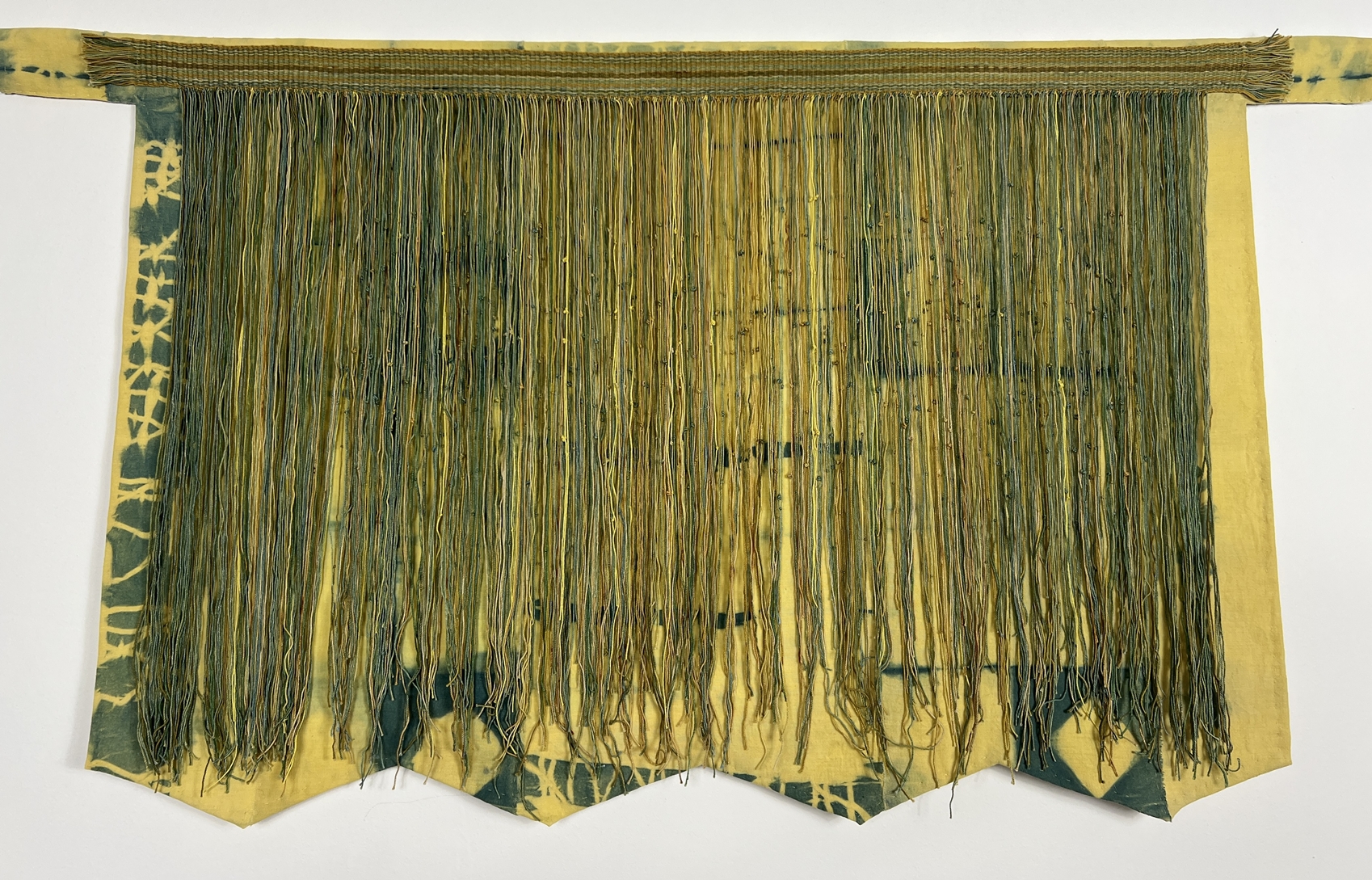
Joanna Rogers
Erin O’Brien’s War Belt, 2026
Mercerized cotton thread dyed with weld, marigolds, pomegranate, myrobalan, plants from my yard, and indigo. On cotton fabric shibori dyed with weld and indigo. 22" x 40"
Dr. Erin O'Brien is the Ecology and Development Director with the Pender Island Conservancy Association. As an avian ecologist, Erin studies songbirds to monitor habitat quality and detect environmental changes on local scales. I translated the poem To the Skylark by William Wordsworth into morse code and knotted it into the threads of this war belt. Erin O'Brien's War Belt reflects Erin's dedication to conservation and her work preserving land and studying birds on Pender Island in an effort to start remediating the damage done to this fragile island ecosystem.
Joanna Rogers
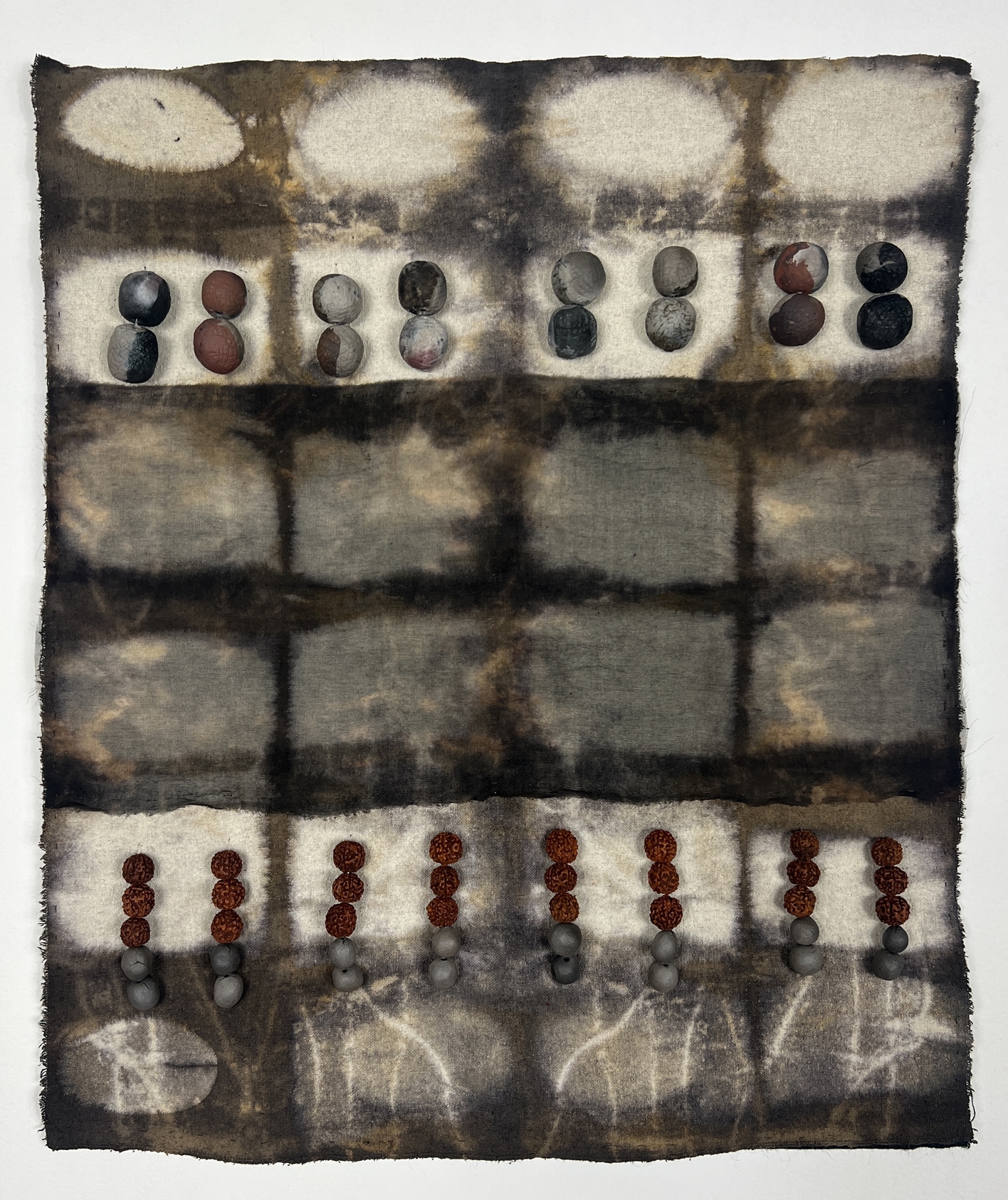
Abacus, 2025
Silk dyed with iron and tannins. Hand made clay beads and thrifted beads. 17" x 14.5"
Part of the series In Search of Lost Time. Imaginary objects from the Museum of Princess Ennigladi of Ur. The Museum of Princess Ennigaldi of Ur is considered to be the first public museum. It contained artifacts excavated by Ennigaldi's father, King Nabonidus (the last king of the Neo-Babylonian Empire), who is seen as the first archaeologist because he not only looked for and found artifacts but also strived to place them in chronological order. Some artifacts had been collected previously by Nebuchadnezzar. Some are thought to have been excavated by Ennigaldi herself. The museum dates to around 530BCE. The artifacts contained in the museum were from southern Mesopotamia and some dated back as far as the 20th century BCE. My imaginary artifacts capture the essence of the innovation of the Sumerians (5500 - 1800BCE). We know a lot about these people because of the myriad extant clay tablets inscribed with cuneiform, the first system of writing. The Sumerians were mathematicians and invented the abacus.
Joanna Rogers
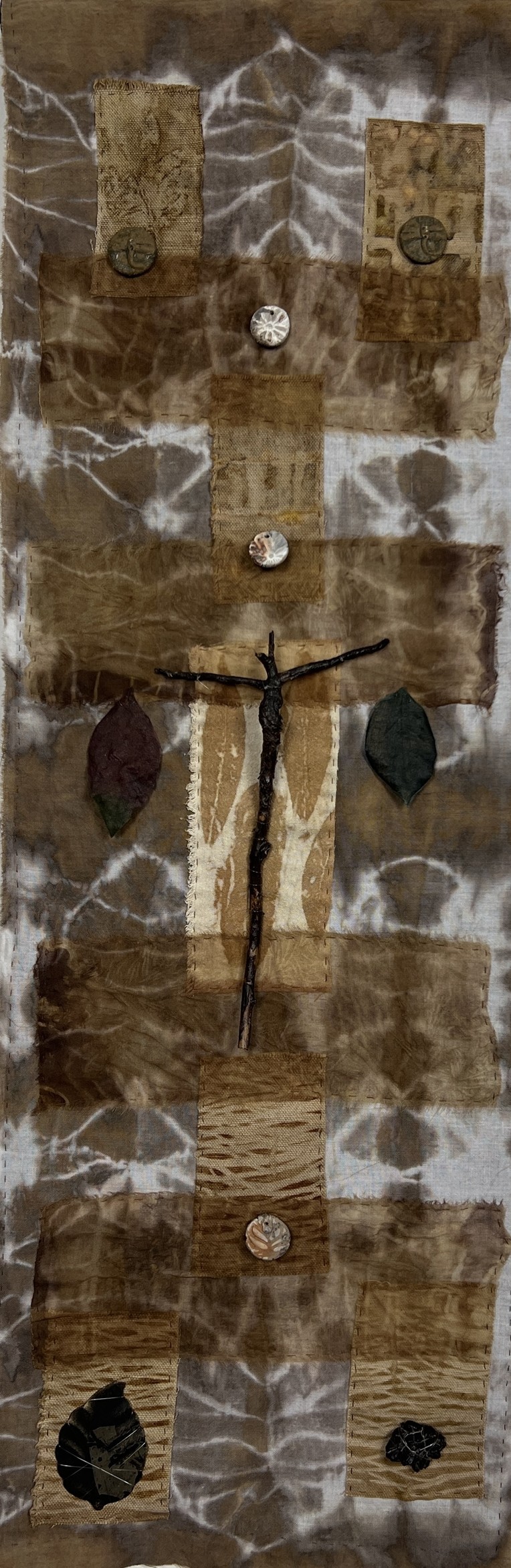
Water Screw, 2026
Cotton and silk dyed with iron and tannins. Hand made pottery discs and found objects. 32" x 11"
Part of the series In Search of Lost Time. Imaginary objects from the Museum of Princess Ennigladi of Ur. The Museum of Princess Ennigaldi of Ur is considered to be the first public museum. It contained artifacts excavated by Ennigaldi's father, King Nabonidus (the last king of the Neo-Babylonian Empire), who is seen as the first archaeologist because he not only looked for and found artifacts but also strived to place them in chronological order. Some artifacts had been collected previously by Nebuchadnezzar. Some are thought to have been excavated by Ennigaldi herself. The museum dates to around 530BCE. The artifacts contained in the museum were from southern Mesopotamia and some dated back as far as the 20th century BCE. My imaginary artifacts capture the essence of the innovation of the Sumerians (5500 - 1800BCE). We know a lot about these people because of the myriad extant clay tablets inscribed with cuneiform, the first system of writing. The Sumerians invented the water screw which was necessary to water elevated gardens, such as those known as The Hanging Gardens of Babylon, which were probably in Nineveh.
Joanna Rogers
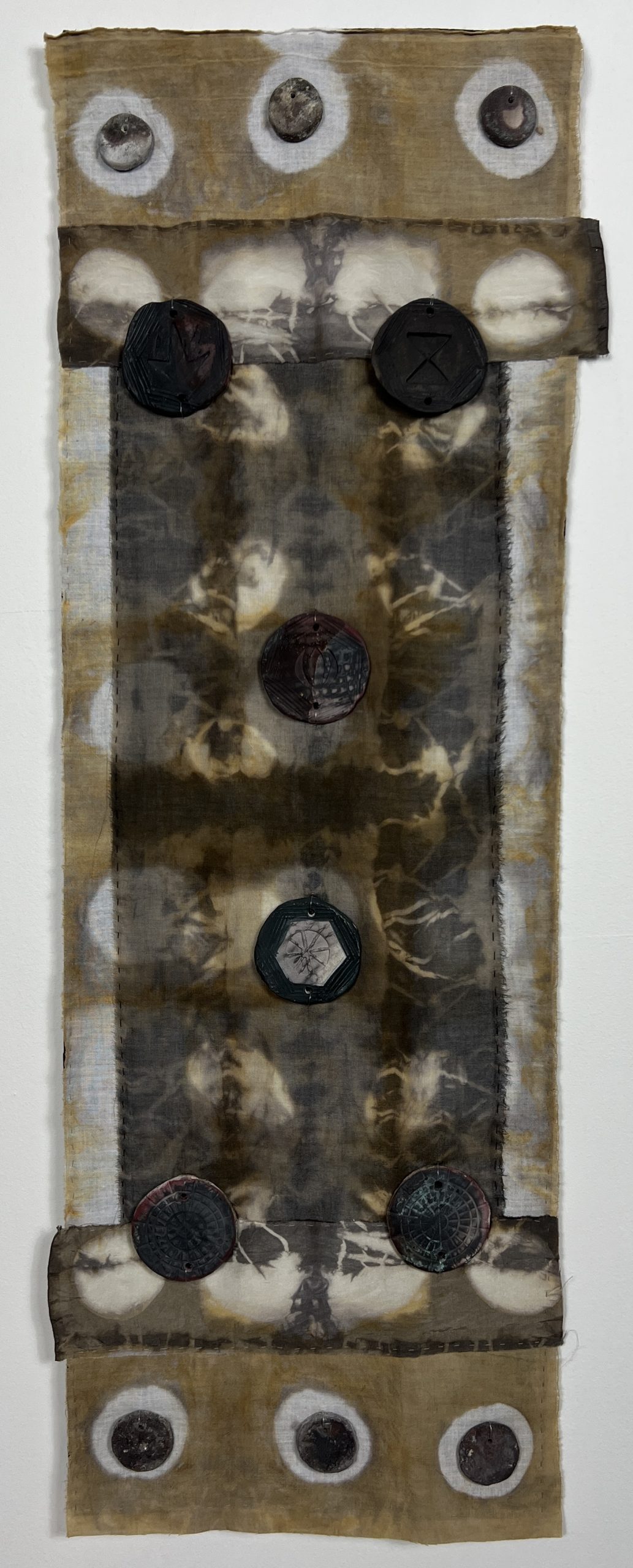
Wheel, 2026
Cotton and silk dyed with iron and tannins. Hand made pottery discs. 32" x 11"
Part of the series In Search of Lost Time. Imaginary objects from the Museum of Princess Ennigladi of Ur. The Museum of Princess Ennigaldi of Ur is considered to be the first public museum. It contained artifacts excavated by Ennigaldi's father, King Nabonidus (the last king of the Neo-Babylonian Empire), who is seen as the first archaeologist because he not only looked for and found artifacts but also strived to place them in chronological order. Some artifacts had been collected previously by Nebuchadnezzar. Some are thought to have been excavated by Ennigaldi herself. The museum dates to around 530BCE. The artifacts contained in the museum were from southern Mesopotamia and some dated back as far as the 20th century BCE. My imaginary artifacts capture the essence of the innovation of the Sumerians (5500 - 1800BCE). We know a lot about these people because of the myriad extant clay tablets inscribed with cuneiform, the first system of writing. The Sumerians invented the wheel at around the same that it was invented in Europe. The Sumerians first used the wheel to throw pottery.
Joanna Rogers
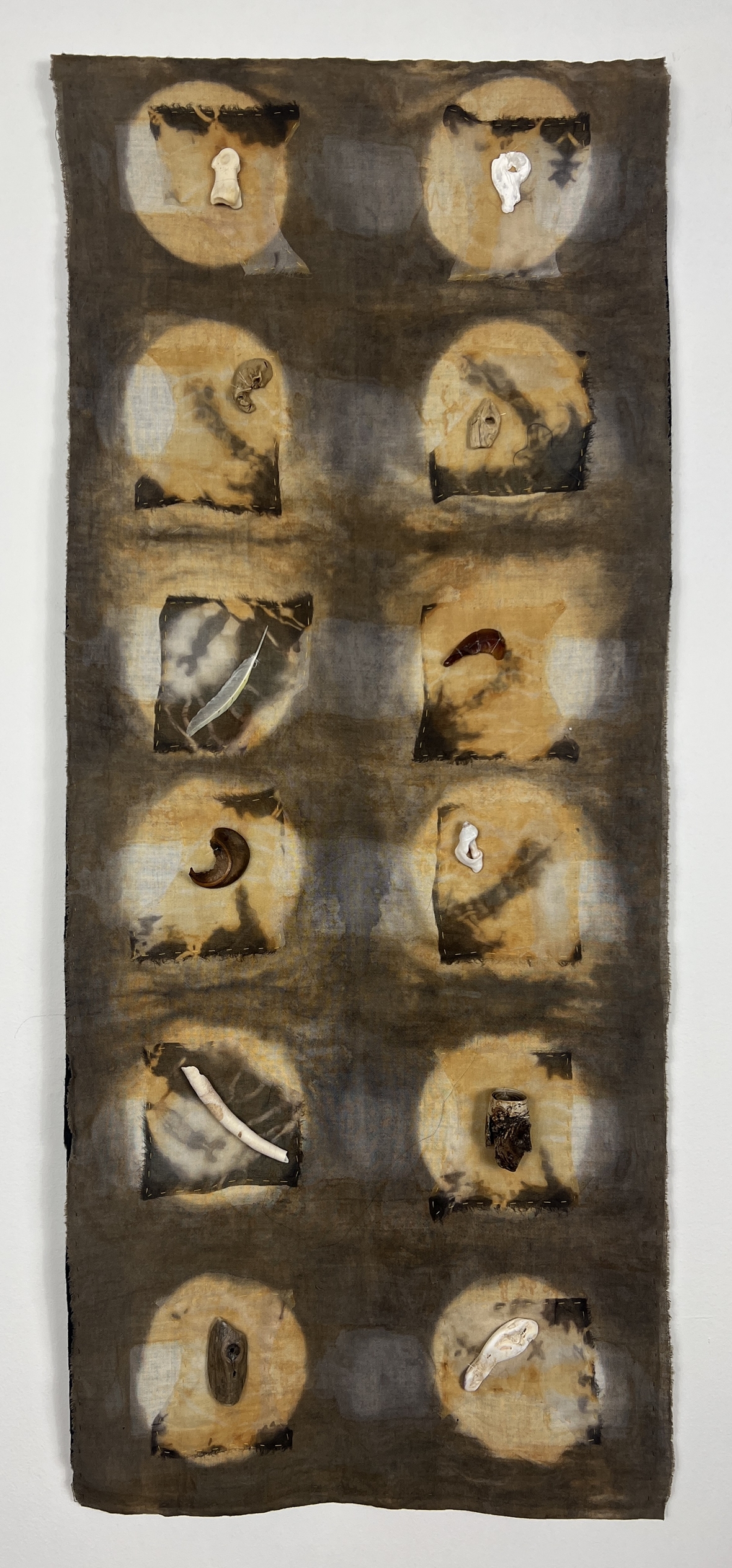
Calendar, 2025
Cotton and silk dyed with iron and tannins. Found objects. 32" x 13.5"
Part of the series In Search of Lost Time. Imaginary objects from the Museum of Princess Ennigladi of Ur. The Museum of Princess Ennigaldi of Ur is considered to be the first public museum. It contained artifacts excavated by Ennigaldi's father, King Nabonidus (the last king of the Neo-Babylonian Empire), who is seen as the first archaeologist because he not only looked for and found artifacts but also strived to place them in chronological order. Some artifacts had been collected previously by Nebuchadnezzar. Some are thought to have been excavated by Ennigaldi herself. The museum dates to around 530BCE. The artifacts contained in the museum were from southern Mesopotamia and some dated back as far as the 20th century BCE. My imaginary artifacts capture the essence of the innovation of the Sumerians (5500 - 1800BCE). We know a lot about these people because of the myriad extant clay tablets inscribed with cuneiform, the first system of writing. The Sumerians invented the calendar.
Joanna Rogers
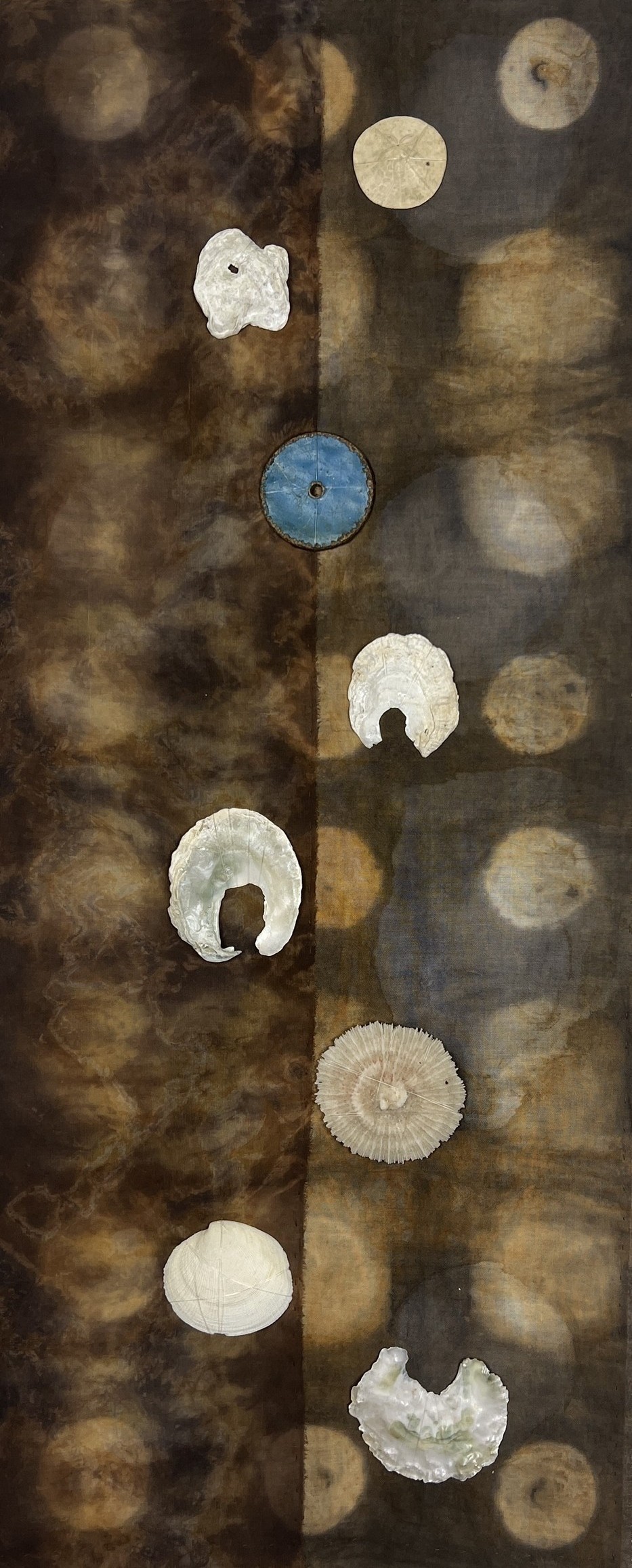
Ephimeris, 2025
Cotton and silk dyed with iron and tannins. Found objects. 32" x 13"
Part of the series In Search of Lost Time. Imaginary objects from the Museum of Princess Ennigladi of Ur. The Museum of Princess Ennigaldi of Ur is considered to be the first public museum. It contained artifacts excavated by Ennigaldi's father, King Nabonidus (the last king of the Neo-Babylonian Empire), who is seen as the first archaeologist because he not only looked for and found artifacts but also strived to place them in chronological order. Some artifacts had been collected previously by Nebuchadnezzar. Some are thought to have been excavated by Ennigaldi herself. The museum dates to around 530BCE. The artifacts contained in the museum were from southern Mesopotamia and some dated back as far as the 20th century BCE. My imaginary artifacts capture the essence of the innovation of the Sumerians (5500 - 1800BCE). We know a lot about these people because of the myriad extant clay tablets inscribed with cuneiform, the first system of writing. An ephimeris is a table or set of data that provides the calculated positions of, and other information about, celestial objects at specific times. The Sumerians were able to calculate this information and could predict eclipses.
Joanna Rogers
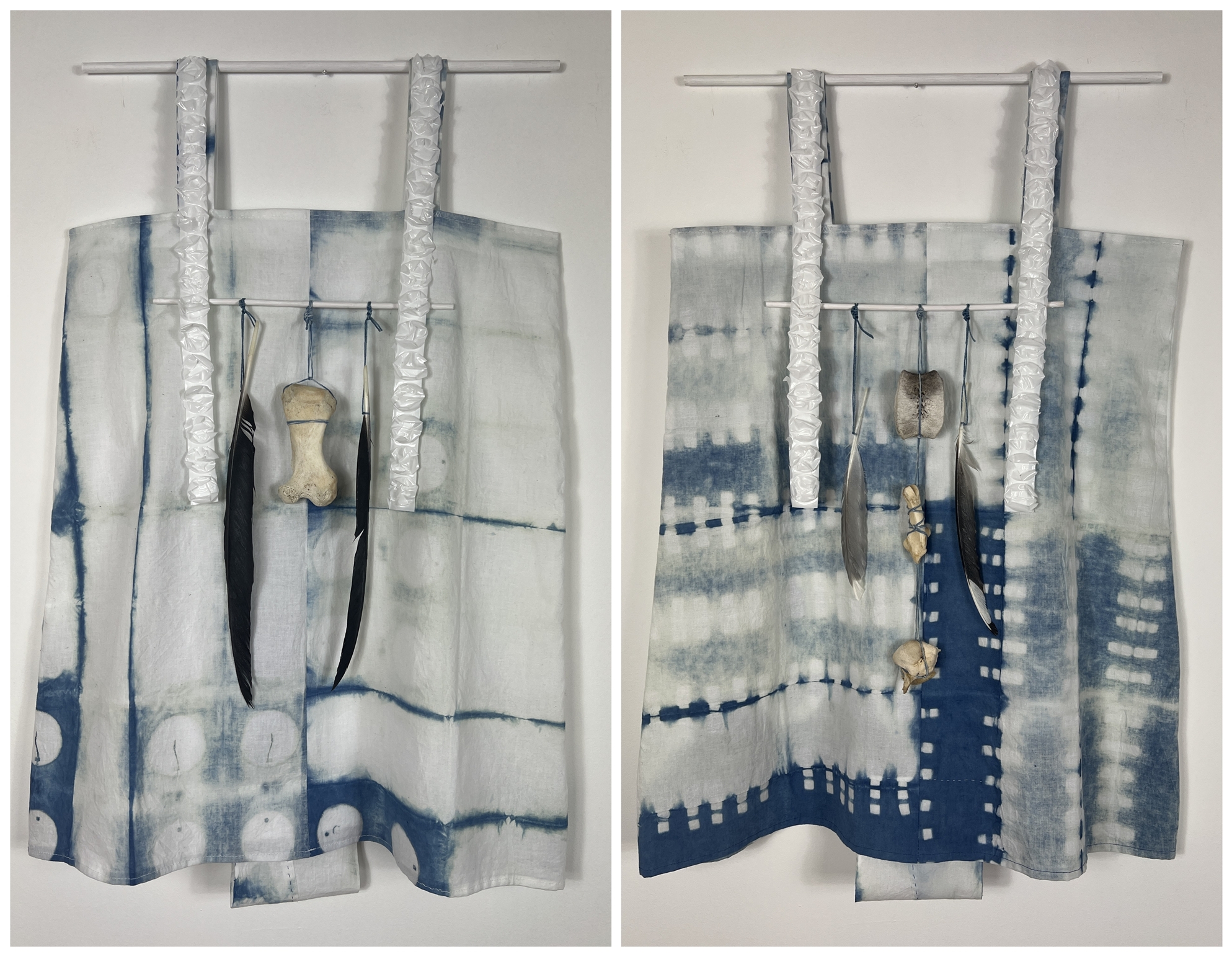
Arctic/Antarctic, 2024
Indigo on japanese kimono cotton. Bubble wrap. Found bones and feathers. Each piece 35" x 27"
Arctic/Antarctic is part of the series What Once Was. The Apocalypse Is Now. We think of the Apocalypse as being a future, calamitous event. But perhaps it is happening now and we are living in the middle of it. This present day apocalypse is entirely human caused as we carry out the global destruction of species and habitats in our rush to harvest the natural resources still remaining. The pieces in this series are styled after a vintage woman's shift This intimate undergarment, designed to be worn next to the skin, provides a moving metaphor for the need to protect what we cannot see; to expose the need to cherish what we hold dear. This series is intended to inspire action and a deeper understanding of the consequence of our actions. What Once Was. The Apocalypse Is Now represents all that could be lost to future generations: continents, ecosystems, individual species, time itself. Some of the pieces look like they could have been recently unearthed from a future archaeological dig and carry upon them remnants of once living things. These objects are attached to an outer carapace that fits over each shift. The artifacts are carried like a burden but also with care, the way we carry our wounded and dead; a part of and apart from the garments.
Joanna Rogers
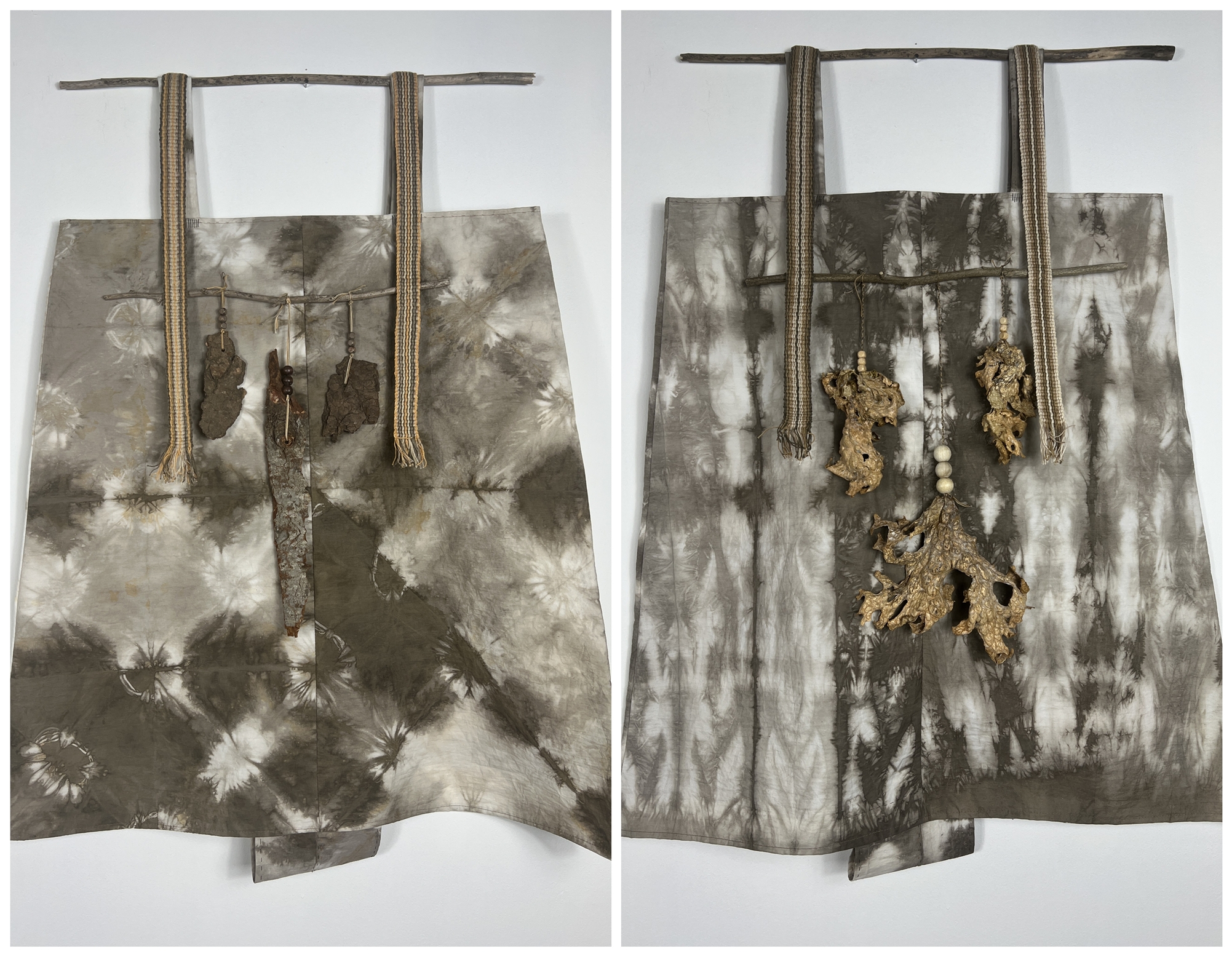
Boreal Forest/Rainforest, 2024
Japanese knimono cotton dyed with iron and tannins, inkle woven straps, found bark, beads. Each piece 35" x 27"
Boreal Forest/Rainforest is part of the series What Once Was. The Apocalypse Is Now. We think of the Apocalypse as being a future, calamitous event. But perhaps it is happening now and we are living in the middle of it. This present day apocalypse is entirely human caused as we carry out the global destruction of species and habitats in our rush to harvest the natural resources still remaining. The pieces in this series are styled after a vintage woman's shift This intimate undergarment, designed to be worn next to the skin, provides a moving metaphor for the need to protect what we cannot see; to expose the need to cherish what we hold dear. This series is intended to inspire action and a deeper understanding of the consequence of our actions. What Once Was. The Apocalypse Is Now represents all that could be lost to future generations: continents, ecosystems, individual species, time itself. Some of the pieces look like they could have been recently unearthed from a future archaeological dig and carry upon them remnants of once living things. These objects are attached to an outer carapace that fits over each shift. The artifacts are carried like a burden but also with care, the way we carry our wounded and dead; a part of and apart from the garments.