SDA Book Club: Mauka to Makai reviewed by Faith Hagenhofer
July 11, 2025
Mauka to Makai: Hawaiian Quilts and the Ecology of the Islands edited by Marenka Thompson-Odlum
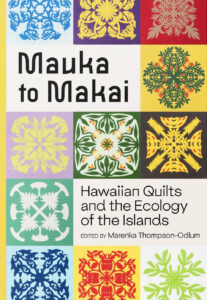
This group of essays is a companion to a commissioned collection of fifteen Hawaiian quilts at the Pitt Rivers Museum, University of Oxford in the UK. In this book editor Marenka Thompson-Odlum opens with narratives from each of the collective of makers; information on their own background, and a simple explanation of symbolism for each quilt.
It quickly becomes apparent how important it is to first know that Hawaiian quilting is embraced as traditional, and yet it is a very young practice (200 years). Colonizers arrived to a sovereign place that already had deep cultural practices in place and centuries of systematic environmental care. In the post-colonial embrace of Hawaiian quilts they have come to embody much local meaning, and were “developed in response to outside influences—ever-changing but rooted in the knowledge of the kupuna (ancestors).” (p.109)
Mauka to Makai is essentially a work of land pedagogy, providing a framework of place-based environmental Reciprocity between the people and Hawai’i itself. This has given rise to imagery, depicted through this imported skill, in the craft form of quilting. Mauka to Makai is not a textile How To; it does not offer patterns to be copied. It is more accurately a cultural How To, possibly a template for readers to find or create in their own communities. It is an offering of information on pre and post colonial history but more centrally, the cultural context of Reciprocity. Reciprocity, which is at the heart of Hawaiian culture, can be explained in the broadest sense as Humans take care of Nature and Nature will take care of Humans. The Land (which in an Island geography includes the water) is the teacher, with lessons on ecology, culture and history.
In addition to the presentation of quilts and their makers, Mauka to Makai has sections on history, the mountain ecosystems, the fields and plains, the near ocean and the estuarine places. For example Kalo/Taro root is celebrated on several quilts, and talked about in the Field & Plains section. Kalo’s origin story, which is told here, perfectly exemplifies Reciprocity simply and elegantly.
“Kalo is considered the elder brother to humans. Hawaiian mo’olelo tells of Wakea, Father Heaven, who bore a child with the Daughter of Earth. The infant, Haloa, was born prematurely in the shape of a bulb. Wakea buried Haloa in a corner of his house. The couple’s second child, also named Haloa, was born healthy and would later become an ancestor of the Hawaiian people. Haloa was to respect and look after his older brother, the elder Haloa, for all of eternity The elder Haloa was known as the root of life and would always sustain and nourish his younger brother and his descendants.” (p.83)
Mauka to Makai is an unmistakable joy to read, and an entry into the world of Hawaiian quilts.
–Faith Hagenhofer
- Publisher: Common Threads Press (buy it here)
- Date: 2024
- ISBN: 9781068625008
If you’ve read this book, leave a comment and let us know what you think!
Do you have a recommendation for a recent fiber-related book you think should be included in SDA’s Book Club? Email SDA’s Managing Editor, Lauren Sinner, to let her know!