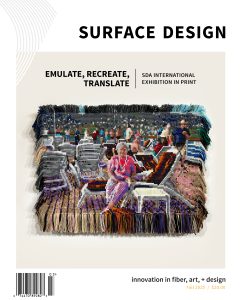
Emulate, Recreate, Translate, SDA International Exhibition in Print Fall 2025 Journal, Out Now!
October 13, 2025
Surface Design Association is excited to announce Emulate, Recreate, Translate SDA International Exhibition in Print, our Fall 2025 edition of Surface Design Journal. This year’s Exhibition in Print challenged artists to think about the ways fiber can be emulated, recreated and translated into other qualities and contexts. Whether that’s through metaphor or materiality, culture, language and more, this year’s EIP pushes what forms fiber can become from many different perspectives. Lauren Sinner, SDA Managing Editor & Co-Juror
Here’s a preview of what you’ll discover:
Guest Juror Statement: Making Fiber Speak by Nirmal Raja: “Making art is an act of translation, of our inner lives and our outer worlds. It might be a reflection of the past, a projection into the future, or an articulation of the present. When we think of making as an act of translating, a whole, rich world filled with potential reveals itself. The artists that responded to this call have a varied, rich, layered and intimate understanding of translation.”
Performing Fiber Award, Diana Baumbach: “In my current practice, I work intuitively with a variety of fibers to create wall hangings, objects and costumes. I am interested in how materials can be transformed from one kind to another: from fabric to paper, from hair to yarn, from object to photograph. By reconstructing materials, I can understand both the tactile world and my inner world in new ways. I embrace materials’ ability to carry meaning. I draw upon their histories and use them to tell my own story.”
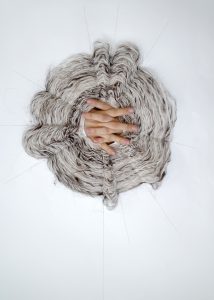
Diana Baumbach, Worn: Interlaced, 2024. Digital photograph, dimensions vary. Photo: Zac Pelleriti collaboration.
Material Exploration Award, Isabella Covert: “I force interactions between the body’s functions, sourced materials and medical apparatuses. Manipulated and contaminated by my body, these works act simply as byproducts of shed skin. Materials like latex and hair are left to decay against the porous skin and skeletal threshold. These bodies violate standard rules imposed upon materials, tampering with tactile relationships that promote rapid aging, cracking, discoloration and festering. They are bodies of infinite space confined within a space that will inevitably cause a decomposition cycle. They are bodies thrust into a process of ontogenesis in which nylon and metal may be all that remains.”
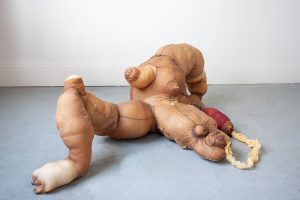
Isabella Covert, Limb Drainage, 2025. Nylon, latex, metal hook and eyes, 32 x 38 x 16 inches. Photo by the artist.
Modern Meets Traditional Award, Lakshmi Madhavan: “My artistic practice is rooted in the traditional textile of kasavu, the gold-and-white handloom cloth native to Kerala. I have spent the past several years working intimately with the weaving community of Balaramapuram, one of the oldest kasavu handloom centres in South India. Through this long-term engagement, I’ve come to see the kasavu not only as a heritage textile but as a charged surface where histories of caste, gender, labour and identity collide. My work attempts to reconfigure this material beyond its symbolic function, imagining it as a living archive of the body, of memory and of transformation.”
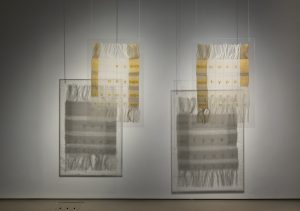
Lakshmi Madhavan, Bodied – Panel 1 & 2, 2024. Kasavu with glass, 24 x 34 inches each. Photo: Anil Rane.
Nature of Translation Award, Amy Usdin: “Though speaking broadly to loss, longing and the dissonance of nostalgia, much of my work is autobiographical. When I began weaving on discarded nets, I’d been caring for elderly parents in protracted decline. I felt a parallel to the careful but imperfect tending of worn objects that had outlived their function. As I manipulate these nets through a personal lens, I consider my own changing relevance.”
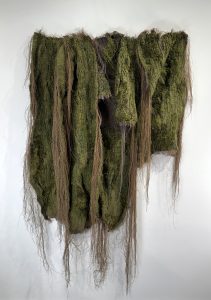
Amy Usdin, In the Falling, 2025. Needle-woven animal, plant and synthetic fibers on vintage fishing nets, 60 x 36 x 6.5 inches. Photo by the artist.
Guest Juror Award, Jeana Eve Klein: “By recreating/reinventing/resurrecting these images, I reflect on the dramatic evolution of vernacular photography and the impact thereon of digital and social media. Thirty years ago my grandparents used a camera loaded with film to document their travels. Every picture was precious and private, though certainly not perfect. This is in stark contrast to the common documentation of today, when every moment—even the most mundane—can be instantly recorded (and re-recorded, and re-re-recorded), edited, curated and publicly shared. I am pixelating the images through beads and making them larger than life, all for public display: essentially transforming the typical social media sharing of today into physical form.”
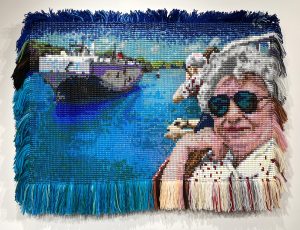
Jeana Eve Klein, Automotive Carrier Passing in Canal 2/93, 2023. Hand-woven plastic beads, monofilament and acrylic yarn, 36 x 50 inches. Photo by the artist.
Unconventional Materials Award, Lauren Comerato: “This body of work is both an investigation and reimagining of construction materials. What happens when I apply the fiber techniques passed down from my grandmothers to the industrial components of my father’s and brother’s trade? What stories surface when I spotlight the overlooked—an outlet cover or a wire nut—and recast them through the lens of craft? How can I weave my personal fascination with kitsch and overly adorned objects into my practice? Weaving and crochet become the dominant methods through which these worlds meet, creating new, hybrid forms.”
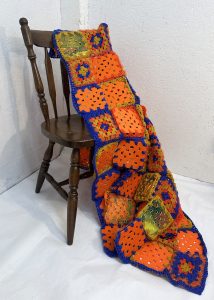
Lauren Comerato, Tradesmen’s Quilt, 2024. Yarn, laser-cut acrylic sheets and wooden chair, 3.5 x 4 x 3 feet. Photo by the artist.
Current Statement Award, Emiko Kuhs: “Using both digital and traditional tools, I have created quilted film stills that incorporate handcrafted elements while leveraging digital technology like machine embroidery and graphic design software. Even in these mechanized elements, there are traces of my hand in the digitization of each hand-drawn file, a reminder that a human being is behind their creation…I am drawn to quilting because it is a historically collaborative and political art form. Additionally, the art can be a marker of a specific time, place and identity. My existence is inherently political, and it would be a disservice to try to separate politics from my art. I am not imitating a film’s ideas with fabric; my work in quilting marks the time in which it was created.”
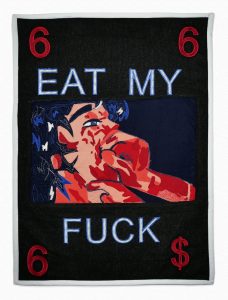
Emiko Kuhs, Doomed, 2024. Quilted and machine-embroidered cotton and glitter fabric, 27 x 15 inches. Photo by the artist.
This year’s EIP also has 22 Featured Artists included alongside the award winners: Anastasia Azure, Blair Martin Cahill, Shin-hee Chin, Kyoung Ae Cho, Lisa Cooreman, Rachael Segrest Cox, Ian Danner, Melissa Dorn, Helen Geglio, Precious Gyekye, AnnaBrooke Hill Greene, Laurel Izard, Mo Kelman, Fawzia Khan, melissa matson, Bobbi Meier, Hannah O’Hare Bennett, Joanna Rogers, Karen Searle, Lars Shimabukuro, Adrienne Sloane, and Madeline Thoman. Congrats to all our artists spotlighted in this lovely Journal!
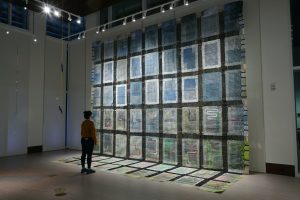
Lars Shimabukuro, In Camouflage, 2024. Installation with handmade paper sheets, handwoven cotton and wool, 21 x 22 x 7 feet. Photo: Michael Webster.
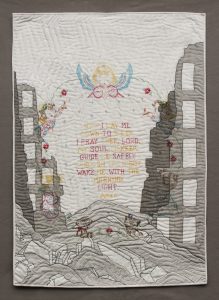
Laurel Izard, Now I Lay, 2024. Hand-embroidered and
quilted vintage baby blanket, 41 x 29 inches. Photo: John Spomer III.
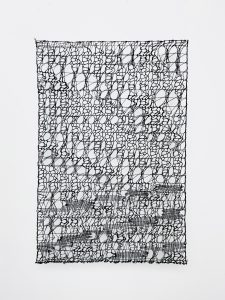
Madeline Thoman, How to Make Lace III, 2025. Linen bobbin lace, 9.6 x 6.3 inches. Photo by the artist.
Outstanding Student Awards: Presented annually to students who have demonstrated excellence in fiber arts. This year, the SDA Education Committee selected four awardees to be featured in print: Claire Krienitz, Fiona Fan, Prisma Andrade, and Rutuja Pawase. The work of these artists embodied inventive and innovative use of technique, materials and concepts not only in fibers and textiles, but in printmaking, sculpture, and more. It is an honor for the Education Committee to be able to see student work, review it, and learn more about the personal and societal issues they are tackling through their work.
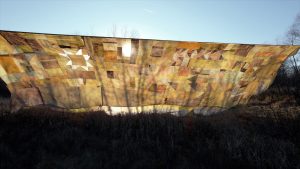
Claire Krienitz, Toulon, 2024. Sewn cotton and silk dyed with goldenrod, willow and iron, 42 x 72 inches. Photo by the artist.
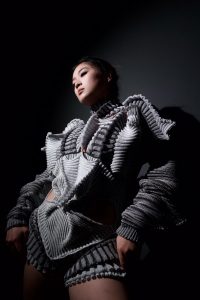
Fiona Fan, The Sculpted Body, 2024. Double bed knit elastomeric and nylon. Photo: Gavin Jin.
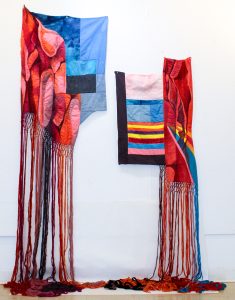
Prisma Andrade, El Segundo, 2025. Hand-dyed muslin with direct dye overlay, cotton batting, thread and assorted yarn, 75 x 27 inches. Photo by the artist.
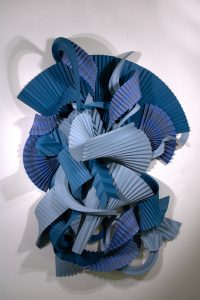
Rutuja Pawase, Amalgamate, 2025. Laser-etched, flatbed UV resin printed and origami cardstock paper, 42 x 32 x 14 inches. Photo by the artist.
Crafting Tomorrow: An SDA Small Group Show: Crafting Tomorrow (October 10–November 2, 2025) is organized in partnership with LA Artcore and Textile Arts LA and juried by Fafnir Adamites. Highlighting fiber and textile-based materials and techniques, including traditional and cross-disciplinary practices, experimental processes, and material innovation, this group exhibition showcases work from artists who are “crafting tomorrow.” Featuring the work of Ivy Laurel Anderson, Juan Gomez, Emily Hunt, Robert Mertens, and Sara Torgison.
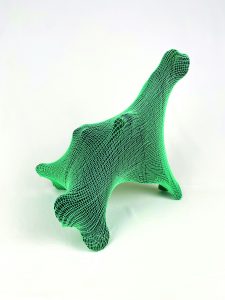
Ivy Laurel Anderson, Bicolor Assemblage no. 37, 2025. Machine-knit elastic encasing found objects, 10 x 11 x 8 inches. Photo by the artist.
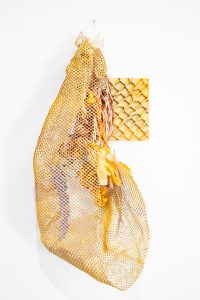
Juan Gomez, The Presence, 2022. Rope, thread, metal links and cardboard netting, 30 x 16 x 10 inches. Photo: Tatiana Mata.
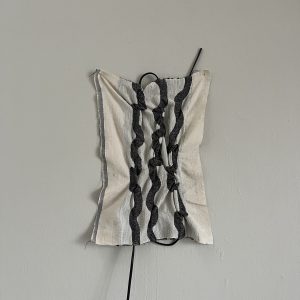
Emily Hunt, Untitled, 2024. TC2 woven cotton and industrial wire, 28 x 16 inches. Photo by the artist.
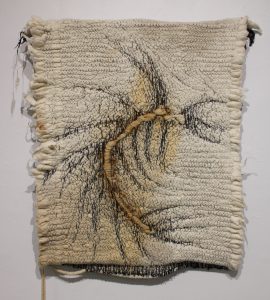
Robert Mertens, Artifact #4, 2021. Digital Jacquard-woven and felted steel wire, wool, cotton thread and rust, 27 x 21 inches. Photo by the artist.
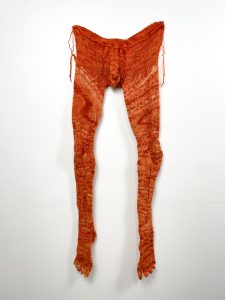
Sara Torgison, Empathy Pants, 2021. Knitted wool yarn dyed with madder root, 40 x 18 x 3 inches. Photo by the artist.
To buy a copy of Emulate, Recreate, Translate, go to the SDA Marketplace, or you can check out a free digital sample on our SDA Journal page.