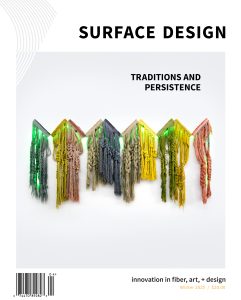
Traditions and Persistence – Out Now!
January 5, 2026
Surface Design Association is excited to announce Traditions and Persistence, our Winter 2025 edition of Surface Design Journal. “This issue of Surface Design Journal is dedicated to Latinx writers and artists from the Americas or, as it conventionally referred to: Latin America, which is one of the most ethnically diverse areas of the planet. Uneasily, the term Latin America suggests a homogeneous group of people and attempts to bind together a diverse, multiethnic and multicultural peoples into one vast geographical region, while also underlining colonization from Europe. This couldn’t be further from the truth. With a spirit of inclusivity and cultural equity, I invited an international mix of historians, curators, art critics and artists to share their unique perspectives and powerful stories. These amazing and diverse contributors bring viewpoints from Mexico, Colombia, Venezuela, the Dominican Republic, the U.S., Puerto Rico, Cuba, Brazil, Guatemala, Chile, and beyond. Their discussions of contemporary art practices explore culture, heritage, history, natural resources and political geography, offering visibility and representation that deepen our understanding of textile art’s enduring legacy across time and locales.” –Giannina Coppiano Dwin, Guest Editor
Here’s a preview of what you’ll discover:
In The Studio: Guapísimas and the Weaving of Worlds by Pepe López Reus: “The Guapísimas series began in 2004 when I traveled to Puerto Ayacucho in the Venezuelan Amazon to learn basket-weaving from the Piapoco, Curripaco, Panare, and Guahibo peoples. What started as a desire to master techniques became a deeper exploration of culture. I found that traditions were shifting: younger generations cared less for weaving, more for motorcycles, television and Japanese anime. Homes filled with Hello Kitty dolls, Spider-Man T-shirts and Dragon Ball Z murals revealed a new cultural weave.”
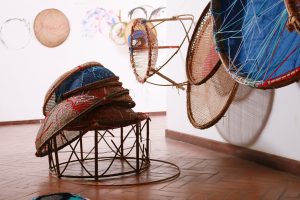
Broken baskets in Pepe López Reus Studio, Caracas, Venezuela, 2022. Photo: Julio Osorio. Courtesy of Dot Fiftyone Gallery and the artist.
Visions in Contemporary Maya Art by Adriana Herrera, PhD: “A round Lake Atitlán in Guatemala—swept by the Xocomil, a wind so intense that crossing it feels like venturing into the open sea—and bordered by three volcanoes and thirteen towns, a movement of contemporary art deeply embedded in the lifeworld of this sacred Mayan territory has emerged. The works of Tz’utujil artists from San Pedro La Laguna, Antonio Pichillá Quiacaín and Manuel Chavajay, who often collaborates with his wife, Cheen Cortez, have been exhibited in Basel, London, Madrid, and Miami. Their practices bring the ancestral traditions of their community into the realm of contemporary art while preserving their ritual essence.”

Manuel Chavajay, Oq Ximtali/Nos tienen amarrados, 2020. Video still from performance, 2:57 minutes. Photo courtesy of the artist.
Ruchul Pospo’y (Fiber and Color): Sandra Monterroso’s Textile Work by Francine Birbragher-Rozencwaig, PhD: “Working with fiber led Monterroso to ask herself: ‘How is the colonial history of our territories woven? Are we willing to cut these knots that bind the inequalities and violence they generate: discrimination, racism, Eurocentrism, patriarchy and extractivism?’ On the other hand, ‘The invitation to undo the knots or cut them is linked to liberation; that is, we are invited to free ourselves. However, there will always be the colonial impossibility of untying ourselves.’”
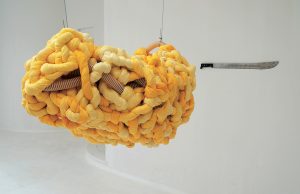
Sandra Monterroso, Nudo Gordiano, 2011. Sculpture with thread, plastic tubes and engraved machete, 47.25 x 31.5 x 23.6 inches. Photo by the artist.
First Person: Aurora Molina Fiber Narratives by Carol Damian: “Molina recognized the need for a space where fiber artists could come together to share techniques, inspire new ideas, and elevate the profile of textile and fiber-based art in the city. While open to artists of all disciplines, Red Thread Art Studio is a hub for fiber artists who transform fabric and thread into powerful concepts and ideas. The name Red Thread is rich with meaning. It symbolizes power, passionate love, adventure and energy: qualities that Molina and her artists believe are essential to art and community. In many cultures, the red thread represents connection: an invisible thread that ties people together across distance and time.”
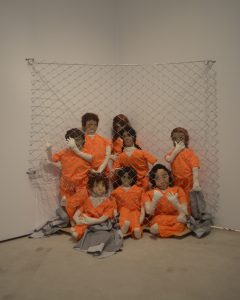
Aurora Molina, Cacophony of Wails and Sobs, 2017. Installation with cotton and needle-felted wool, dimensions vary. Photo by the artist.
Diana Eusebio: Preserving Ancestral Knowledge by Kandy G Lopez-Moreno: “Diana Eusebio is a first generation American, a textile artist born and based in Miami. Inspired by her ancestry, family, and the natural landscape, she uses natural dyes to create works that remind her of who she is and where she comes from. As a researcher, she is expanding her visual vocabulary by fusing modern and Pre-Columbian dyeing techniques with photography. She has established a signature style that teaches the viewer culture, history and memory. As I walked through the space, I could not help but think of the studio as a classroom. This is her curriculum. It’s specific. It’s her lab. This is her terreno (land).”
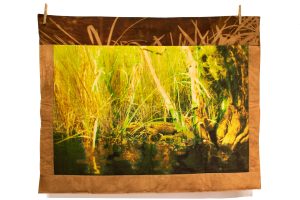
Diana Eusebio, Alligator Alcatraz, 2025. Digital-printed photo on cotton fabric, natural-dyed with Spanish moss and sapote and hand-quilted, 27 x 37 inches. Photo courtesy of the artist.
Exposure: A Gallery Of SDA Members’ Work: “This edition of Exposure spotlights fourteen Latiné/Latinx SDA members who work in a wide variety of fiber & textile media.”
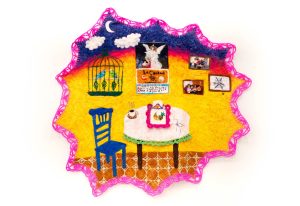
Meli Bandera, The chair is now empty and the birds are no longer singing (atardecers y telarañas), 2025. Needle-felted, embroidered and crocheted wool with chamomile and acid-dyed wool yarn and paños on cotton, 49 x 44 inches. Photo by the artist.
In The Studio: Coconut Grove by Martin Casuso: “Years ago, I bought a Mattel Knit Magic, a toy designed in the 1970s to automate knitting. I remember commercials for it on TV. I wanted it but my papa said no, it was for girls. Finding it as an adult, I noticed Anisa Jones from the smarmy TV show Family Affair was on the box. Smiling, with blond hair in pigtails, she wears makeup and fake eyelashes. She died from a drug overdose at age 16, but here she is happily cranking out a knit tube that, to me, looked like a knit condom. Displayed before her are a phallus-shaped doll and a red knit diaphragm. This brand of bent nostalgia is just my speed.”
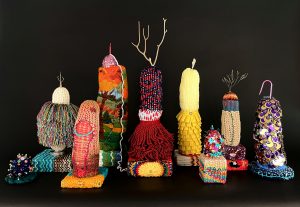
Martin Casuso, Knit Dicks (Fancy), 2024. Mixed media, dimensions vary. Photo by the artist.
Stitching Resistance Across Borders: A Conversation with Karen Rosentreter Villarroel by Diana Albarran Gonzalez: “Karen Rosentreter Villarroel is a Chilean textile artist, historian and activist whose work bridges fibre art, feminist resistance and diasporic memory. Her practice challenges individualistic paradigms by foregrounding collective making, intergenerational knowledge and political engagement. In this conversation, Karen shares her journey through textile artivism, the artist’s term for textile practices as artistic and political acts to denounce injustices and preserve collective memory, the founding of the initiative Mil agujas por la Dignidad (A Thousand needles for Dignity), and the transformative power of fibre in Latin American diasporic communities.”

Karen Rosentreter Villarroel, La gente despertó, 2020. Embroidered fabric and burlap with thread and wool yarn, 23.6 x 15.75 inches. Photo by the artist.
First Person: Weaving Connections: Diasporic Experiences in the Work of Maria Maea by Maru López: “In recent years Maea has begun making a body of work which includes both figurative sculpture and abstract pieces, all incorporating the palms she forages. She also collaborates with her mother and brother, as part of her natural tendency to build community and foster relationships through her practice. She continues to develop new projects and teach in inner city schools using basketry as an entry point. Similar to Ursula Le Guin’s theory about nets, baskets hold and protect, not only things but also stories, community and memories of generations.”
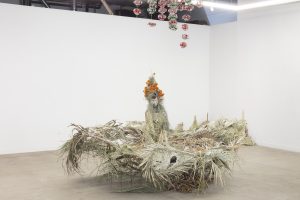
Maria Maea, All in Time, 2022. Woven palm fronds, milkweed, rebar, chicken wire, magnolia seed pods, marigolds and concrete, dimensions vary. Photo: Josh Schaedel. Photo courtesy of artist and Murmurs Gallery.
Risk of Extinction in Mexican Traditional Textiles by Lilia Jimenez Meza: “Our textiles are alive; they evolve and endure. Each piece, made stitch by stitch, reflects an identity built over centuries. The history, beliefs and creativity of the maker are written into each piece. The color, figures, stitches and form, each carry meaning, can be read like a story. I encourage you to learn about the textiles that are around you, whether from your country or mine. Look at them with new eyes, filled with curiosity. Whenever possible, ask about the origin of the maker: who taught them, what memories are woven into them, and where does the tradition originate.”
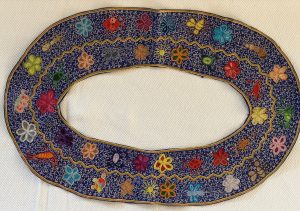
Pinotepa Nacional, Pacific Coast of Oaxaca, huipil neck, circa 2020. Embroidered fabric with chain stitch, 12 x 18 inches.
In The Studio: That Which Inhabits Me by Lisu Vega: “My practice is born from the act of weaving as a way of writing and remembering. When I weave, I don’t just build forms: I trace stories, revisit memory and link each process to the next. Recycled rope is my essential material; it acts as a brush and an umbilical cord that connects me to my ancestors, while becoming both root and second skin. I work with found and reused materials, trusting in the power of the discarded to transform into poetry.”

Lisu Vega, El Túnel, 2021. Woven and knotted repurposed rope, dimensions vary. Photo: Simon Soong.
Made Aware: Design as Memory and Future: My Journey with Oiamo by Tiago Braga: “Brazilian design is experiencing renewed visibility on the international stage. Within this movement, I have found my voice through Oiamo, the nomadic studio I founded in 2019 in Rio Grande do Sul, in the far south of Brazil. My work is not limited to creating objects; it is about shaping cultural artifacts that carry memory, spirit and identity. From the beginning, my intention with Oiamo has been to map, revitalize and preserve the memory of communities in Southern Brazil. I combine handcraft practices, natural fibers and reclaimed materials to create limited, signed and numbered collections. For me, design is a living language—sensorial, emotional and multifaceted—that connects tradition and innovation while remaining open to the world.”
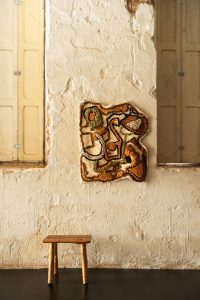
Tiago Braga, Encruzilhada Tapestry, Vento Pampo Collection, 2025. Handwoven and embroidered recycled cotton and responsible natural wool, 31.5 x 37.4 inches.
To buy a copy of Traditions and Persistence, go to the SDA Marketplace, or you can check out a free digital sample on our SDA Journal page.