SDA Book Club: Textile Design Theory in the Making reviewed by Vivien Zepf
April 3, 2026
Textile Design Theory in the Making by Elaine Igoe
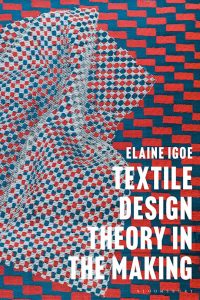
I like the idea of a textile designer as a translator. Designers ask questions and respond to problems. They gather, reflect upon and respond to concepts as varied as zeitgeist and personal experience, function, fashion and philosophy. In the process, they “interpret and tidy images, words, stories, feelings, memories and object” to develop a “communicative cloth,” (p. 47) as Elaine Igoe calls it. They create something that speaks to others through texture, mark making, pattern, color, design or function. Textile designers themselves are often an unheralded group, in part because “the ultimate fate of textiles is the assimilation into something else” (p. 172). That reality aside, Igoe argues that designing textiles is a rigorous and unique discipline, one that deserves thoughtful analysis and study. She offers ample evidence in her book, Textile Design Theory in the Making.
Igoe is a Senior Lecturer in Textile Design at Chelsea College of Arts, University of the Arts in London, and has spent most of her academic career considering textile design, both as a scholar and a maker. This book builds upon her doctoral studies and includes her own continued investigations into textile design—which she notes doesn’t have to include fabric—as well as critiques and analyses by notable designers and researchers whose work engages with the topic. By her own admission, Igoe states it is easier if the reader is knowledgeable about the design theory field, particularly the writings of Bracha Lichtenberg Ettinger and Tim Ingold. She hopes the reader will embrace her auto-ethnographic approach, a research path which includes personal narratives and experiences as integral to the process, but unapologetically writes it “may be too much or too little for you” (p. 4).
I am not a textile design scholar and I don’t have the in-depth understanding the book’s typical audience might already have. Instead, I had to look up concepts, words, and people (the book’s glossary was too lean for me on that front). I had to think. A lot. However, my lack of knowledge didn’t keep me from finding the book fascinating. Until now, I didn’t know that Aristotle posited a “hylomorphic” theory of making– joining materials and design to give “form to matter”—and that Ani Albers built upon that theory. I hadn’t considered the etymology of the word “paraphernalia” (the items a woman brought with her that weren’t part of her dowry), and how this gendered term might connote vital elements to some practices, but trivial ones in others. My burgeoning textile design theory lexicon— indicative of its interdisciplinary nature—now includes textility, methectic, Deleuzian folding, poiesis, frayages. And as for people, let me encourage you to get to know Althea McNish.
It’s true these are disparate topics, but that’s also the point. Igoe submits that design thinking is woven from all manner of experiences, philosophies and perspectives, an infinite mesh like Indra’s net. She suggests that the “concept of continuously and endlessly expanding lines” (p. 161) is a way to define textile design and it’s what makes design theory so intriguing and ripe for discussion and study. With Textile Design Theory in the Making, Igoe meaningfully contributes to the research and invites others to interrogate, develop, and elevate the study of design theory. It also asks the reader to consider, What influences and experiences do you call upon as you transform / give form to your ideas?
–Vivien Zepf
- Publisher: Bloomsbury Visual Arts (buy it here)
- Date: August 2021
- ISBN: 978-1350061569
- If you’ve read this book, leave a comment and let us know what you think!
Do you have a recommendation for a recent fiber-related book you think should be included in SDA’s Book Club? Email SDA’s Managing Editor, Lauren Sinner, to let her know!