SDA Book Club: The Alphabet of Expectations
June 12, 2026
SDA Book Club: The Alphabet of Expectations: An ABC Primer for Today’s Girl by Kachina Leigh, interviewed by Vivien Zepf
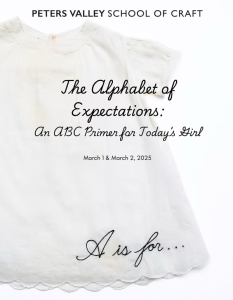
Presented with support from the Peters Valley School of Craft
Words matter. We’ve all witnessed or experienced the positive and negative power of language, labels, implications, connotations, and/or assumptions. In my personal childhood experience, taunts or slurs often raised emotional welts. Interestingly, what might have been an insult two decades ago might now be considered a compliment. How does this happen?
“In language-use as in other practices of self-expression (like fashion, music and art), it’s the rising generation—adolescents and young adults—who tend to be innovators. And in the case of language, it’s typical to find that young women are a step ahead of young men.”(1)
Deborah Cameron wrote that statement in 2015 to defend her long-held views derived from her academic research. Cameron offered her statement in rebuttal to a position presented in an article that judged women for linguistic choices that seemed new and/or out of place. However, Cameron was building upon a well-established sociolinguistic pattern: women lead 90% of linguistic change(2).
I hadn’t yet investigated linguistic change when I spoke with artist Kachina Leigh, so we didn’t discuss it. Interestingly, though, Leigh noticed this very phenomenon in the classroom. “I’ve always been interested in words and, working with the age group that I do, the fluidity they have with words—it’s been interesting for me to see the evolution of words that you never wanted to hear spoken about yourself in high school,” she explained. Leigh studied English literature and art, and currently is a high school art teacher in Pennsylvania. She explained that she listened and learned from her students, observing how female students were verbally judged by themselves and others. She began to consider her perceptions of language in relationship to the dialogues she overheard amongst the students.
Referencing classic Dick and Jane readers which offer primary students a basic understanding of necessary common words, Leigh wondered, “ What words would have to be included for a contemporary young woman? “ To work through this query, Leigh began to hand stitch along the front and back hems of small dresses, with a “vocabulary” word corresponding to each letter of the English alphabet. She decided to use vintage children’s dresses, many of which had been gifted to Leigh by her grandmother, who had taught her how to embroider and was a formative influence in Leigh’s life. The use of these garments personally connected Leigh to her grandmother, but also visually strengthened the connection between older generations and the modern sensibilities expressed in her stitching. In addition, “There’s such a presumed innocence to it [children’s clothing]” that its use in this context prompts viewers up to consider how our descriptors of girls change as they mature. Is innocence actually lost when a girl develops breasts?(3)
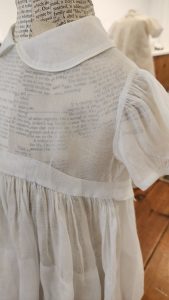
Kachina Leigh, I is for … Invisible. Hand embroidery on vintage children’s dress, form created with plaster, covered in pages from Emily Post’s Etiquette: the Blue Book of Social Usage. Photo by the artist.
“Embroidery is a delicate art,” Leigh expressed, so it’s interesting to see this artwork in juxtaposition with stitched drawings of potentially provocative words and strong language. Using a stem stitch to outline most of her illustrations, Leigh also employed color choice and garment features to amplify the definition and/or ambiguity of selected words. For example, stitching the word “invisible” using black thread was done tongue in cheek, but Leigh also elected to stitch the word on a worn dress that is sheer (though why it is sheer is unclear). The young “tomboy” climbing a tree is wearing pink shorts and a lavender top. “Slut” is represented by a corset, both as a nod to its use as lingerie and its current symbolism in sexuality, but also as a reflection on this undergarment’s use to constrain a woman’s figure to meet societal expectations. The image also suggests “the ability for all that structure to be pulled apart quickly,” shared Leigh.
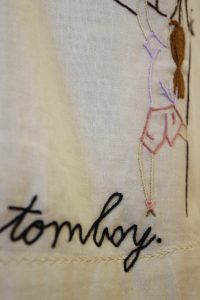
Kachina Leigh, T is for … Tomboy (detail). Hand embroidery on vintage children’s dress, approximately 12 x 12 inches. Photo: Erika Hewston.
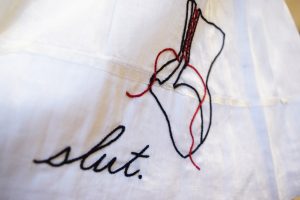
Kachina Leigh, S is for … Slut (detail). Hand embroidery on vintage children’s dress, approximately 12 x 12 inches. Photo: Erika Hewston.
“Hysterical” is the only outlier in terms of stitch. The words hysterical and hysterectomy share etymological roots, so Leigh used pink chain stitch within a red stem stitched outline to draw a uterus, using the dimensional stitch “to emulate the thickness one might associate with a uterine lining,” described the artist.
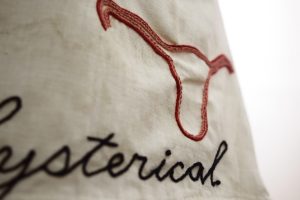
Kachina Leigh, H is for … Hysterical (detail). Hand embroidery on vintage children’s dress, approximately 12 x 12 inches. Photo: Erika Hewsto
After stitching on the dresses over the course of a decade (starting with A and ending with Z), it was time to figure out how to exhibit the garments. Leigh felt it was important to create something that would do more than present the dresses, that would “resonate with this idea of things that women should do, things that girls should do, ways they should behave, unspoken rules that they should follow.” After evaluating and discarding ideas like a clothes line, Leigh opted to present the dresses on papier machè forms she constructed, which she covered with pages taken from old Emily Post etiquette guide books. The old pages, too, were made from thin paper that harkened back to dress patterns. The combination is, as Leigh puts it, “a perfect marriage”.
Each form was individually made to accommodate the unique shape of a dress. “Just like each dress is individual, I wanted each stand to be individual,” explained Leigh. When the work was installed at the Peters Valley School of Craft, Leigh mixed the displays throughout the exhibition space. In the same way that Leigh is interested “in how words morph and change and move”, she also played with the interaction of the words in relation with one another, visually and thematically. Forms faced in different directions, suggestive of movement in concert with the various ways a guest might move through the space, having their own internal dialogue. The randomness was also a way to mitigate expectations of following the “rule” of alphabetical order.
Because there were no barriers between viewers and the artworks, Leigh observed guests reaching out to touch the garments in the installation. Some would lift the skirt of the garments, sometimes to evaluate the stitch work. Of course, touching artworks is never a good idea, but it was fascinating to watch viewers reach for garments in an exhibition about rules and etiquette, that often referenced personal space and body agency. Did it seem easier to reach out because they were children’s garments, as opposed to adult sized clothes? If so, what does that suggest?

Kachina Leigh, The Alphabet of Expectations: An ABC Primer for Today’s Girl (installation), 2025. Peters Valley School of Craft. Photo by the artist.
To make it easier for readers, the exhibition catalog, The Alphabet of Expectations: An ABC Primer for Today’s Girl, presents the artworks from A to Z, starting with “A is for … adulteress” (stitched in scarlet red, of course) and ending with “Z is for … zaftig.” The front and back of the dresses appear on facing pages so readers have the opportunity to view both sides of the garment in unison, an experience exhibit-goers didn’t have. These images are followed by the word’s definition(4), taken from Merriam-Webster and urbandictionary.com to add additional context. Full-page detail shots reveal some of the vintage fabric wear or highlight a particular element of the stitching. The catalog is an interesting and valuable substitute for being able to interact with the actual artworks.
Yes, much of Leigh’s artwork in this exhibition originates from a gendered perspective, but it loops in male and female perspectives and perceptions. The overall work challenges us to consider culture, generational linguistic change, and social norms. It gives us space to contemplate what it now means, for example, for a woman to be “U is for … unruly.” The Alphabet of Expectations asks us to question our assumptions and expectations of women and girls, to consider how language evolves, and to revisit how we respond to the language and labels we use.
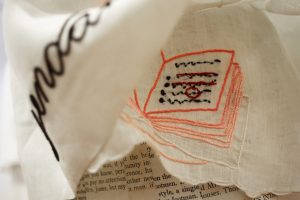
Kachina Leigh, V is for … Vagenda (detail). Hand embroidery on vintage children’s dress, approximately 12×12 inches. Photo: Erika Hewston.
(1) Deborah Cameron. debuk.wordpress.com, July 26, 2015. At the time, she held the Rupert Murdoch Professorship in Language and Communication at the University of Oxford.
(2) William Labov, Principles of Linguistic Change, 1990
(3) “This endless policing of women’s language—their voices, their intonation patterns, the words they use, their syntax—is uncomfortably similar to the way our culture polices women’s bodily appearance.” Deborah Cameron. debuk.wordpress.com, July 26, 2015
(4) For example, the definition for “cougar” reads, “C is for … cougar and “Cougar – /koo-ger/ noun. 1. A large, tawny cat, Felis concolor, of North and South America: now greatly reduced in number and endangered in some areas. 2. Informal. An older woman who sleeps with younger men; cougars who are “true hotties” are gaining in popularity as they are thought to be looking for fun, and not trap a man into a relationship.
–Vivien Zepf
Publisher: Pretzel City Press (buy it here)
If you’ve read this book, leave a comment and let us know what you think!
Do you have a recommendation for a recent fiber-related book you think should be included in SDA’s Book Club? Email SDA’s Editor, Lauren Sinner, to let her know!