SDA Book Club: Connecting Threads reviewed by Faith Hagenhofer
September 4, 2026
Connecting Threads: Tactile Social History by Lynn Setterington
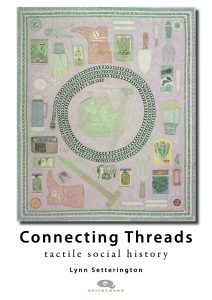
Lynn Setterington compiled a guide to her fascinating intersectional work that combines the often solitary practices of embroidery with art that focuses on socially engaged practices. Early on she proposes that the book reviews her own work processes through twelve pieces. Actually, there are more “pieces”/works than twelve, and the book draws more on overarching topics than a list. They aren’t chronological, as Setterington’s interests and concerns leapfrog but retain continuity, sometimes revisiting ideas. Early works explore what become through lines of concern: PLACE, what it means to belong, and how ordinary life presents itself as inspiration as well as examples of connectedness and community. Some of the work and projects, but not all have enlarged to result in installations.
The bodies of community created work are categorized as “Crossing Cultures”, “Identity and Belonging” and “Health and Well-being.” In “Crossing Cultures” Setterington has been stimulated to learn the practice of kantha cloth creation, bringing the running stitches method into her own projects while maintaining a focus on domestic and everyday ordinary objects, usually within the sphere of women’s work. After her own work comes that of sharing the practice in groups. “Identity and Belonging” settles on the embroidered human signature as the signifier of individual identity, whether one’s own or that of a historical figure. The belonging part comes in collectively working and joining these signatures in multiple ways. These are excellent examples of socially engaged practice.
Setterington has been an academic, though she never reveals her area. Is it anthropology, ethnography, history, museum studies? This piece of information is missing, though in writing style, she often refers to the writings of others. These references are not collected in a bibliography of any kind, which is frustrating for a reader.
I was unfamiliar with this artist before encountering this book. As an art teacher of textile skills it is a pleasure to have her work as an example for students. Her own handwork is precise and impeccable and her community oriented group work is inspirational. Her writing about that work is also instructional—it’s not a “how to”, but she does outline some bare bones steps that someone with any kind of hand/art/craft practice who wants to become more engaged with the public should consider.
–Faith Hagenhofer
- Publisher: Quickthorn (buy it here)
- Date: May 2026
- ISBN: 9781739316051
If you’ve read this book, leave a comment and let us know what you think!
Do you have a recommendation for a recent fiber-related book you think should be included in SDA’s Book Club? Email SDA’s Interim Editor, Lauren Sinner, to let her know!