Kathy Landvogt
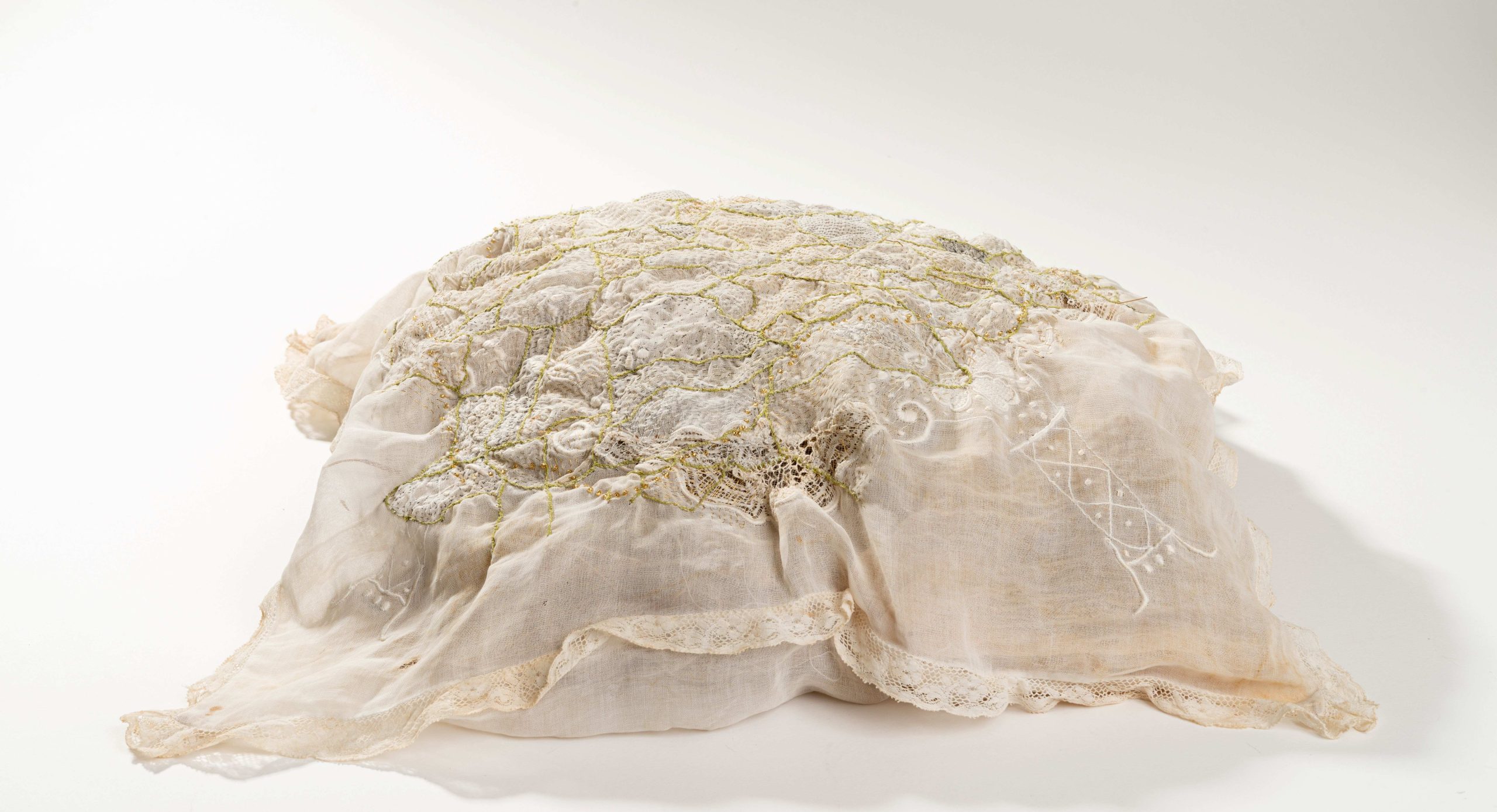
Pillow, 2026
Vintage muslin pillowcase, thread (metallic, stainless steel silk, cotton), stuffing (kangaroo grass, tea-dyed muslin) H8 x W50 x D50cm
Through learning and unlearning about settler history and first contact with Indigenous Australians, I strive to increase my sense of belonging on land that I do not rightfully own. ‘Pillow’ is the second of my textile works based on a map of sheep stations established on the Country of the DajDja Wurrung people in south-eastern Australia in the 1840’s. This map is stitched onto a stained and torn vintage muslin pillowslip of unknown provenance, representing English traditions of fine embroidery passed down to me from my matrilineal ancestors. The pillow is stuffed with the indigenous ‘Kangaroo Grass’ which used to blanket this area but has almost disappeared under the hard hooves of introduced sheep and cattle. I use gold and silver thread and beading to denote both the colonial wealth brought by the land and its continuing preciousness to everyone connected with it. Only one small area of this extensive Country was set aside for the original inhabitants (clearly identifiable in the work by the different thread used). This was known as a Protectorate and was intended, in the misguided words of the day, “to smooth the pillow of a dying race”. My stitching, though, is basic, in keeping with my knowledge of this country: a beginner’s effort that parallels the clumsy, error-strewn efforts of our settler culture to make good this colonial history.
Kathy Landvogt
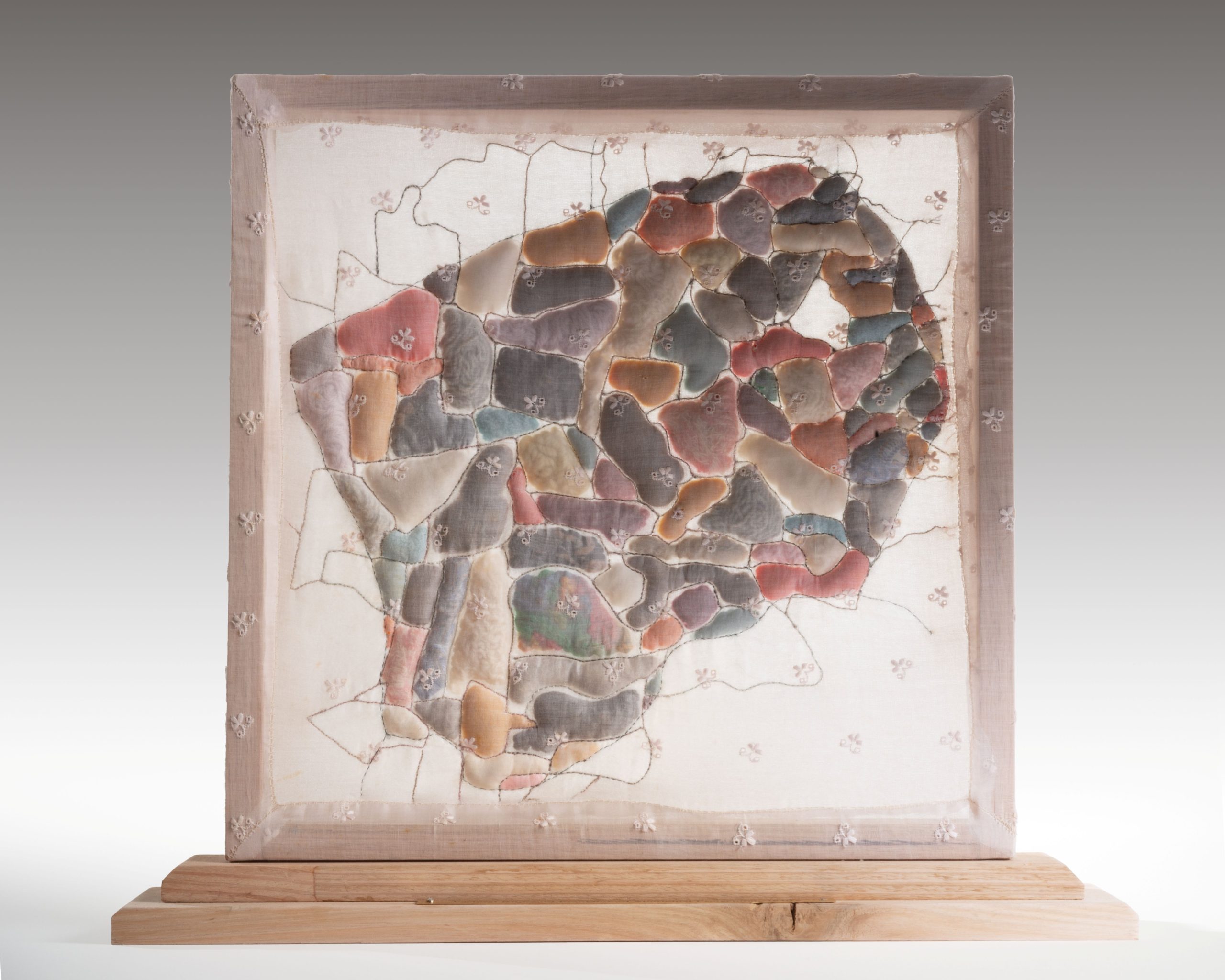
The Wrong Side, 2025
vintage organza, wool gauze fabric, silk thread, woolen stuffing (various), timber (native Eucalyptus), brass H46.5 x W54 x D11cm
‘The Wrong Side’ probes the cultural silences absorbed throughout my life as a white Australian woman of settler heritage. We say we are ‘on the wrong side of history’ if we fail to correct mistakes of the past: here I challenge one of the founding stories of Australia’s wealth, ‘riding on the sheep’s back’. In using and subverting materials and conventions of textile construction and display, the work questions assumptions that still often dominate historical understandings today. This textile work is based on a map of 1840’s sheep stations (known as pastoral runs) within what was, and still is, the Djaara Country of the DjaDja Wurrung people, in south-eastern Australia where I live. The wealth of wool and a ‘civilizing’ mission were the two motivations behind this colonial push into the great Australian interior. Accordingly, fine gauze woollen fabric forms one side of the quilted map and a vintage broderie organza that speaks of refinement and gentility the other. Deliberately semi-sheer, these fabrics ask us to see through the opaque language and blind-spots to become clear-sighted about this colonial history. The work is stuffed, even over-stuffed, with wool gleaned from woven scraps, unravelled yarn, dyed and natural unspun fleece, and remnants of a childhood blanket. The one small area left empty is a so-called Protectorate set aside for the original inhabitants to prevent the worst abuses by the settlers, but comprising a fraction of the land they own/ed (as shown on the complete map), and a fundamentally paternalistic gesture. ‘The Wrong Side’ borrows the trapunto quilting technique in which shapes are first stitched through the two layers of fabric, then individually stuffed through a small hole which is then repaired. The straining sutures create a sense of scarred land, sacrilegious damage and clumsy repair. The whole piece is made in the style of a traditional colifichet (double-sided) embroidery in order to confound a singular view of its subject. Museums have frequently been tools of colonialism. The stitched map is stretched over a standing timber frame and given brass labels on each side, lending it the authority of a museum artefact. But the land is also present: the frame of Australian hardwood timber from SE Australia is left natural rather than stained dark in the historical style.
Kathy Landvogt
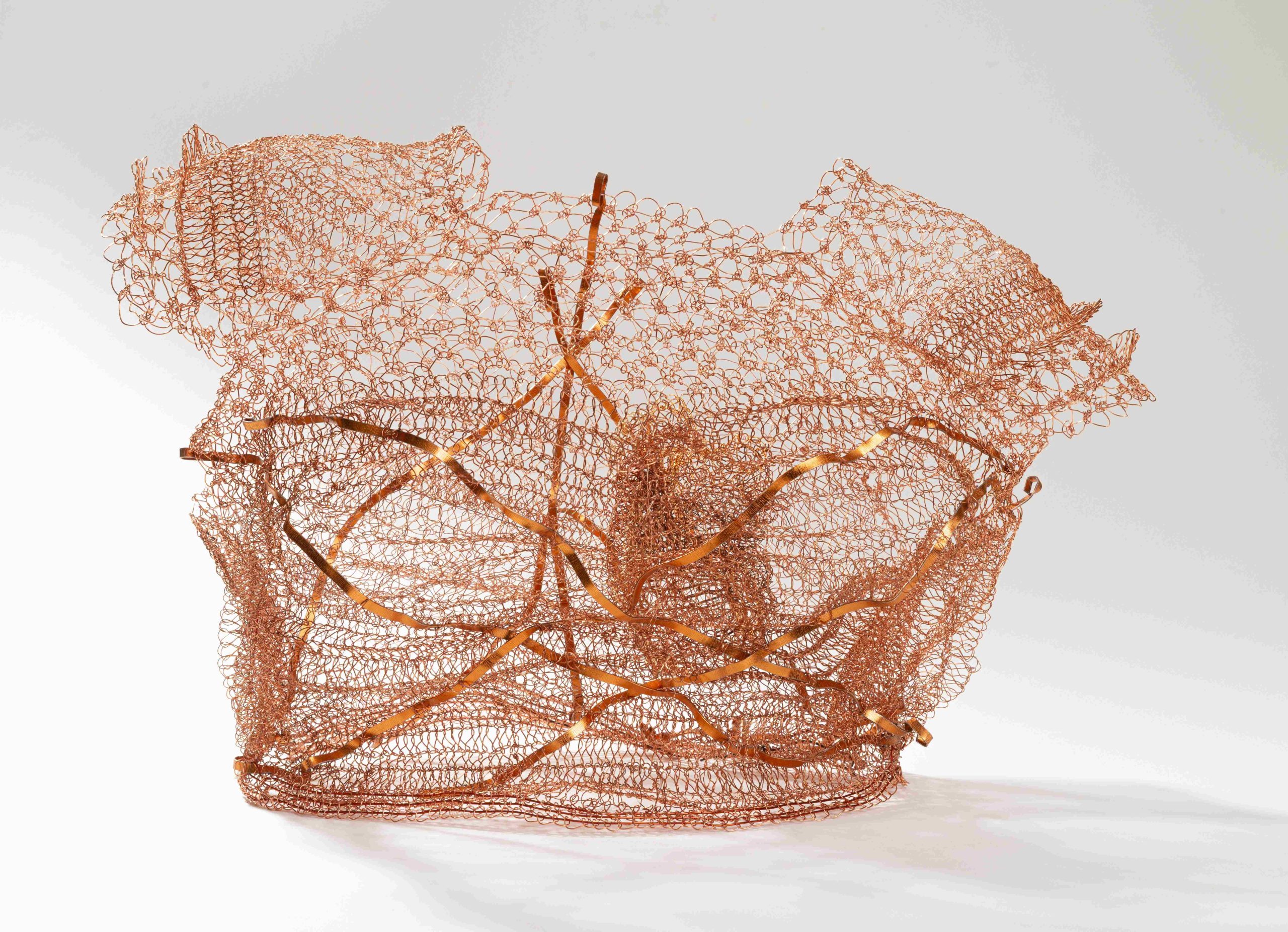
Be Brave, 2026
Recycled copper wire, coloured copper wire, coated aluminium H35 x W50 x D25cm
‘Be Brave’ is my defense for a tender heart in the guise of lace. The copper wire is soft but each loop, pulled hard up against the previous stitch, holds fast to its memory and knits into armour. This chain mail can easily be breached and has seen some trouble, but the hands that made it are strong, and grow stronger through the making.
Kathy Landvogt
Stranded History, 2026
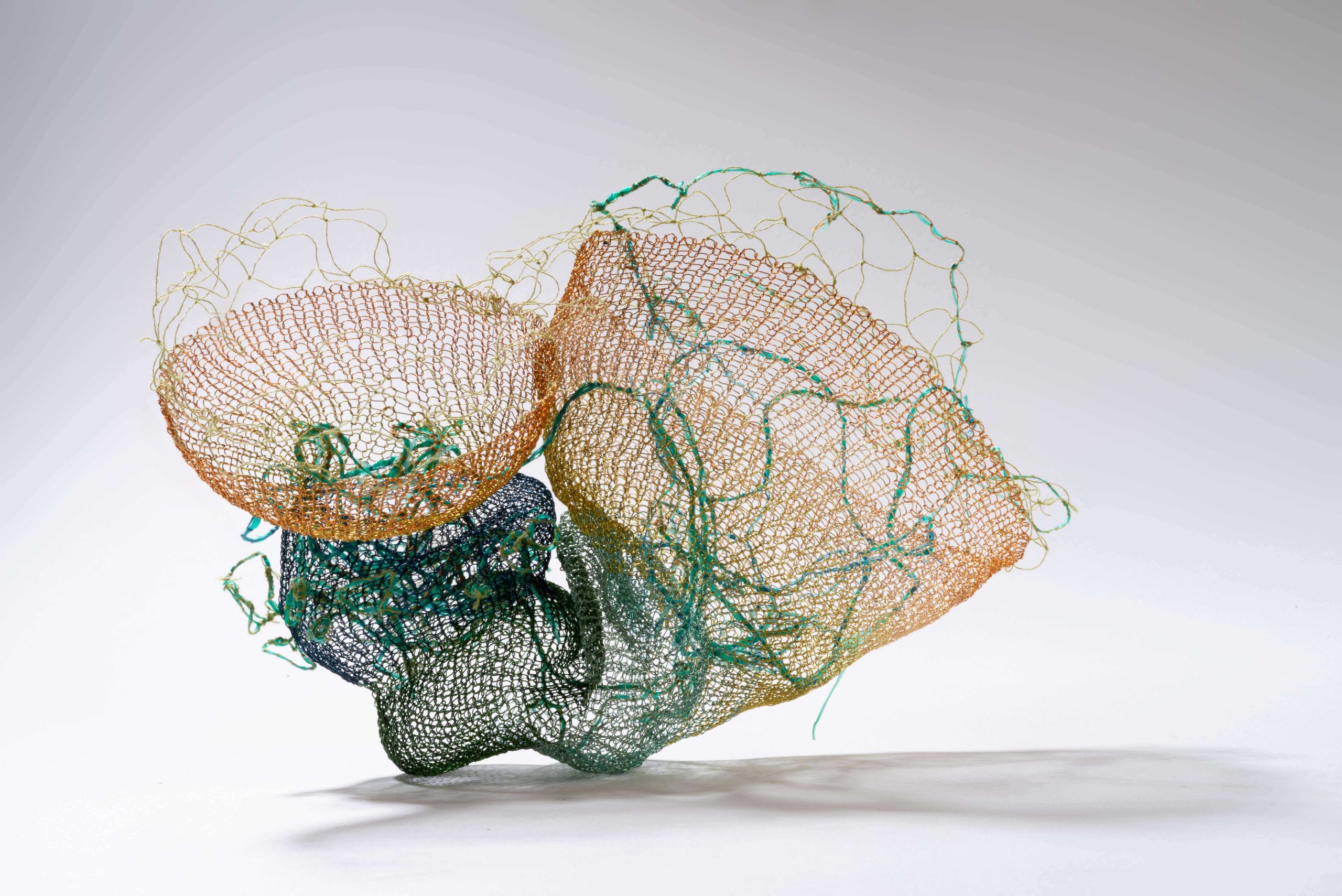
Coloured copper wire, stainless steel thread, flood debris (polypropylene baling twine) H22 x W14 x D14 cm
Once described as a ‘chain of ponds’ before pastoral occupation and gold-mining, the Loddon River is still beautiful, but walking along the riverbed at Newstead my eye caught on something foreign draped high in a tree. It was green plastic baling twine, stranded by the flood three years ago and now shredded but still grasping its straws. Back in the studio I teased it apart, blanket-stitched the tiny filaments of its netted structure with stainless steel silk thread, and trailed these repurposed fibres onto hand-knitted copper wire forms. Together these forms represent the pools and flows of the river and tell the complex, subtle and fraught story of pastoral settlement along the Djarra waterways.
Kathy Landvogt
The Motherline, 2026
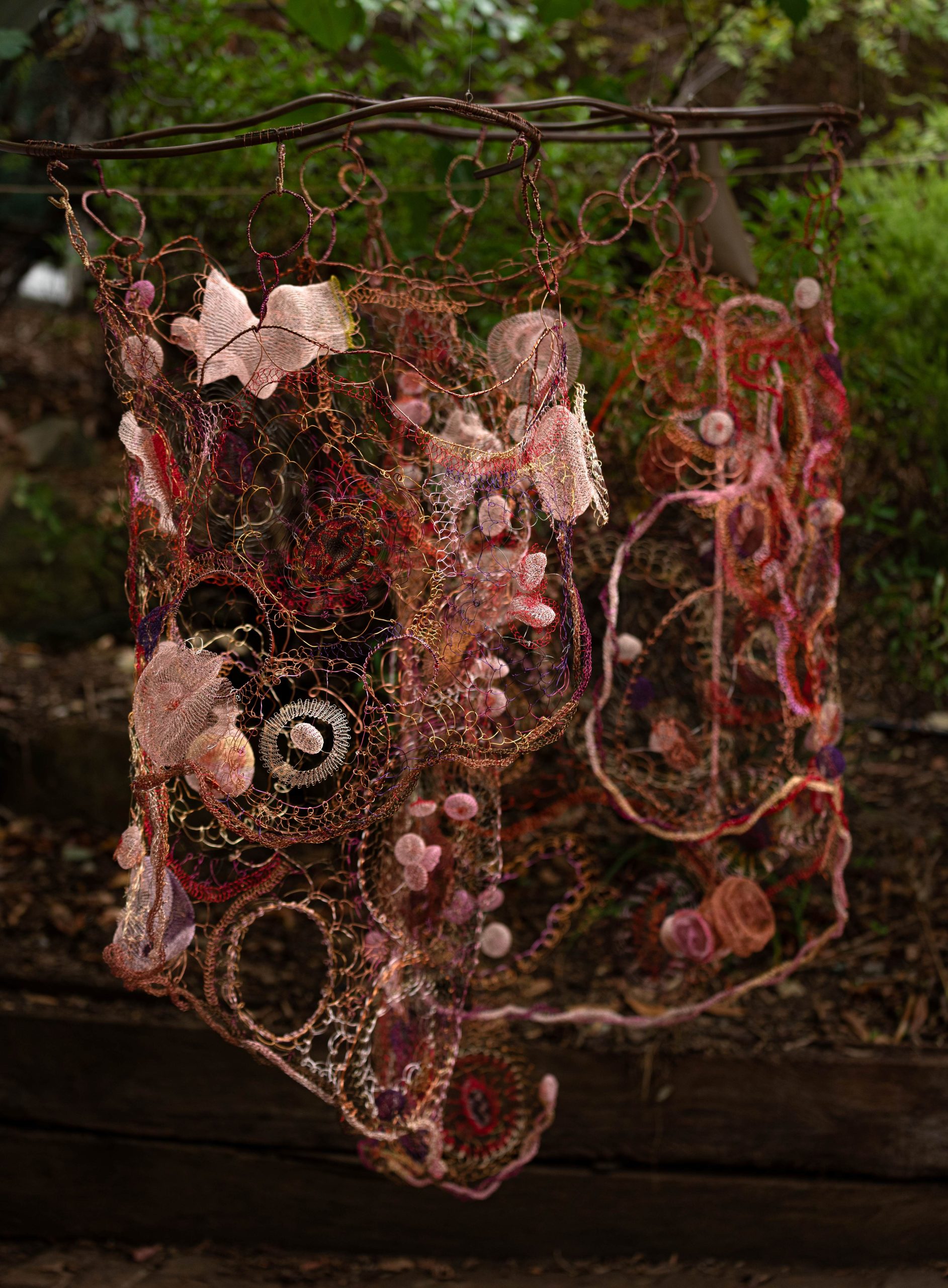
Coloured copper wire, recycled copper wire, recycled copper pipe, stainless steel fittings H140 x W140 x D80 cm
Kathy Landvogt’s textile sculptures give form to what has been silenced but is held in our bodies and imaginings. The concept for ‘Motherlode’ emerged when she learned how mitochondrial DNA carries the matrilineal legacy down through the female line. Its organic forms and powerful symbolism offered her a range of fascinating images and powerful truths to work with. Using copper wire in visceral colour and a range of stitches that create patterns and forms of varied density, she wove a matrix on a larger scale than most of her work, to hold these ideas up to the light. Loosely looped netting is interlaced with amulets knitted in fine wire that stand in for the lost names, faces and stories of a female family tree. Suspended curtain-like on copper tubing, the work invites the viewer to come closer and be enveloped in the enduring maternal that creates us all. The materials and techniques tell as much of the story as the forms themselves: copper wire is pliable yet strong, and it also holds memory. To Kathy, the slow process of building an artwork one stitch at a time is comforting and meaningful, connecting her with women’s precious labour and care.
Kathy Landvogt
Making Good, 2023
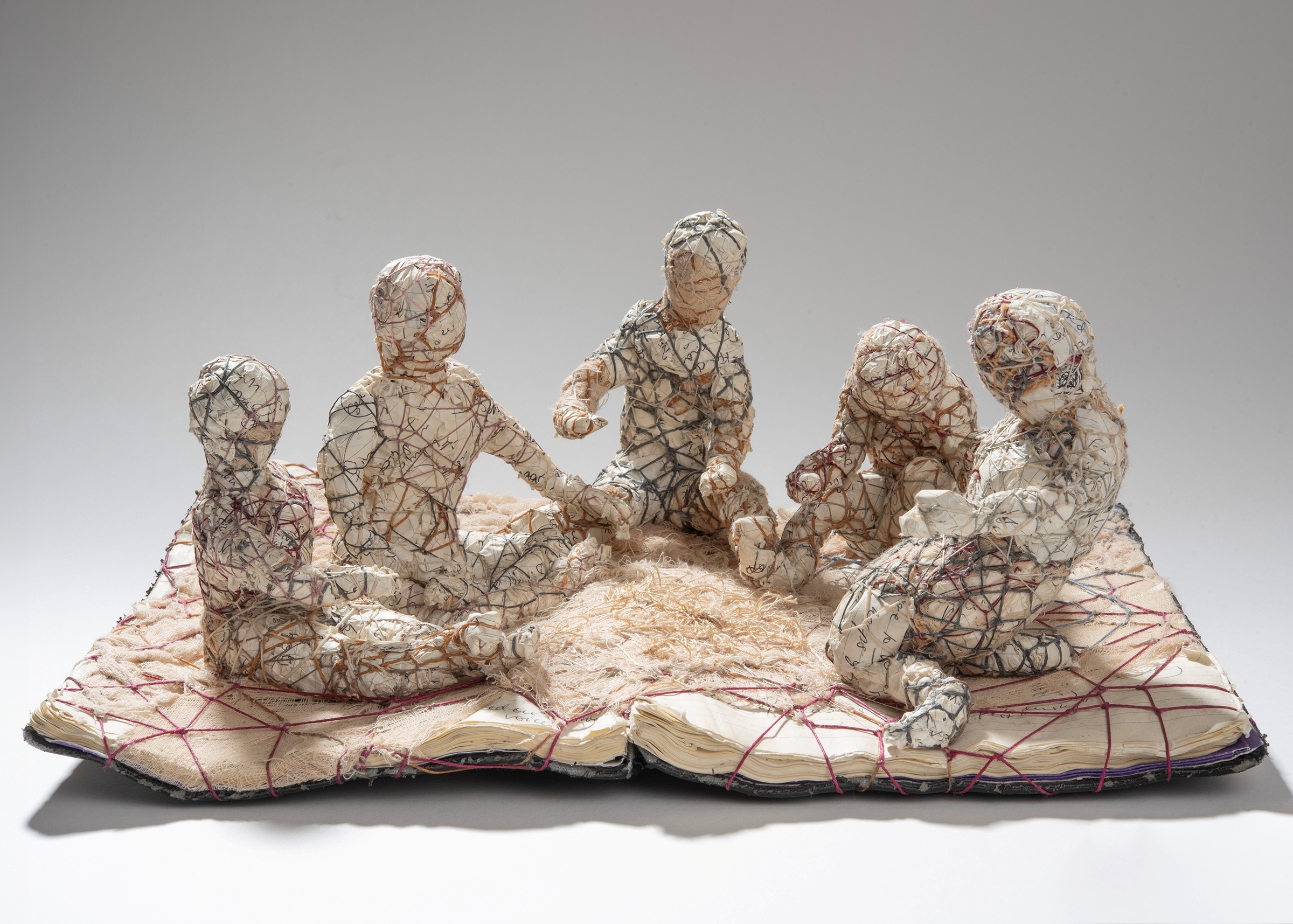
repurposed social research notebooks, thread (various) H16.5 x W37 x D25 cm
To make good is to repair, make fairer, or complete. This small sculpture transforms notebooks – artifacts from Kathy’s former role as a social policy researcher – into a tableau of figures coming together to listen, support and respond to each other: a yarning circle perhaps. While tearing, scrunching, binding and stitching the pages of writing that represented many years of work and knowledge, she reflected on how ’making good’ begins with unlearning mistaken ideas. The layers of stitched netting both honour and eclipse that past work. The words become illegible marks of effort, subsumed into new forms that aim to speak to the heart not the head. This sculpture continues Kathy’s practice of using textile techniques to communicate care and humanity and to explore the meanings to be found in everyday materials.
Kathy Landvogt
The Muse, 2024
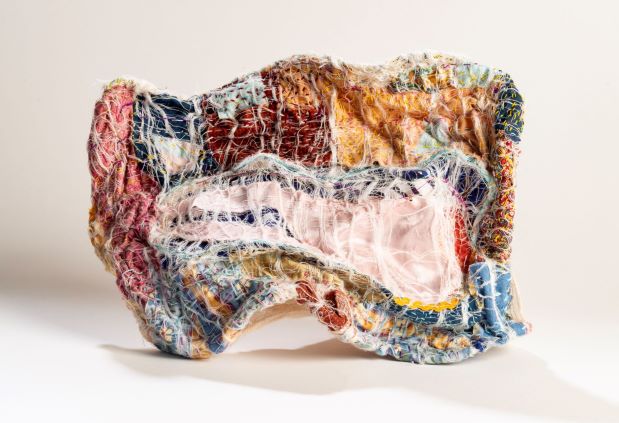
Fabric remnants, thread (various), copper wire H18 x W28 x D12 cm
As an exercise in transcription of works regarded as masterpieces in Western art history, I chose one of Bonnard’s frequent paintings of his wife in domestic interiors, a nude in the bath. Bonnard’s vibrating colours, patterning marks and fluid forms lent it to re-imagining in fabric scraps fine wire and coloured thread. Dissatisfied with reproducing the work in two-dimensions, I stretched it over a wonky wire armature, gave it a back of roughly stitched tea-dyed muslin, and manipulated its shape to suggest precarious balance. As I stitched this work, it became a meditation on the position of the (usually male) artist’s (usually female) muse. In animating the image into three dimensions I was attempting to give her a sense of movement and agency that is perhaps not present in the original.
Kathy Landvogt
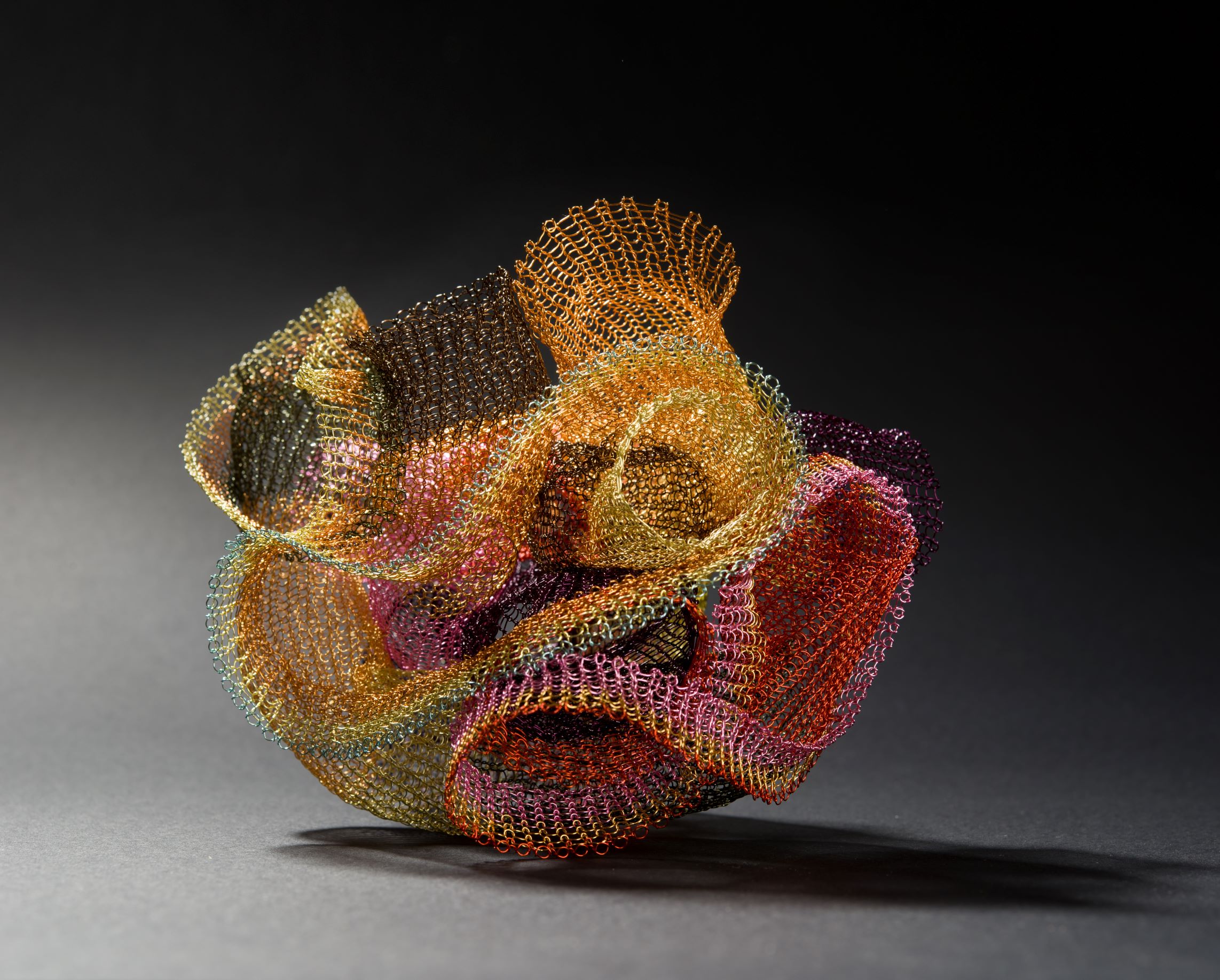
Lateral Thinking, 2022
Coloured copper wire H14 x W20 x D16 cm
'Lateral Thinking' is part of a body or work titled ‘Blooms for a Dark Winter’. Each of the ‘Blooms’ knits tubular and bulbous forms into wire to describe a particular strength I see used in troubling times
Kathy Landvogt
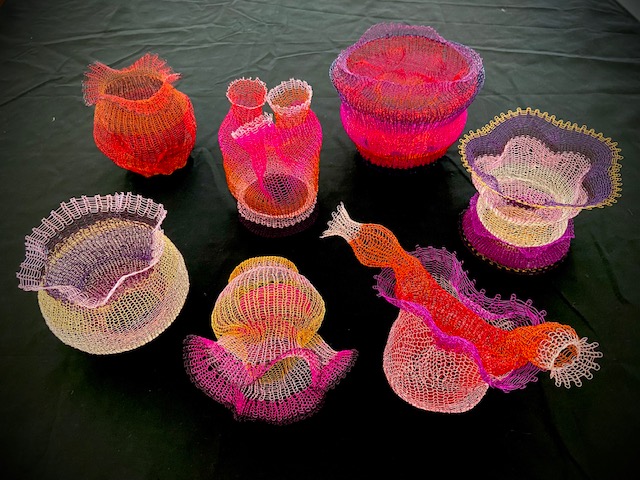
The Salpinx Collection, 2021
Coloured copper wire Various
Salpinx: a trumpet-shaped tube, another term for Fallopian tube. My textile sculptures give form to what has been silenced but is held in our bodies and imaginings. Here my subject is the female reproductive organs, re-imagined, and the hidden ‘women’s troubles’ they hold. Combining lacy knitting with the resistance and toughness of wire mirrors the tensions and contradictions of female experience. To me, the slow process of building an artwork one stitch at a time is comforting and meaningful, connecting me with women’s precious labour and care.