Michele Pollock
Heath/Care Network (detail), 2025
Eco-printed cotton rag paper, foraged invasive vines, cotton thread, waxed linen thread; machine stitching, hand embroidery, basketmaking techniques 100" x 44" x 26"
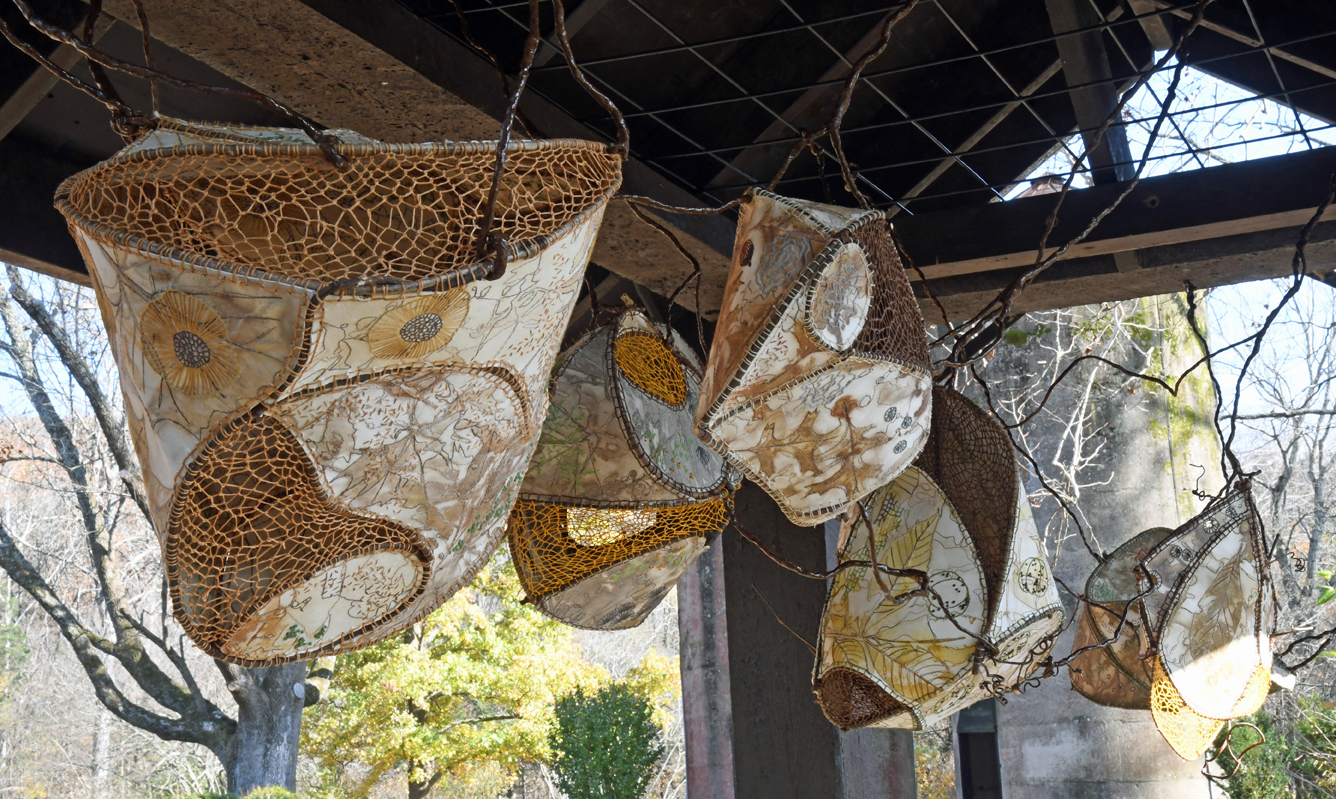
Science has shown that spending time among trees bolsters our immune system, suggesting that trees can improve our health. This is one of seven cellular structures, each based on one individual tree in the arboretum. This was based on a Pawpaw tree. Paper was eco-printed with leaves from the tree and mounted to an armature made from foraged invasive vines. Hand embroidery was inspired by things Michele observed about each tree: leaves, branches, bark, lichen, and moss. Installed at Bernheim Forest and Arboretum.
Michele Pollock
Health/Care Network, 2025
Eco-printed cotton rag paper, foraged invasive vines, cotton thread, waxed linen thread; machine stitching, hand embroidery, basketmaking techniques 100" x 44" x 26"
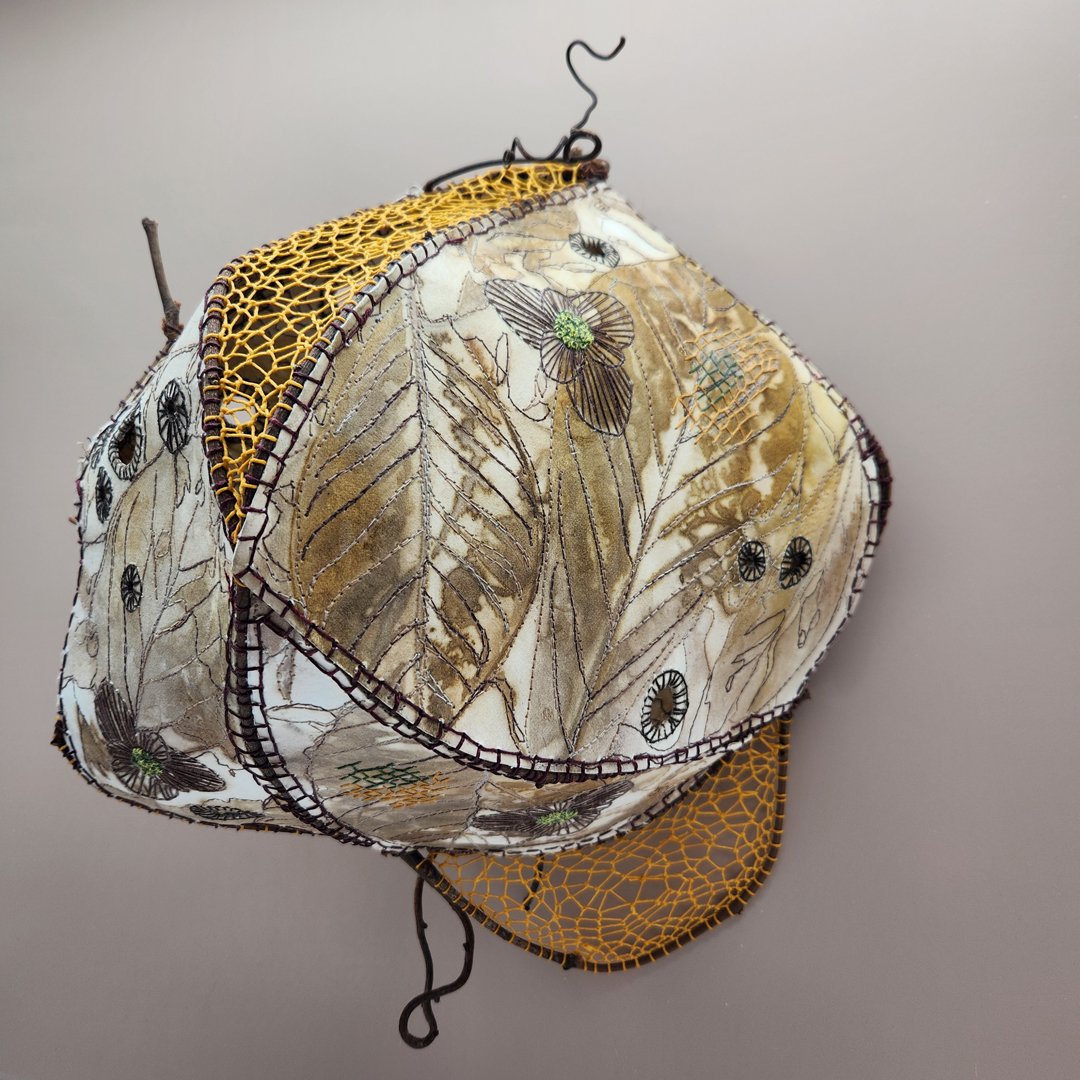
Science has shown that spending time among trees bolsters our immune system, suggesting that trees can improve our health. Each of the seven cellular structures were based on one individual tree in the arboretum. Paper was eco-printed with leaves from the tree and mounted to an armature made from foraged invasive vines. Hand embroidery was inspired by things Michele observed about each tree: leaves, branches, bark, lichen, and moss. Installed at Bernheim Forest and Arboretum.
Michele Pollock
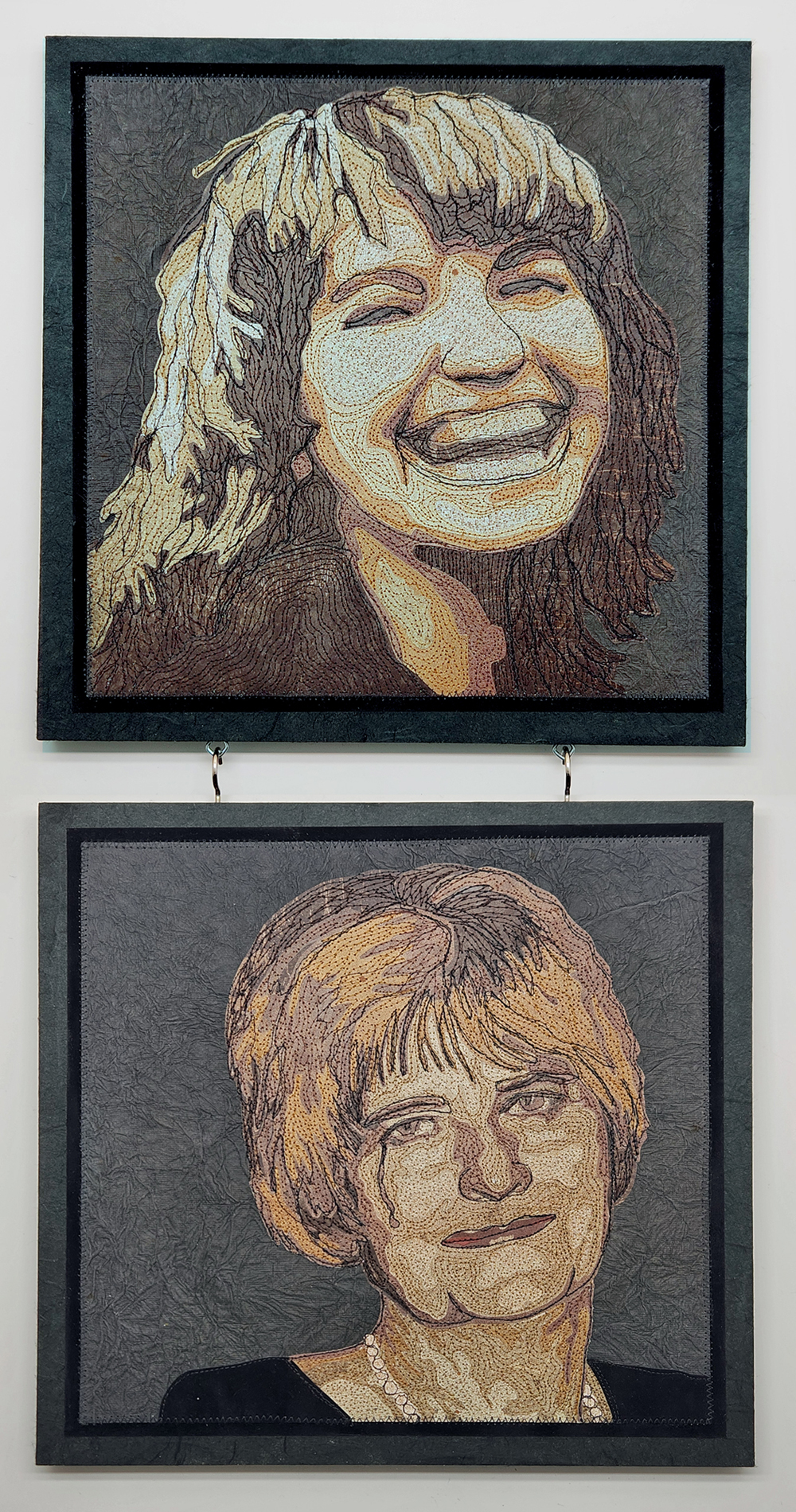
What It Means To Be Human: Laughter & Tears (detail), 2025
Machine stitched paper 24" x 12" x 1"
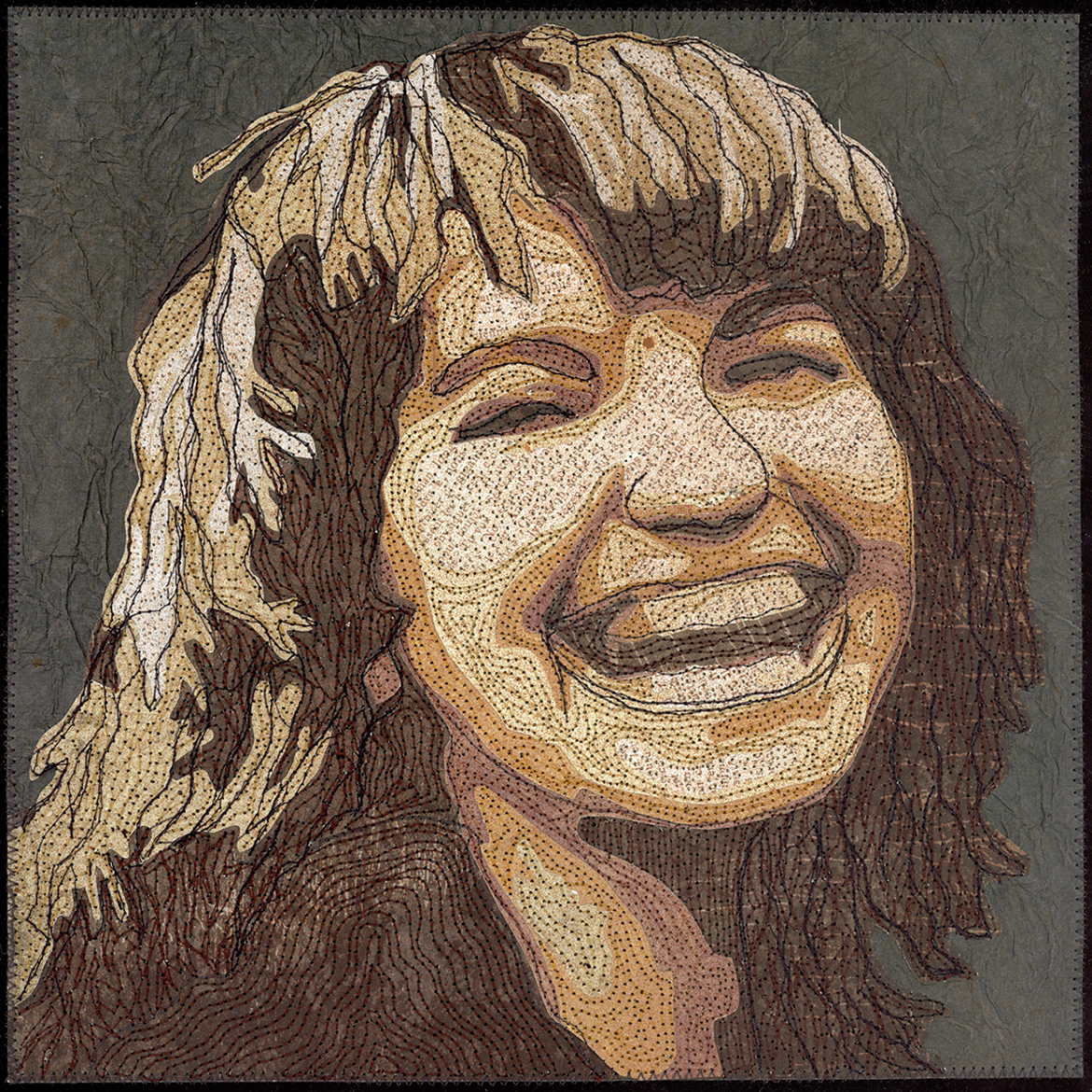
Although we are not the only animals who experience emotions, we have uniquely human ways of expressing them. While chimpanzees - our closest relatives - make a sort of panting sound when tickling and playing, even they can’t laugh the way we do, which requires human vocal chords and breath control. But all humans laugh. It is a form of social glue, binding us to other humans. And although we know other animals appear to grieve and might whimper, moan or howl, scientists seem to agree that we are the only animal that cries tears. Other animals have tear ducts for cleaning their eyes, but somewhere along the line, humans alone developed a connection between tear ducts and the emotional parts of our brains. Scientists still really don’t understand why.
Michele Pollock
What It Means To Be Human: Laughter & Tears, 2025
Machine stitched paper 24" x 12" x 1"
Although we are not the only animals who experience emotions, we have uniquely human ways of expressing them. While chimpanzees - our closest relatives - make a sort of panting sound when tickling and playing, even they can’t laugh the way we do, which requires human vocal chords and breath control. But all humans laugh. It is a form of social glue, binding us to other humans. And although we know other animals appear to grieve and might whimper, moan or howl, scientists seem to agree that we are the only animal that cries tears. Other animals have tear ducts for cleaning their eyes, but somewhere along the line, humans alone developed a connection between tear ducts and the emotional parts of our brains. Scientists still really don’t understand why.
Michele Pollock
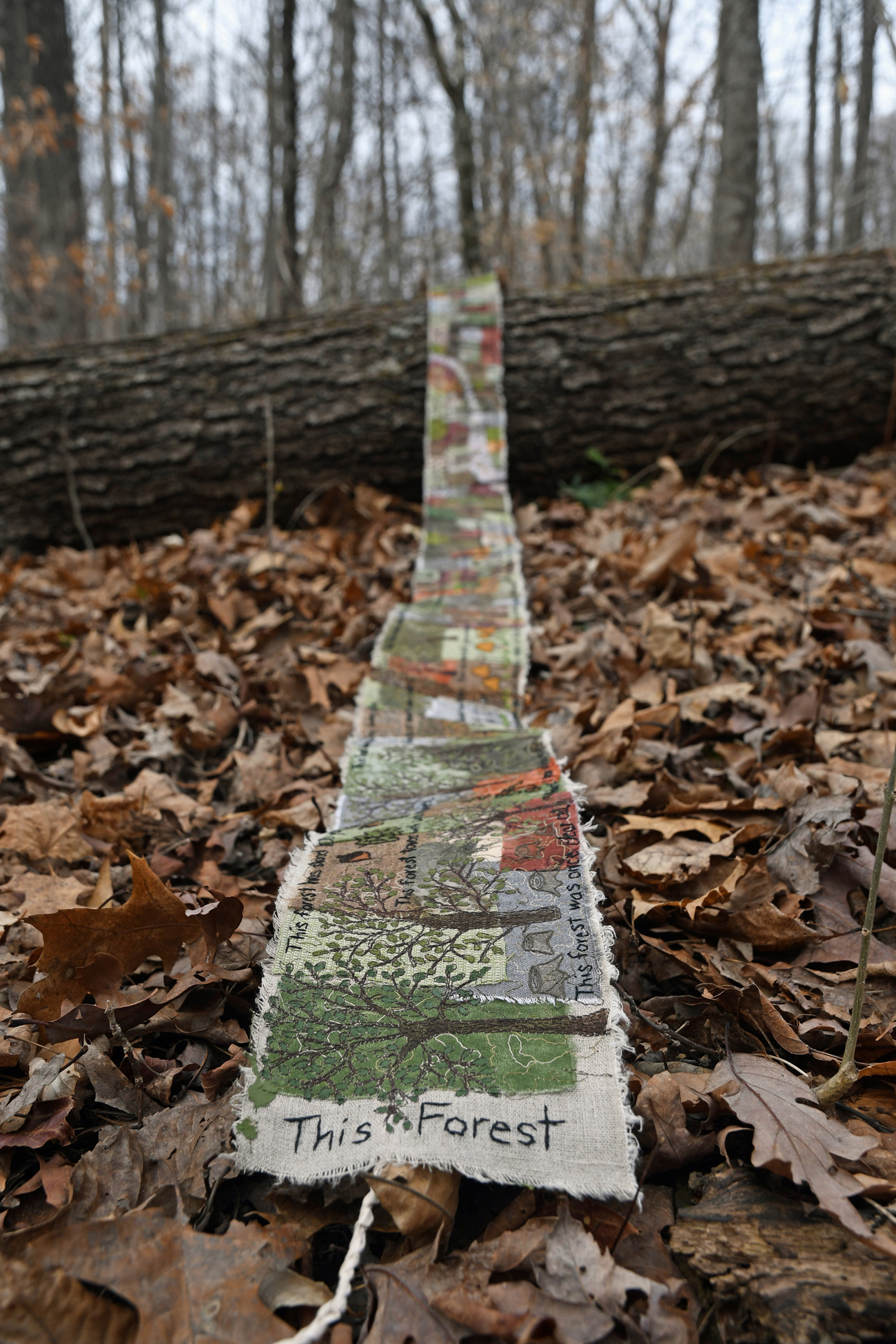
This Forest (unrolled), 2026
Upcycled fabrics and old clothing, machine stitching, acrylic paints, hand embroidery, original poem 7" x 4" (closed); 7" x 84" unrolled
An artist book, a poem quilt, a story scroll. My poem about the forest I live in is hand embroidered along the scroll.
Michele Pollock
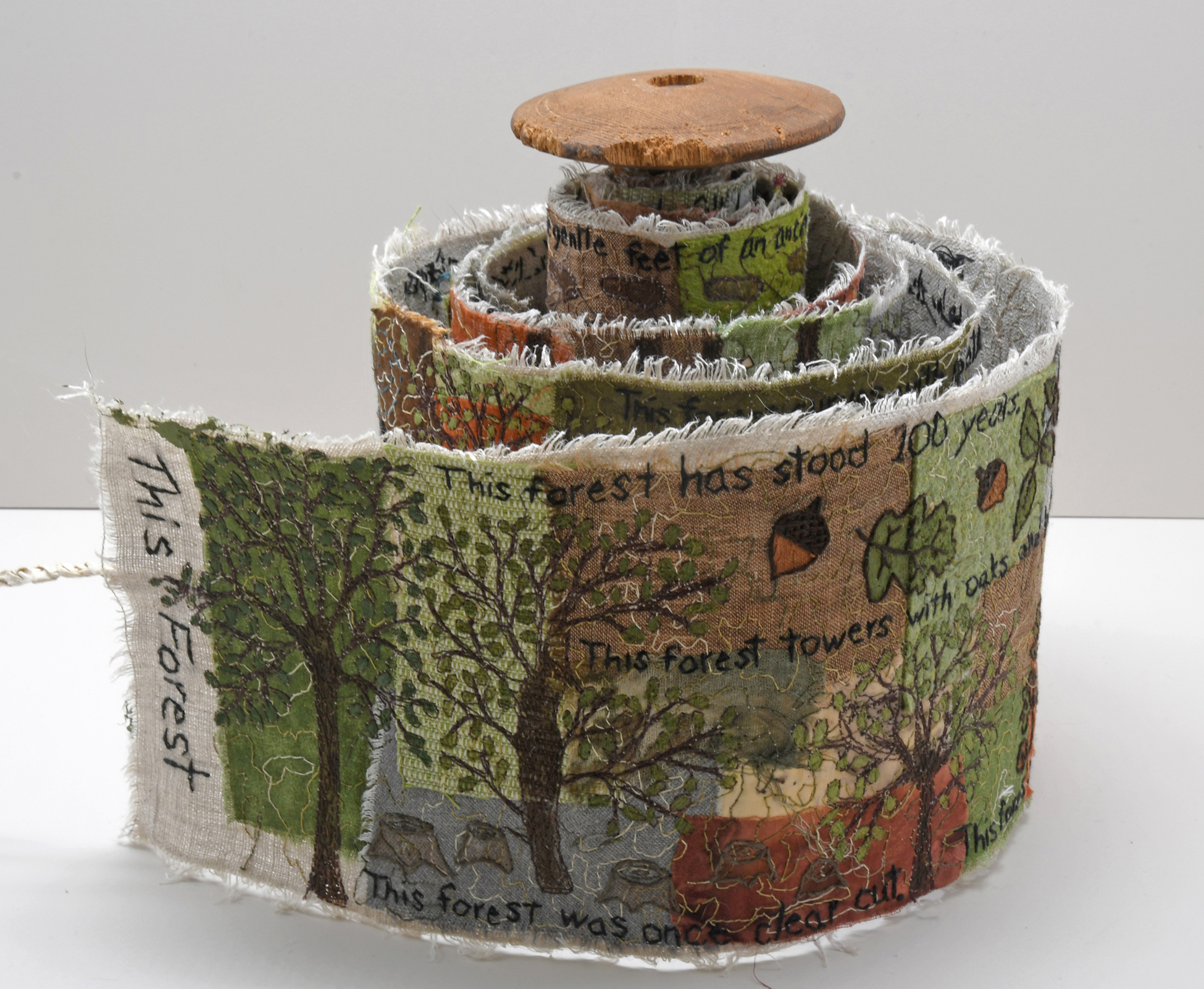
This Forest, 2026
Upcycled fabrics and old clothing, machine stitching, acrylic paints, hand embroidery, original poem 7" x 4" (closed); 7" x 84" unrolled
An artist book, a poem quilt, a story scroll. My poem about the forest I live in is hand embroidered along the scroll.
Michele Pollock
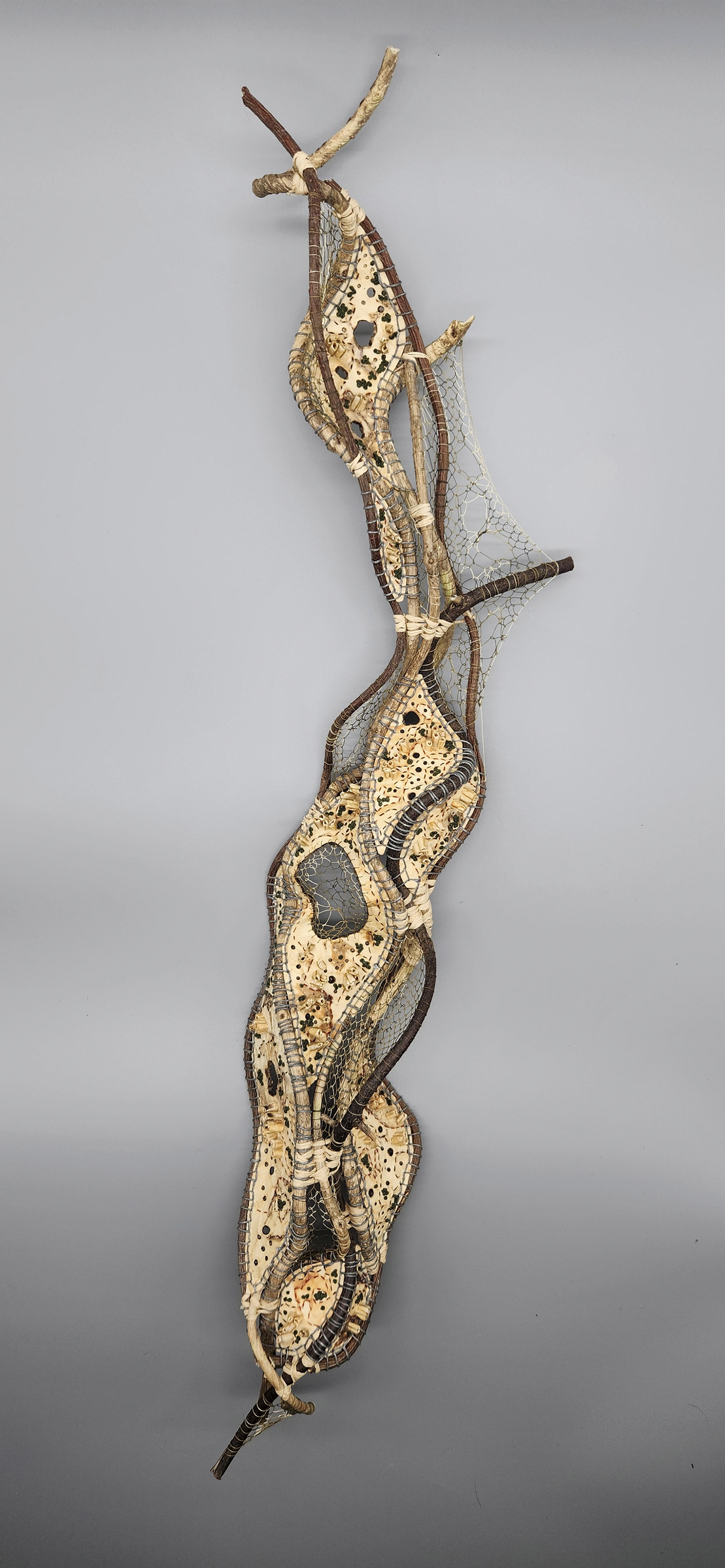
How Grief Moves Through the Heart, 2022
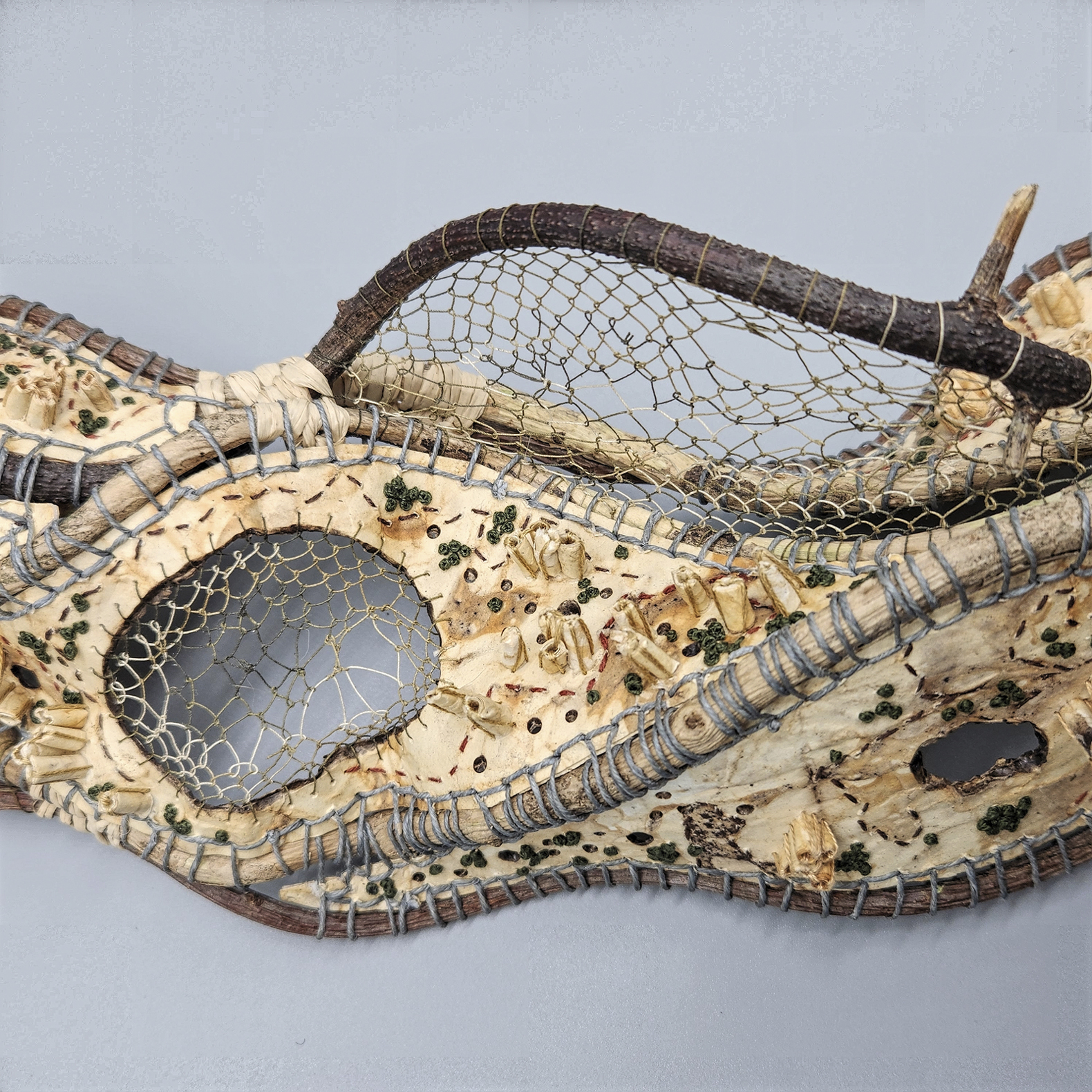
Foraged invasive Bittersweet vines; raffia; paper left over from bookbinding work I can no longer do because of chronic illness; interfacing; cotton embroidery thread; cotton sewing thread; waxed linen thread 26" x 8" x 4"
Over the past year or so, while coming to terms with being diagnosed with Scleroderma (a rare autoimmune disease that makes it difficult to do many things, including machine stitching), I started hand quilting, burning, and hand embroidering into paper that I eco-dyed using leaves from my forest floor. The small intuitive quilts are like fragile skins, like maps to unknown places, like the shapes of cells and antibodies under the microscope. I foraged invasive Bittersweet vines from my woods, where they wrap around small trees and branches and can be harvested with amazing spiral shapes. When I laid out the vines on my workbench and twined them with raffia where they touched, it created a solid structure with curved shapes and spaces between the vines. I've been searching for ways to "frame" or present my little quilts, and I cut pieces to fit in some of the spaces between the vines and attached them to the vines using waxed linen thread and a modified bookbinding stitch. In the remaining spaces, I wanted something more open, less solid, to contrast with the quilts. I looped in those spaces using fine cotton variegated sewing thread that I waxed with beeswax. These "webs" are delicate and messy, yet dimensionally stable. They have holes and ragged spots yet remain structurally sound and have their own strange beauty, like old cobwebs in nature but also like my tangled emotions, my struggle to come to terms with my illness and remain intact.
Michele Pollock
How Grief Moves Through the Heart (detail), 2022
Foraged invasive Bittersweet vines; raffia; paper left over from bookbinding work I can no longer do because of chronic illness; interfacing; cotton embroidery thread; cotton sewing thread; waxed linen thread 26" x 8" x 4"
Over the past year or so, while coming to terms with being diagnosed with Scleroderma (a rare autoimmune disease that makes it difficult to do many things, including machine stitching), I started hand quilting, burning, and hand embroidering into paper that I eco-dyed using leaves from my forest floor. The small intuitive quilts are like fragile skins, like maps to unknown places, like the shapes of cells and antibodies under the microscope. I foraged invasive Bittersweet vines from my woods, where they wrap around small trees and branches and can be harvested with amazing spiral shapes. When I laid out the vines on my workbench and twined them with raffia where they touched, it created a solid structure with curved shapes and spaces between the vines. I've been searching for ways to "frame" or present my little quilts, and I cut pieces to fit in some of the spaces between the vines and attached them to the vines using waxed linen thread and a modified bookbinding stitch. In the remaining spaces, I wanted something more open, less solid, to contrast with the quilts. I looped in those spaces using fine cotton variegated sewing thread that I waxed with beeswax. These "webs" are delicate and messy, yet dimensionally stable. They have holes and ragged spots yet remain structurally sound and have their own strange beauty, like old cobwebs in nature but also like my tangled emotions, my struggle to come to terms with my illness and remain intact.
Michele Pollock
Catharsis, 2023
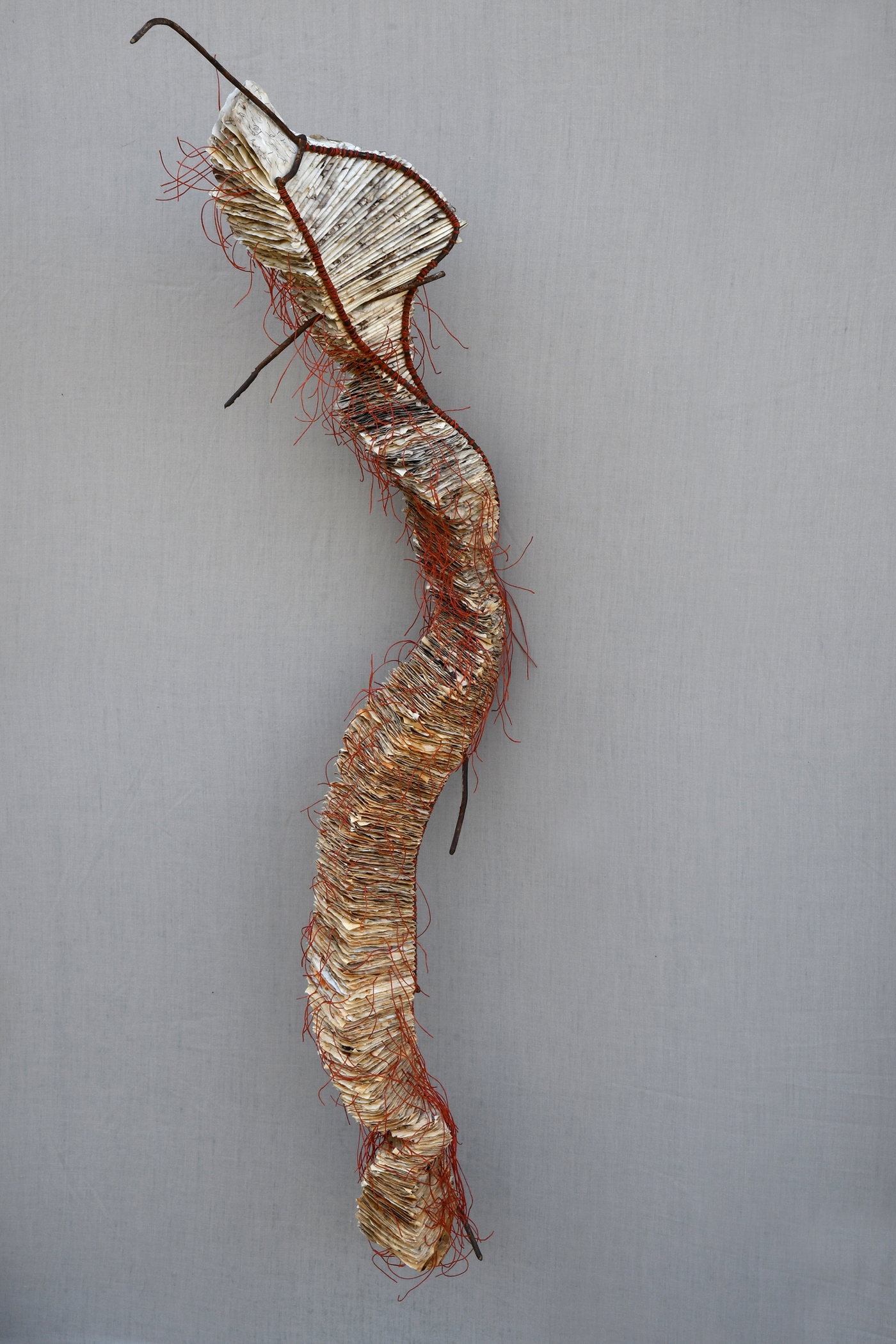
Found metal, eco-dyed leftover papers, waxed linen, pencil 40" x 14" x 12"
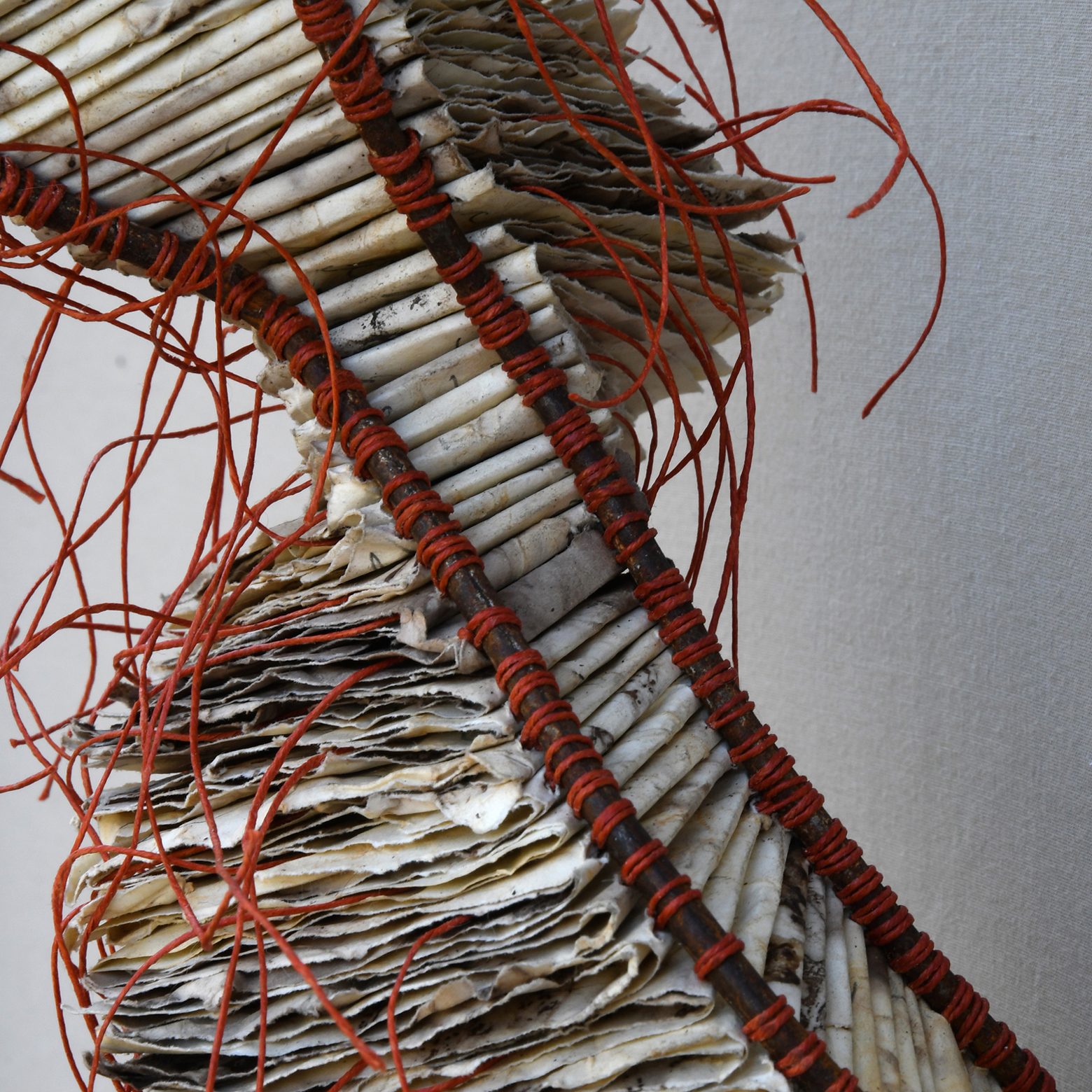
When I found this piece of rusted metal on one of our field trips to the scrapyard, bent and deformed and no longer useful for its original purpose, it reminded me of grief, of anger, of loss, of anxiety – and I thought I might find a way to affix my own emotions to its structure, to use it as an armature for my own volatile feelings about having Scleroderma and the limitations it places on my body and my life. I can no longer handle bookbinding like I used to do it, making blank book after blank book, but I can bind one or two signatures of a book per day. I no longer have use for the reams and reams of white text-weight paper left over from making blank books, but I can repurpose that paper by eco-dying it using leaves from my woods. After dying it, I tore the paper to size and folded it into signatures of 8 small pages each. Then, almost daily, I did automatic writing on one of these small signatures, purging myself of negative emotions, my hand moving as fast as my mind was going, so the final writing is – thankfully – illegible. Handwriting bears witness to the body, uses the body, demands of the body, taxes the body. The point is not to ever go back and read this journal, or to let anyone else read it, but to rid myself of the emotions, to channel them into another vessel. I bound each of the signatures individually to the rusted and bent metal piece using waxed linen thread and a modified Coptic binding stitch. Returning to the piece almost daily for nearly a year, the piece grew slowly, slowly – literally converting grief and anxiety and loss into artwork, signature by signature, joining my difficult emotions to strange beauty – or if not beauty, exactly, then a kind of grace and movement. What does it mean to work on something for an extended period of time? Time itself becomes a raw material in the work. The time spent making this piece is the whole point, really. The catharsis is in the writing itself, in the making, in the alchemy of converting emotions into something material, something apart from myself that I can examine and observe. The making IS the artwork, and the final piece is really an artifact of that time spent making.
Michele Pollock
Catharsis (detail), 2023
Found metal, eco-dyed leftover papers, waxed linen, pencil; 40" x 14" x 12
When I found this piece of rusted metal on one of our field trips to the scrapyard, bent and deformed and no longer useful for its original purpose, it reminded me of grief, of anger, of loss, of anxiety – and I thought I might find a way to affix my own emotions to its structure, to use it as an armature for my own volatile feelings about having Scleroderma and the limitations it places on my body and my life. I can no longer handle bookbinding like I used to do it, making blank book after blank book, but I can bind one or two signatures of a book per day. I no longer have use for the reams and reams of white text-weight paper left over from making blank books, but I can repurpose that paper by eco-dying it using leaves from my woods. After dying it, I tore the paper to size and folded it into signatures of 8 small pages each. Then, almost daily, I did automatic writing on one of these small signatures, purging myself of negative emotions, my hand moving as fast as my mind was going, so the final writing is – thankfully – illegible. Handwriting bears witness to the body, uses the body, demands of the body, taxes the body. The point is not to ever go back and read this journal, or to let anyone else read it, but to rid myself of the emotions, to channel them into another vessel. I bound each of the signatures individually to the rusted and bent metal piece using waxed linen thread and a modified Coptic binding stitch. Returning to the piece almost daily for nearly a year, the piece grew slowly, slowly – literally converting grief and anxiety and loss into artwork, signature by signature, joining my difficult emotions to strange beauty – or if not beauty, exactly, then a kind of grace and movement. What does it mean to work on something for an extended period of time? Time itself becomes a raw material in the work. The time spent making this piece is the whole point, really. The catharsis is in the writing itself, in the making, in the alchemy of converting emotions into something material, something apart from myself that I can examine and observe. The making IS the artwork, and the final piece is really an artifact of that time spent making.