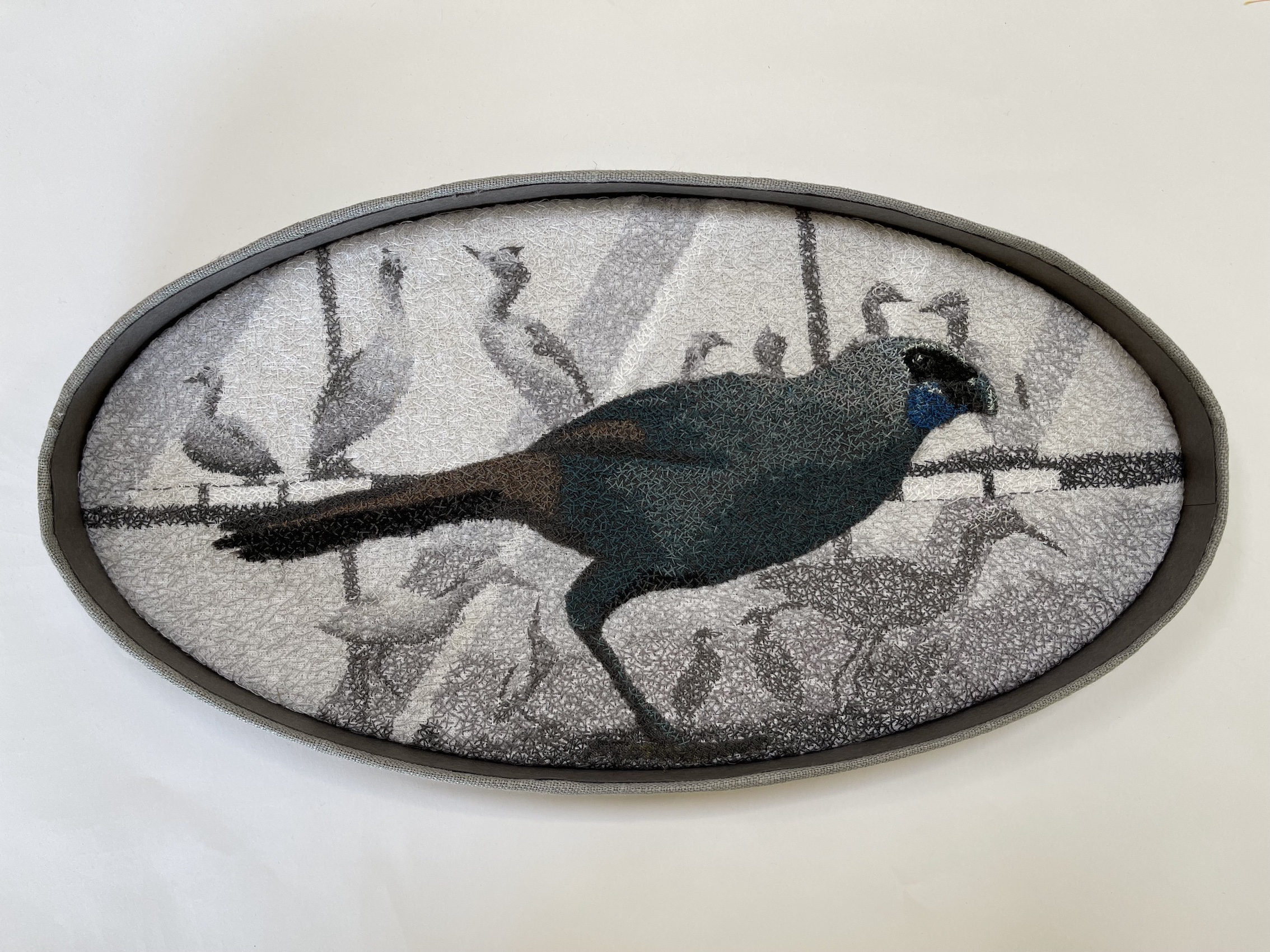
Sharon Peoples
Kokako In The Museum, 2023, 2023
cotton on linen, mixed media 14 1/2" x 7" x 1"
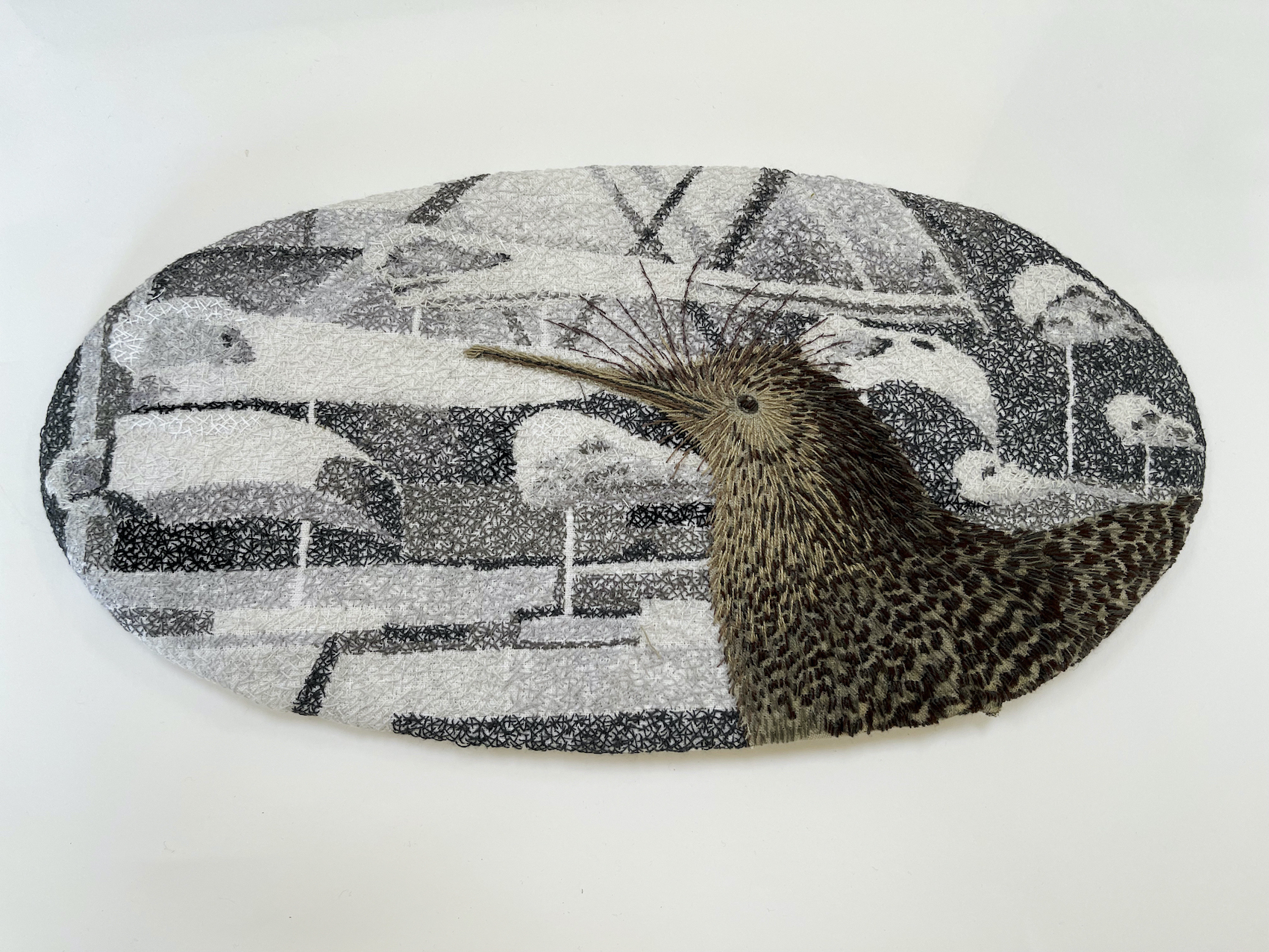
Sharon Peoples
Little Spotted Kiwi at the Museum, 2023
cotton on linen, mixed media 14 1/2" x 7 1/2" x 1"
Sharon Peoples spends much time wandering and wondering about gardens. It’s not plants, so much as the ‘visitors’ and the labour of gardening. From her own domestic garden to the local bushland and further afield to surrounding national parks, she is energised and draw inspiration by walking and observing these environments. Through exhibitions and residencies in recent years, she has become interested in how landscapes such as national parks and land holdings are crafted, often by hand, to manage nature and how conditions need to be manipulated and ‘gardened’ in order to not lose such environments. Although birds have long been a motif in her work, they have become much more central to her thinking and an important constituent to my stitching. In Sharon’s travels through the ‘garden’ of New Zealand, her response has been birds and their environments. The work focuses on threatened birds, encountered both in nature and in museums in New Zealand. This investigation combines her background in museum studies with her concerns of the environment. Fragility of both the environment and the human condition is reflected in stitch as a metaphor for mending the environment. The hand stitched works go beyond a literal translation of imagery of birds into textiles. While these are very small works, she has been thinking of very large historic embroideries, such as the Bayeux Tapestry which shows the marks of stitchers, restorers and menders, all of which stand for her, illustrate the repair, care and protection that is required for the environment.
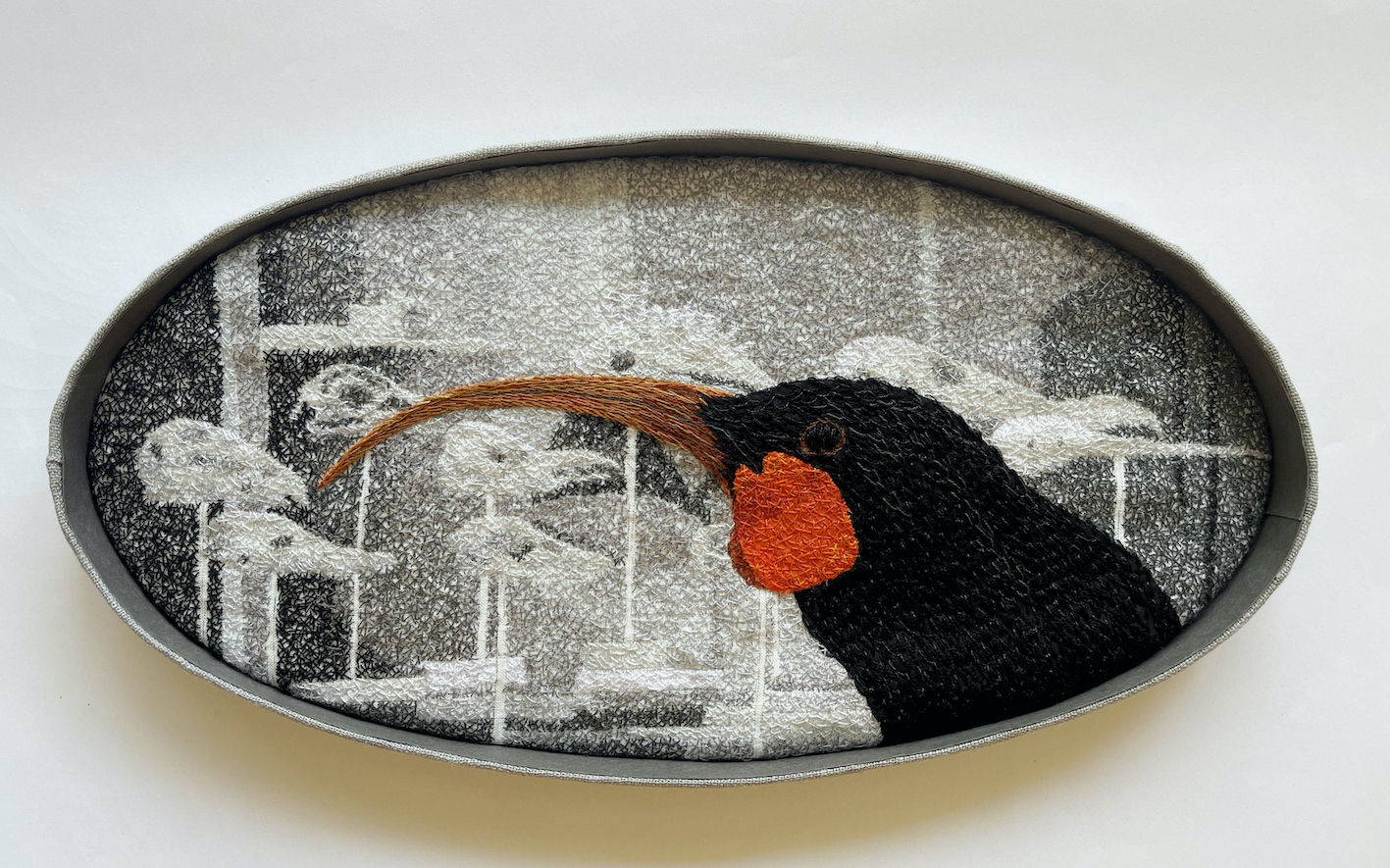
Sharon Peoples
Huia at the Museum, 2023, 2023
cotton on linene, mixed media 15" x 8" x 1"
Sharon Peoples spends much time wandering and wondering about gardens. It’s not plants, so much as the ‘visitors’ and the labour of gardening. From her own domestic garden to the local bushland and further afield to surrounding national parks, she is energised and draw inspiration by walking and observing these environments. Through exhibitions and residencies in recent years, she has become interested in how landscapes such as national parks and land holdings are crafted, often by hand, to manage nature and how conditions need to be manipulated and ‘gardened’ in order to not lose such environments. Although birds have long been a motif in her work, they have become much more central to her thinking and an important constituent to my stitching. In Sharon’s travels through the ‘garden’ of New Zealand, her response has been birds and their environments. The work focuses on threatened birds, encountered both in nature and in museums in New Zealand. This investigation combines her background in museum studies with her concerns of the environment. Fragility of both the environment and the human condition is reflected in stitch as a metaphor for mending the environment. The hand stitched works go beyond a literal translation of imagery of birds into textiles. While these are very small works, she has been thinking of very large historic embroideries, such as the Bayeux Tapestry which shows the marks of stitchers, restorers and menders, all of which stand for her, illustrate the repair, care and protection that is required for the environment.
Sharon Peoples
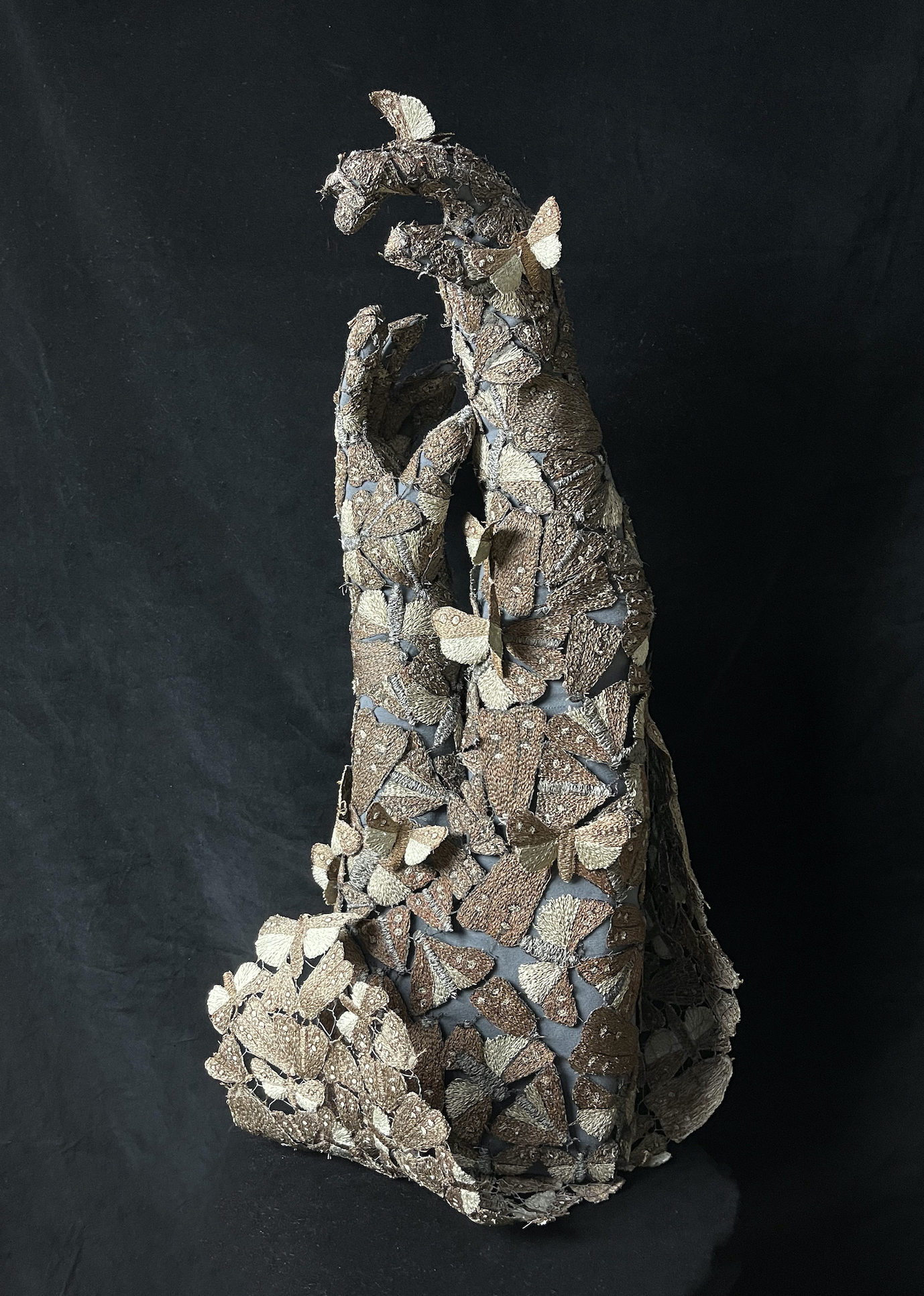
Gardening Gloves: Memories of November (2022), 2022
Rayon polyester thread, linen, cotton, mixed media 28" x 15" x 14"
Gardening Gloves: Memories of November Sharon Peoples’ work explores gardens and gardening: the inner secret garden, artists’ gardens, public gardens, and gardens of the imagination. Her ‘garden’ includes the bush reserves, local hills and national parks that she walks. Fragility of both the environment and the human condition is reflected in the medium: stitching, as a metaphor for repair. During the 2020 lockdowns, she worked constantly in her own garden. Her hands are one of the most important organs as a maker. Protecting them from the ravages of dirt with gardening gloves became a daily practice. Soon the gloves became a vehicle for studio work, demonstrating self-care and care of the environment layered with imagery from her regular walks. In December 2021 the bogong moth was added to the International Union for Conservation of Nature’s Red List. She has been stitching bogong moths into lace-like ‘gardening gloves’ commenting on the astonishing estimated 99.5% decrease in the migration number of the moths, as they pass from Queensland, Australia through to the high country in the south of the country in November. She misses the evening fluttering on the windowpanes as the weather warms towards summer.
Sharon Peoples
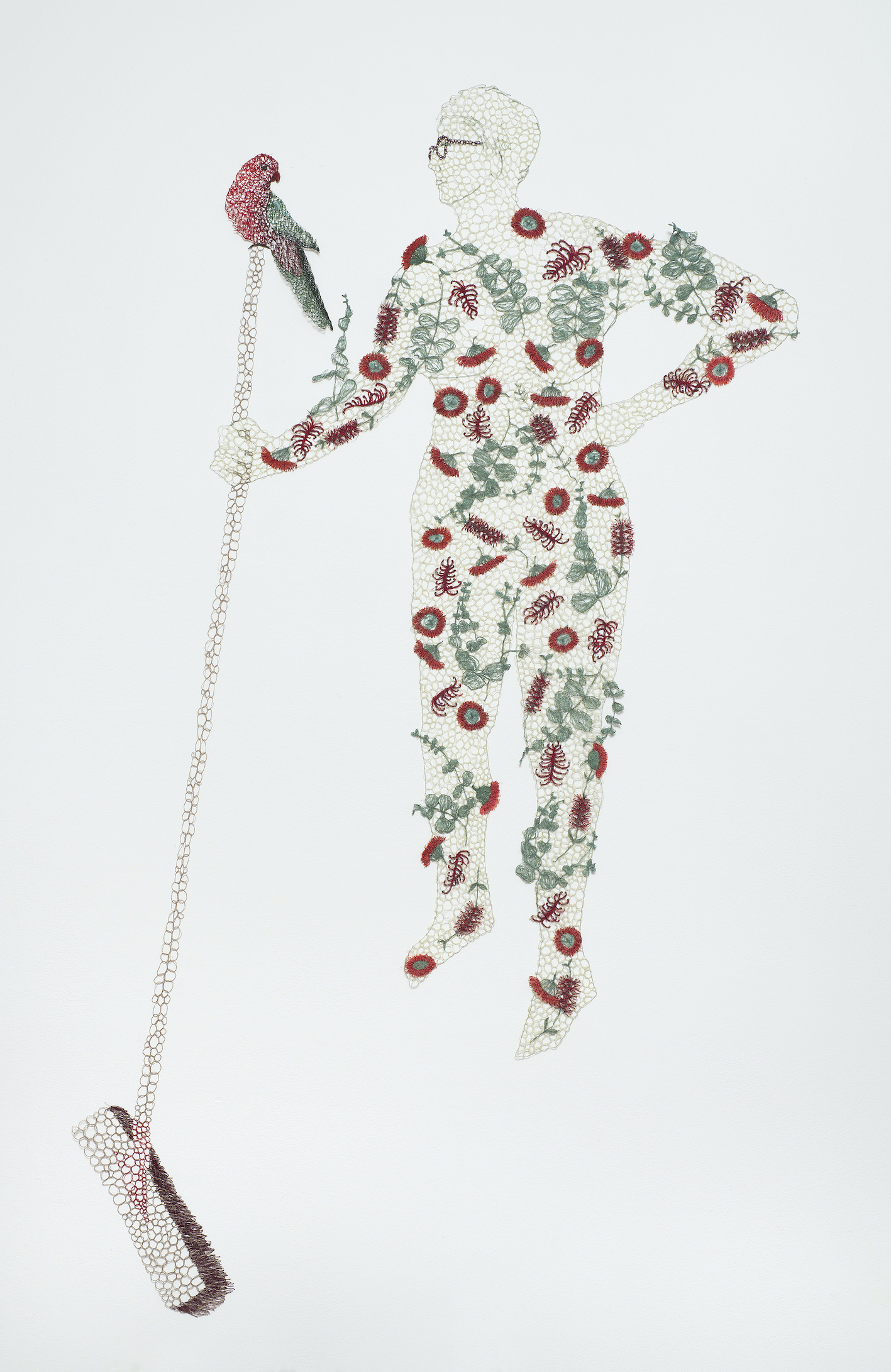
The Red Gardener, 2021
rayon polyester thread, cotton 64" x 37"
Sharon Peoples explore plants and gardens: the inner secret garden, artists’ gardens, public gardens, national parks as gardens and gardens of the imagination. Her ‘garden’ is the areas she walks – the local hills and national parks. Fragility of both the environment and the human condition are reflected in the medium: the stitch. In thinking of very large historic embroideries, such as the Bayeux Tapestry, the marks of stitchers, restorers and menders stand to illustrate the repair, care and protection that is required for the environment. She uses her embroidery as a metaphor for repair. In using the female warrior she explores the continuous battle in the garden in pursuit of ideals of paradise, as noted by eco-feminist Val Plumwood who argues that gardening ideals in Australia are strongly influenced by the twin forces of colonialism and commodification. Home gardens become part of the war against nature.
Sharon Peoples
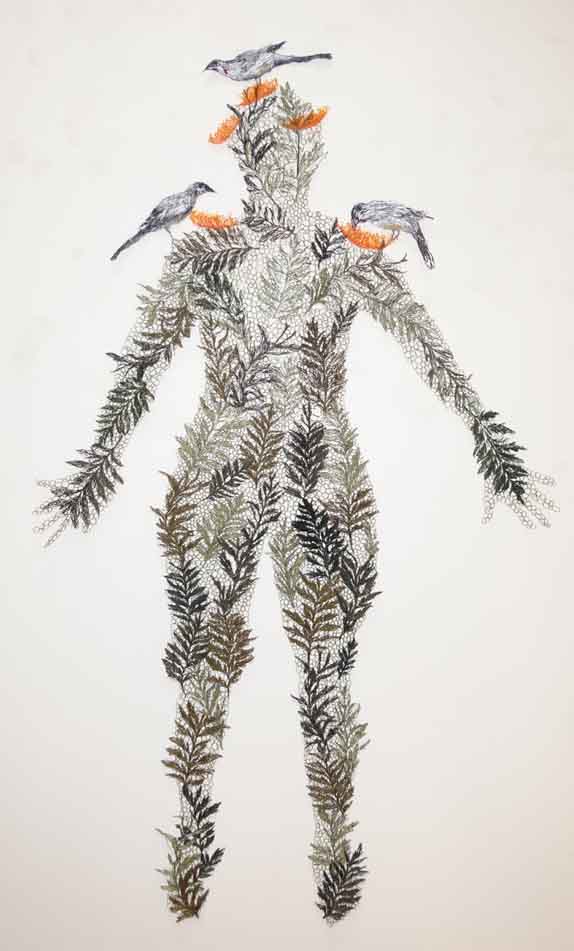
Laced with Silky Oak, 2018
rayon, rayon polyester thread 142 (H) x 84(W) cms
Sharon Peoples
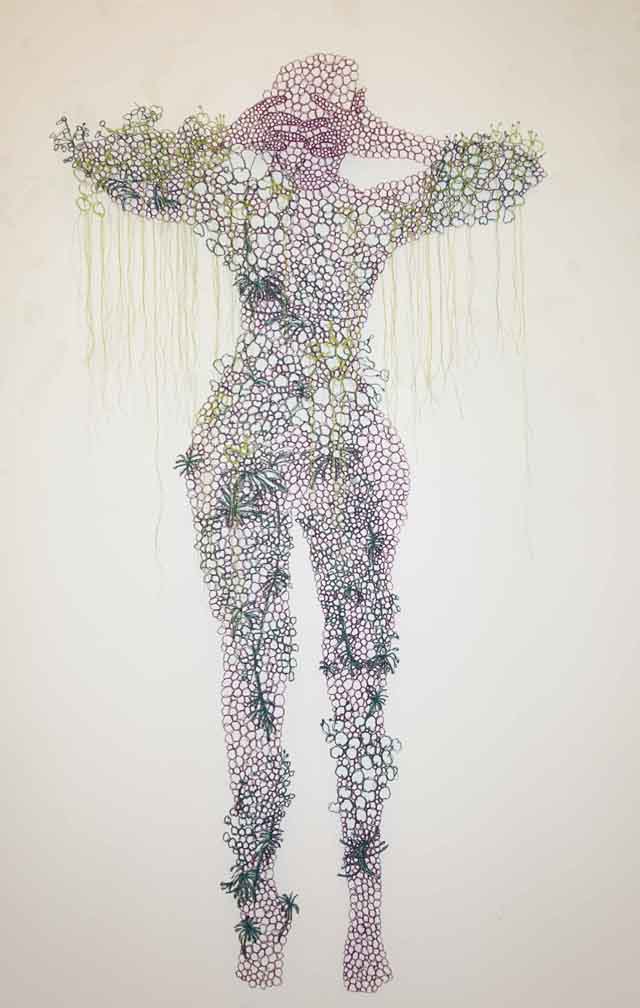
Laced with Euphorbia, 2018
rayon, rayon polyester thread 123 (H) x 66 (W) cms
Sharon Peoples
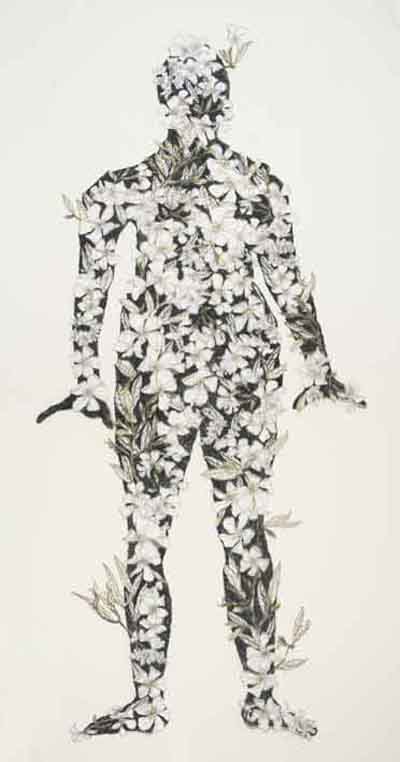
Laced with Oleander, 2017
rayon, rayon polyester thread; 180 (H) x 84 (W) cm