Therese Zemlin
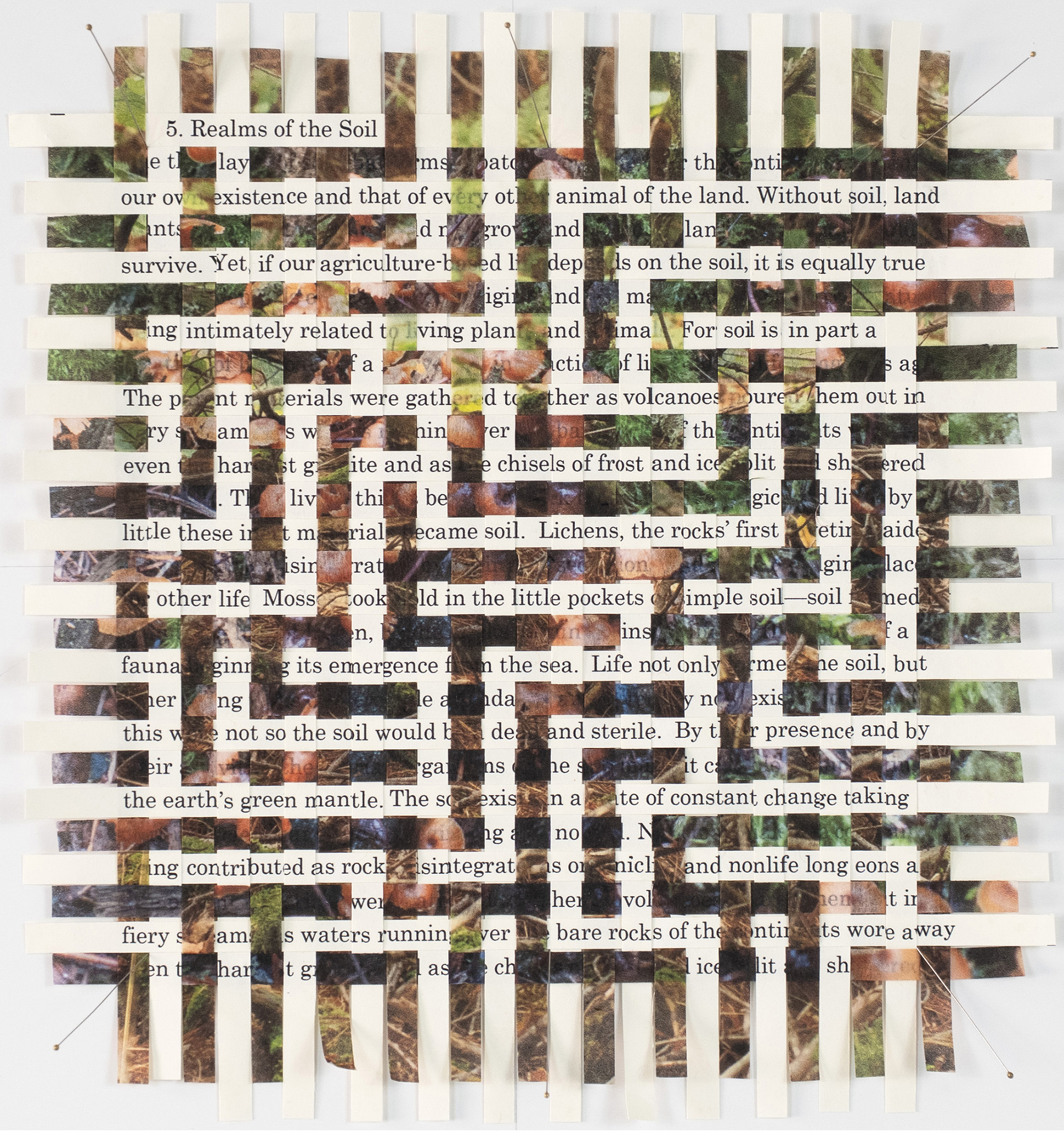
Realms of the Soil, 2025
Inkjet prints of digitally altered text and photographs on Japanese and western papers hand-cut into strips, hand weaving. 7.75 x 7.75"
Weaving Draft: Page 166, Figure 1, Orimono soshiki hen [Textile System], Yoshida, Kiju, Japan, 1903, Handweaving.net #50013 Text is from Rachel Carson, Silent Spring, Realms of the Soil. Photos taken by the artist in Brimson, MN.
Therese Zemlin
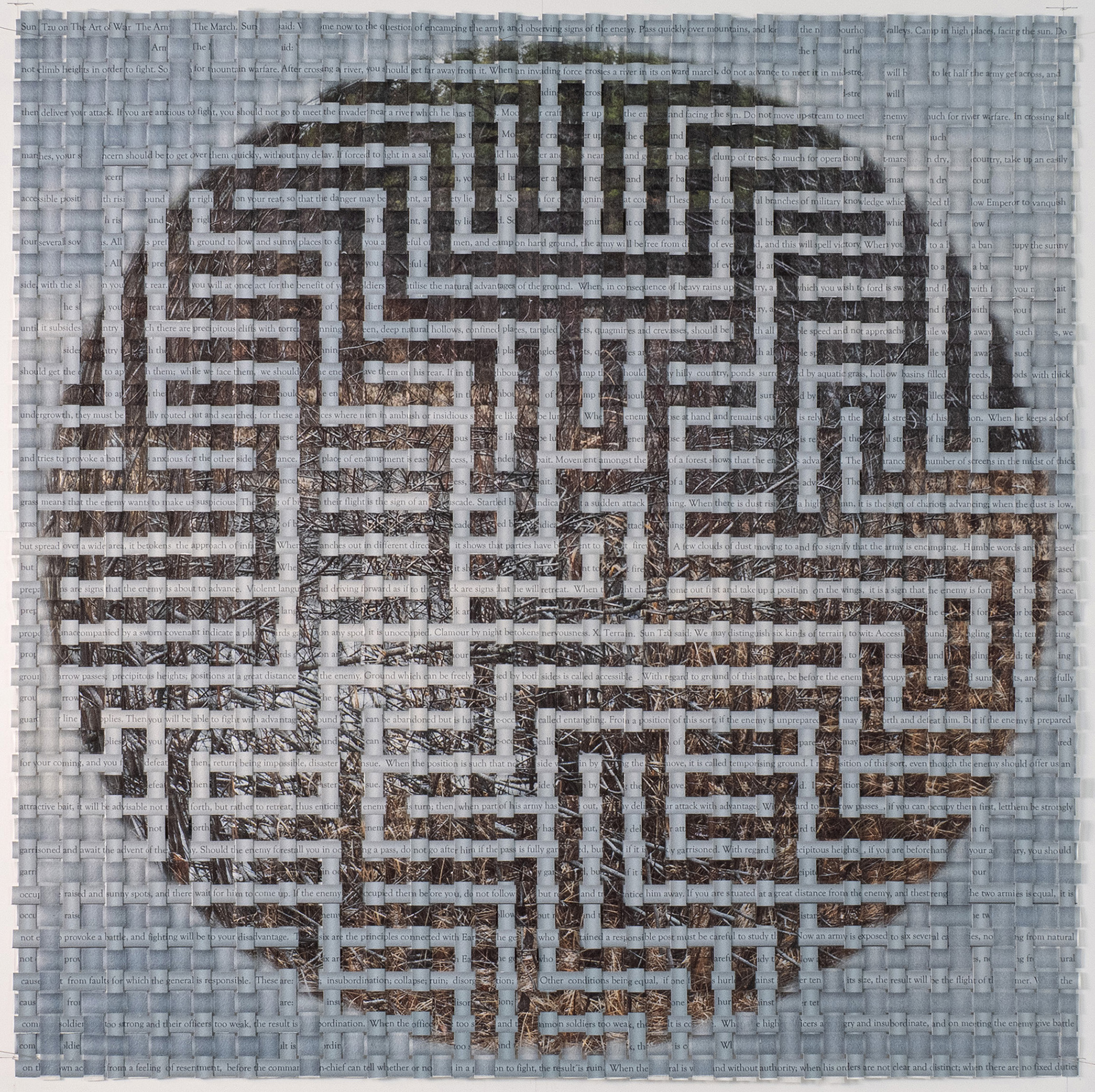
Mandala 14: The Art of War (1), 2025
Inkjet prints of digitally altered text and photographs on Japanese and western papers, hand-cut into strips, hand weaving. 18 x 18"
Text is from The Art of War by Sun Tzu. The photo was taken by the artist in Brimson MN. The weaving pattern is an original design by the artist.
Therese Zemlin
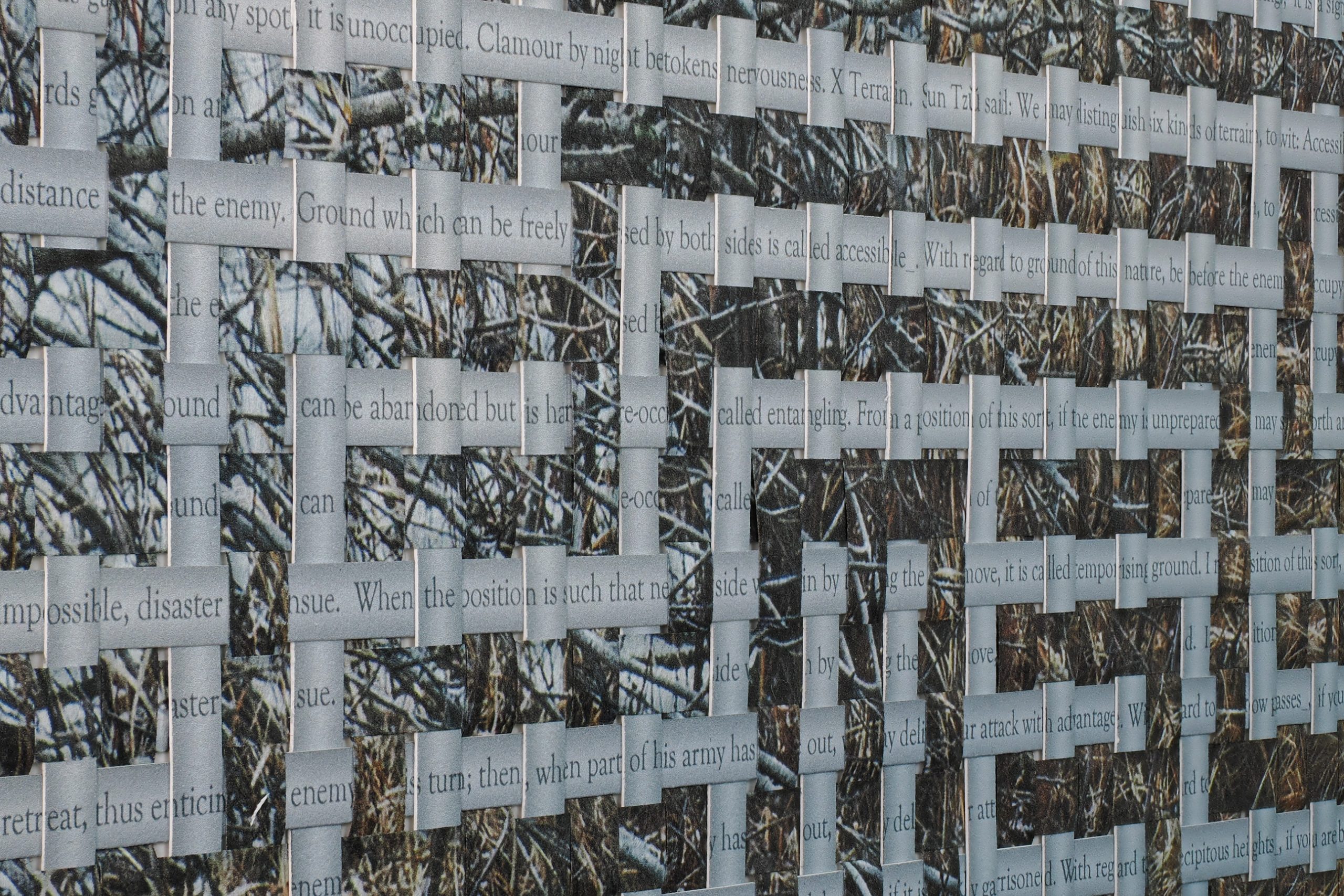
Mandala 14: The Art of War (1). Detail, 2025
Inkjet prints of digitally altered text and photographs on Japanese and western papers, hand-cut into strips, hand weaving. 18 x 18". Text strips are 5/16" wide
Therese Zemlin
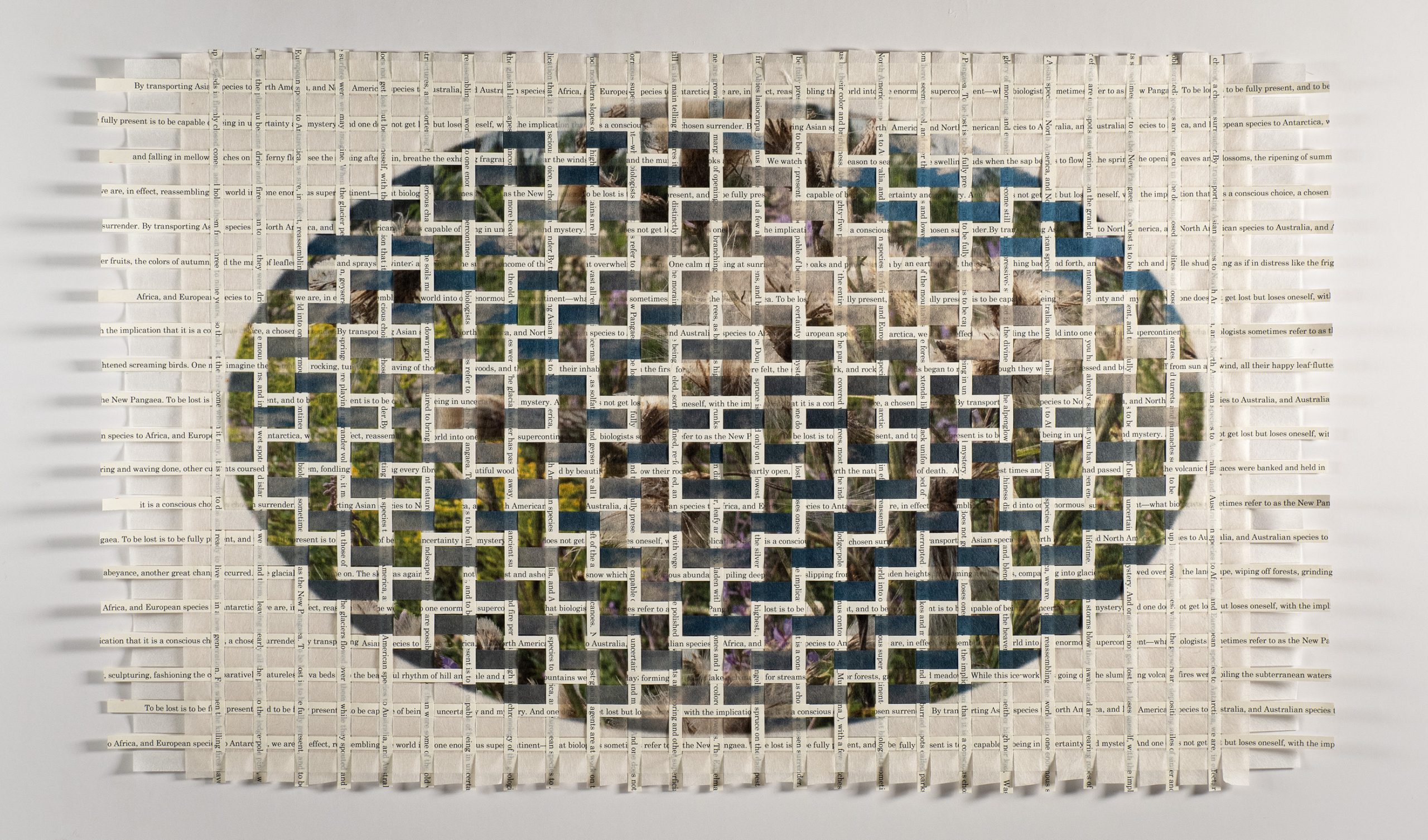
Ellipse 1: Creeping Thistle with Native Plants and Sky, 2024
Inkjet prints of digitally altered text and photographs on Japanese and western papers, hand-cut into strips, hand weaving. 13 x 22:
Weaving draft from Posselt’s Textile Journal, 1908: A variation on draft #53100, from Handweaving.net. Text is quoted from The Sixth Extinction by Elizabeth Kolbert, A Field Guide to Getting Lost by Rebecca Solnit, and Our National Parks by John Muir. The photos were taken by the artist in Brimson, MN. My inspiration has always been rooted in the natural environment, the tactile, the language of materials and process, and finding my way to something compelling through trial, error, and investigation. Weaving strips of photo-based inkjet prints with excerpts of texts from naturalists, poets, environmental advocates, and philosophers has resulted in ways of thinking, responding, and assembling that generate chance juxtapositions and relationships between pattern, text, subject, and image. On the one hand, the text is visual texture and contrast, and on the other, it is content and message. The ellipse and mandala imply objects in space, metaphors for the earth, moon, or a microcosm.
Therese Zemlin
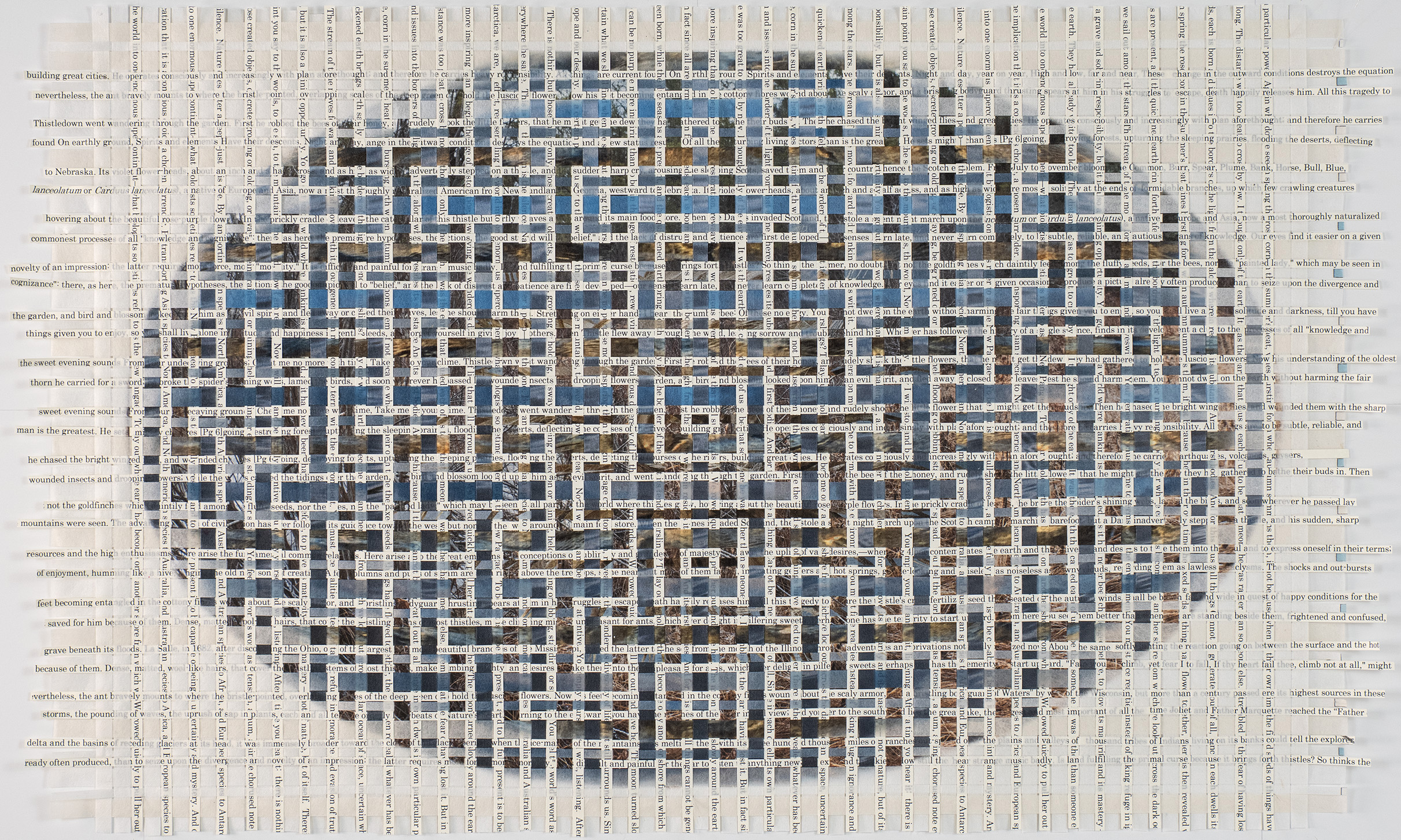
Ellipse 7: The Equation, 2025
Inkjet prints of digitally altered text and photographs on Japanese and western papers, hand-cut into strips, hand weaving. 13 x 22"
Weaving draft from Figurierte Muster Pl. XXVIII Nr. 7 (b), Die färbige Gewebemusterung, Franz Donat, Germany, 1907, Handweaving.net #63698. Short excerpts of text from E.O. Wilson (quote from Braiding Sweetgrass by Robin Wall Kimmerer), Lucretius (Translations from Lucretius Author: Robert Calverly Trevelyan [EBook #64024]) , Italo Calvino (Cosmicomics), Rachel Carson (Silent Spring), Annie Dillard (Teaching a Stone to Talk), and Elizabeth Kolbert (the New Panagea?) Photos by the artist: Walden Pond, Leominster MA, Indian Lake, Indian Creek and sky, Brimson MN,
Therese Zemlin
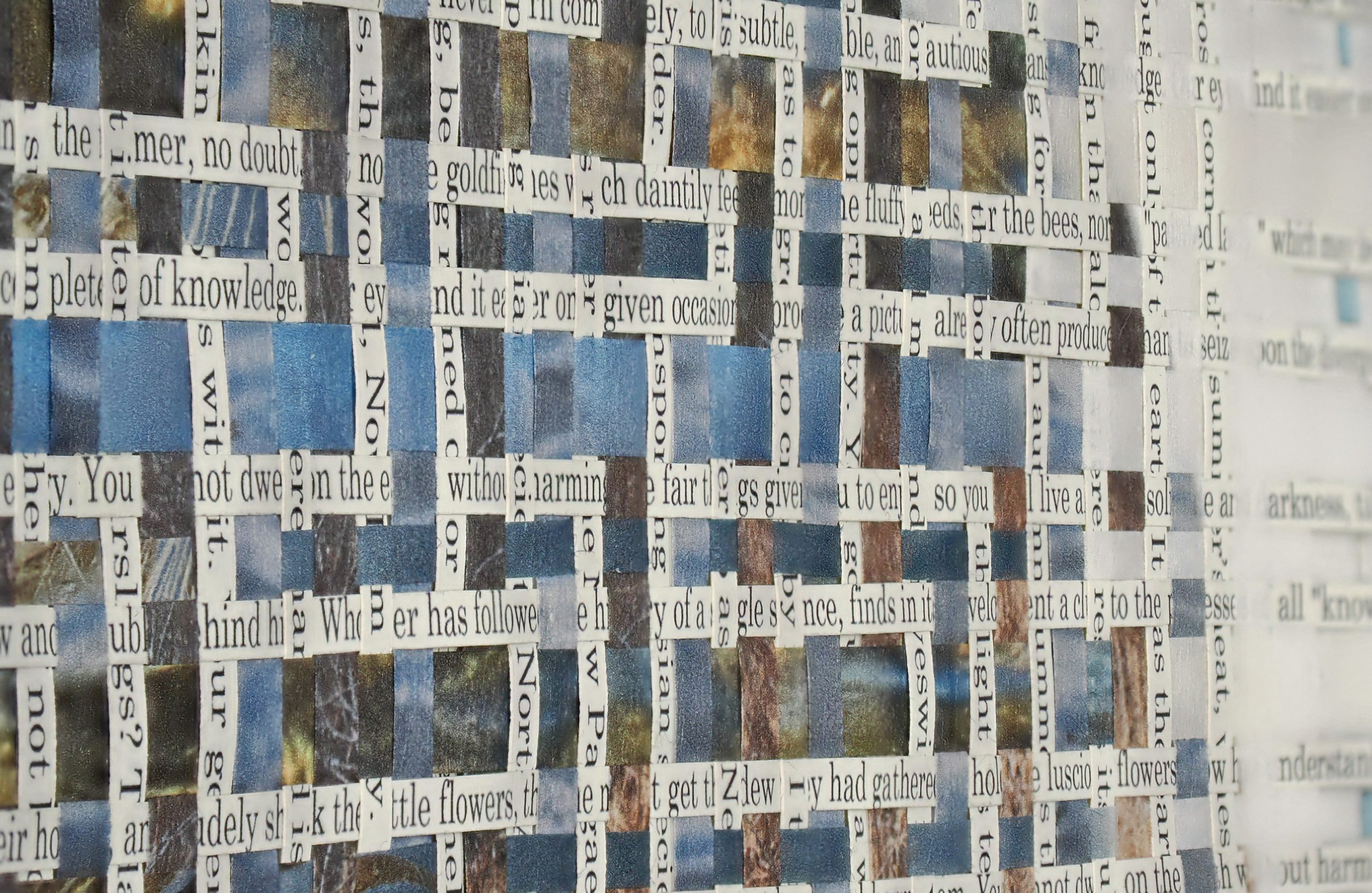
Ellipse 7: The Equation. Detail, 2025
Inkjet prints of digitally altered text and photographs on Japanese and western papers, hand-cut into strips, hand weaving. 13 x 22" Text strips are 3/16" wide.
Therese Zemlin
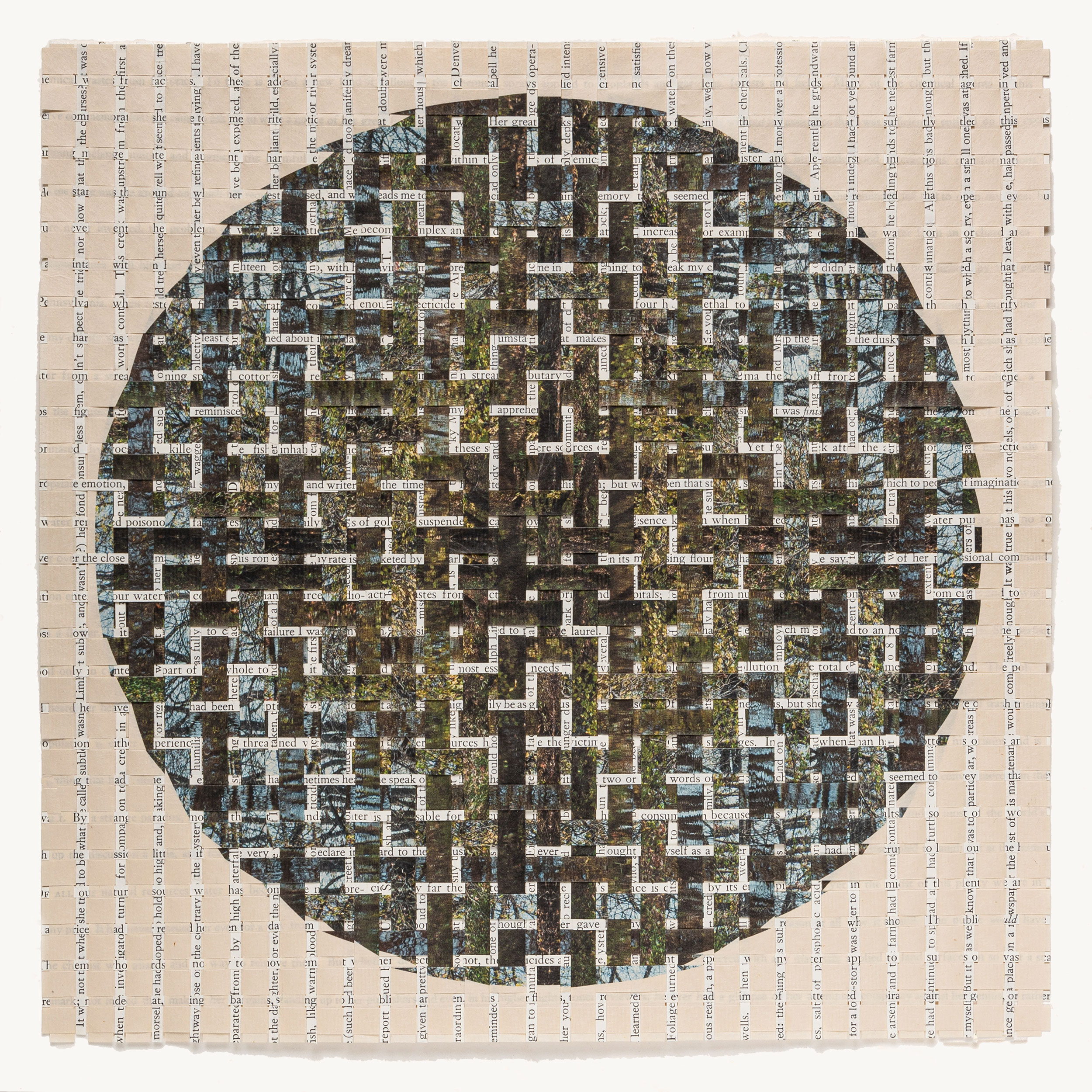
Mandala 2: Cloquet Riverbank, 2022
Inkjet prints of digitally altered text and photographs on Japanese and western papers hand-cut into strips, hand weaving. 12 x 12"
The weaving draft/pattern is by computer scientist Ralph Griswold, 2005, #41506, from Handweaving.net. The cut up book pages are from Silent Spring by Rachel Carson, and Next Time by Henry James. The photo was taken on the Cloquet River in Brimson, MN. The patterns in textiles mimic the patterns in nature. The patterns of human behavior as reflected in the fiction of Henry James are reiterated by Rachel Carson in her descriptions of human endeavors and motivations gone horribly wrong. These associations are not obvious in the work, but hopefully begin to seep in around the edges of the viewer’s awareness.
Therese Zemlin
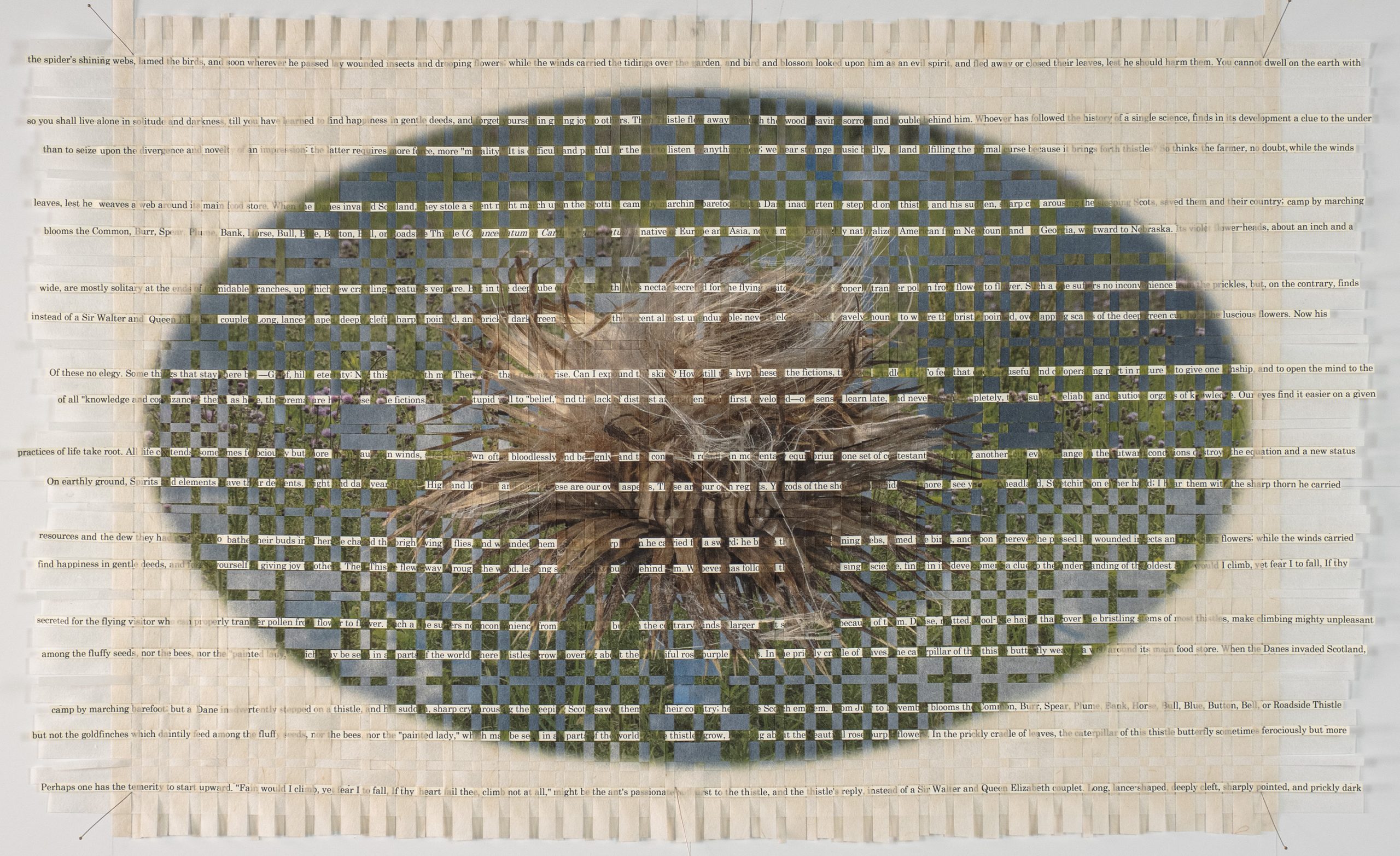
Ellipse 4: Thistledown, 2024
Inkjet prints of digitally altered text and photographs on Japanese and western papers, hand-cut into strips, hand weaving. 12.5 x 21"
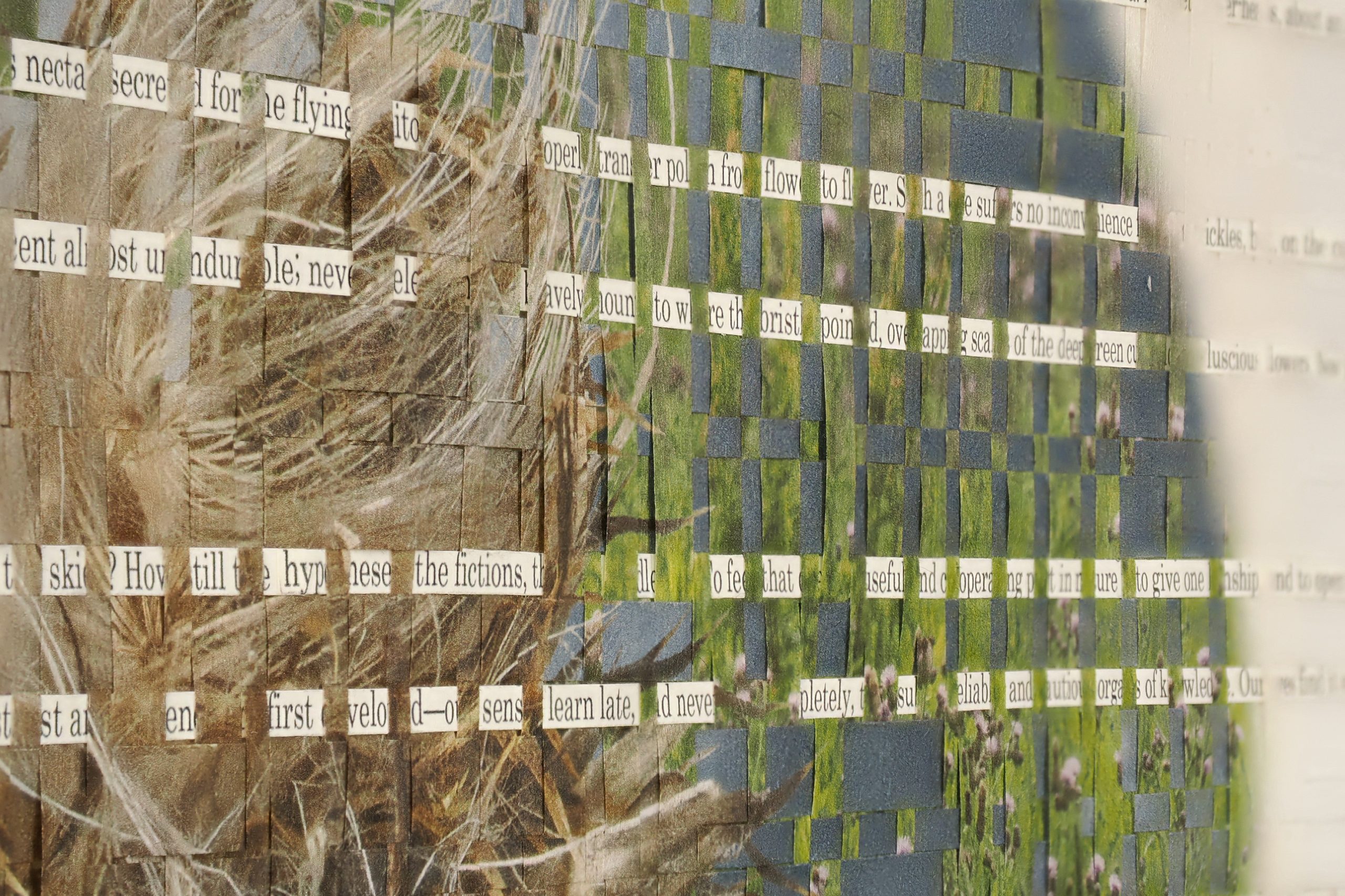
Weaving draft/pattern by Emmy Jacobs, 2004, Handweaving.net #63385. Text excerpts are from Louisa May Alcott (Thistledown 1854), Emily Dickenson (Poems 1830-1886), Neltje Blanchan (Nature’s Garden, 1900), Friedrich Nietzche (Beyond Good and Evil), and L.H.Bailey (The Holy Earth, 1916), (Gutenberg.org) Photographs of the thistle, meadow, and sky taken by the artist at Skibo Mountain, Hoyt Lakes MN, and in the studio.
Therese Zemlin
Ellipse 4: Thistledown. Detail, 2024
Inkjet prints of digitally altered text and photographs on Japanese and western papers, hand-cut into strips, hand weaving. 12.5 x 21". Text strips are 1/8" wide.
Therese Zemlin
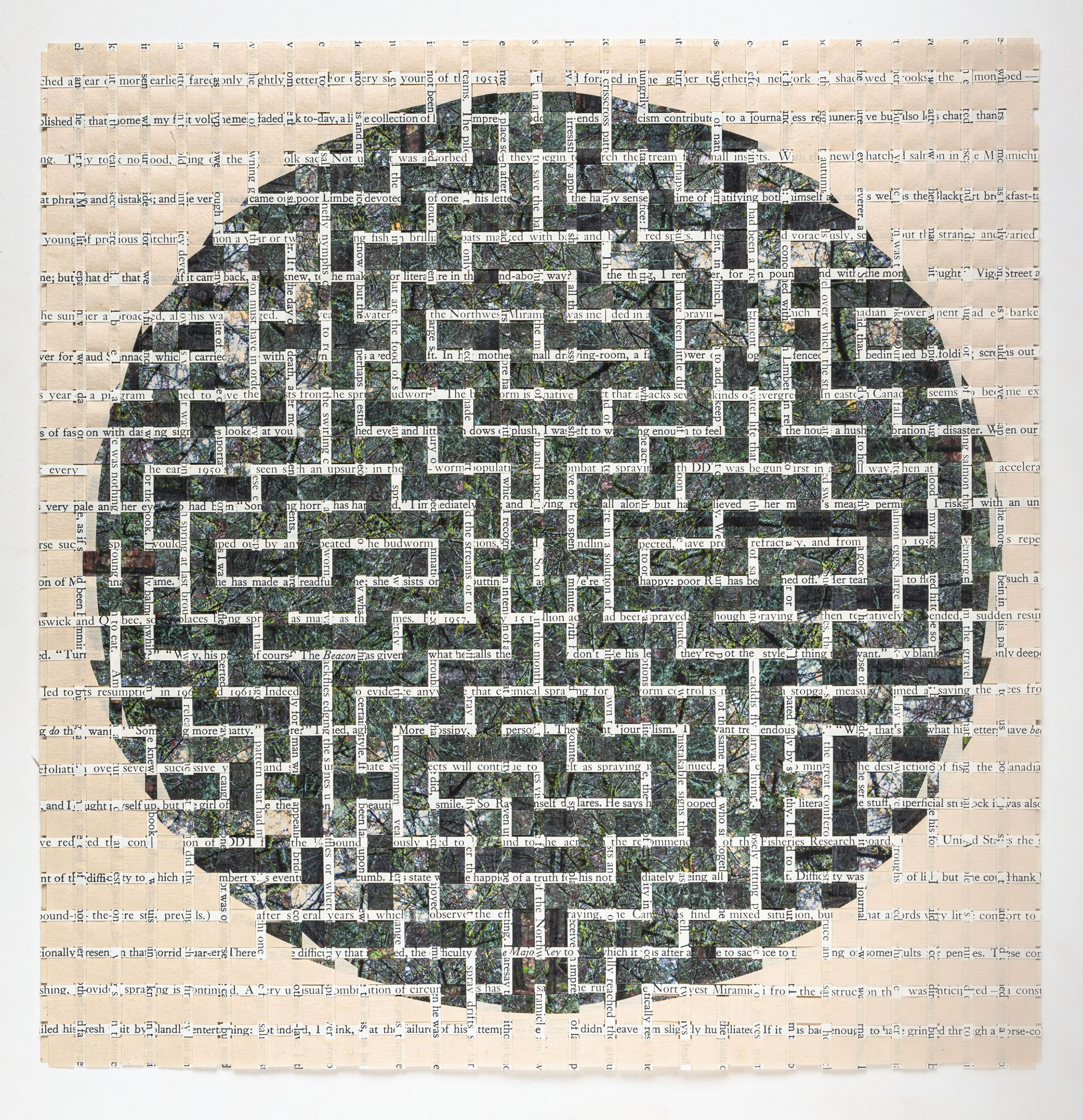
Mandala 3: Lichen on Spruce Branches, 2022
Inkjet prints on Japanese paper cut into strips, text strips cut from book pages, hand plaiting 12 x 12"
The weaving draft is by computer scientist Ralph Griswold, 2005, #41477, from Handweaving.net. Book pages are from Silent Spring by Rachel Carson, and Next Time by Henry James. (Cut up book pages) The photo of spruce trees killed by a spruce budworm infestation was taken in Brimson, MN. The patterns in textiles mimic the patterns in nature. Patterns of human behavior are evident in short stories by Henry James, and as described by Rachel Carson in her timeless and important writings. These associations are woven together in the Mandala series: They are not meant to be obvious in the woven work, but hopefully begin to seep in around the edges of the viewer’s awareness.