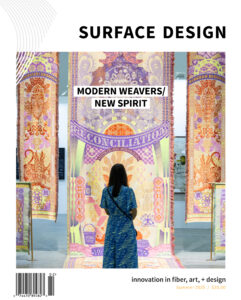
Modern Weavers / New Spirit, Summer 2025 Journal, Out Now!
July 21, 2025
Surface Design Association is excited to announce Modern Weavers / New Spirit, our Summer 2025 edition of Surface Design Journal. This issue takes a deep dive into contemporary weaving while acknowledging a long list of modern innovators whose threads can be located in contemporary approaches. As Patricia Malarcher points out, “textile art produced since the mid-20th century is being re-examined as an integral part of recent art history.” Whether Wall Hangings has stood the test of time or rather marks a point in our history, albeit an incomplete one, the influence of the artists represented including Sekimachi, Amaral and others cannot be contested. –Elizabeth Kozlowski, Surface Design Journal Editor
Here’s a preview of what you’ll discover:
Weaving New Trajectories by Patricia Malarcher: “Generations of weavers have absorbed lessons from Anni Albers’s explorations of woven structures and related writings, then sought expression beyond the formal aspects of fabric construction. Now many artists, working in both abstract and pictorial modes, are drawn to weaving because the process and fibrous materials bring depth and meaning to their intentions. Among those, four whose work differs widely but collectively reflects today’s cultural climate are Christy Matson, Terri Friedman, Melissa Cody and Diedrick Brackens. All have gained recognition through awards and solo exhibitions in museums and prominent galleries around the United States.”
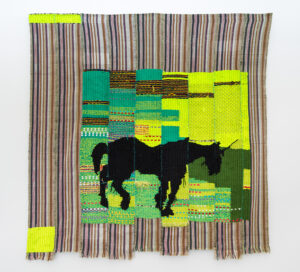
Diedrick Brackens, unicorn kente, 2014. Woven cotton, acrylic and nylon yarn, 72 x 72 inches. Photo: Courtesy of Jack Shainman Gallery.
Threads of Resilience: Contemporary Indigenous Weaving Practices by Manuela Well-Off-Man: “Weaving is one of the most enduring art forms, practiced for centuries by Indigenous cultures worldwide. Blending innovation with tradition, Indigenous weavers from New Zealand, Taiwan and the United States demonstrate how fiber art can serve as cultural and political statements while preserving traditions and strengthening communities. Their work reflects deeply rooted connections between weaving, the land and Indigenous knowledge systems—revealing the power of this medium to express identity, resilience and beliefs.”
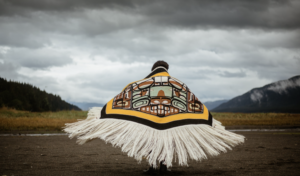
Lily Hope (Tlingit), Aantlenx’ Xh’aak: Between Worlds, 2022. Thigh-spun merino wool with cedar bark, hand-dyed and commercial dyed merino weft and beaver fur, 74 x 47 inches. Photo: Sydney Akagi. Commissioned and permanently housed at Houston Museum of Natural Science.
Faig Ahmed Knotted Vision by Donna Honarpisheh: “Ahmed’s sculptural textile works are rooted in West and Central Asian art histories and literary poetic traditions, which draw on the relationship between text, image, mystical writing and mathematical compositions. Each work encodes a range of transnational references to local communities across Azerbaijan, Iran and the broader region; however, Ahmed’s warping of each carpet establishes each work beyond its historical patterning and invites the viewer to engage with the carpet as an experiential work of art. The formal aspects of carpet making, including the repetitive and invisible labor of weaving knots, are rendered visible through a distortion of scale that foregrounds the knot as a singular and integral structural form.”
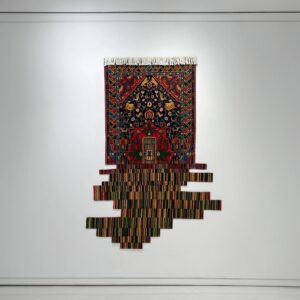
Faig Ahmed, Gen-Culture, 2024. Handmade woolen carpet, 57 x 81 inches. Image courtesy of Faig Ahmed Studio and Sapar Contemporary.
Leonor Antunes: Crafting Another Lineage by Jessica Hemmings: “Antunes’ sculptural practice frequently makes use of suspended elements made of materials such as rope, glass beads, leather and brass, which she realises with the expertise of various craftspeople. And there is weaving, manifest in a variety of structures from bead weaving to rattan. Weaving also occupies another place in her practice, in the primary source material she adapts through changes to scale, technique and material.”
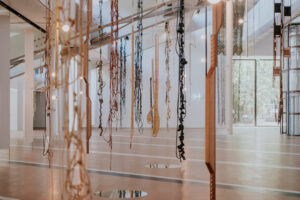
Leonor Antunes, the constant inequality of leonor’s days (installation detail), 2025. Centro de Arte Moderna Gulbenkian, Lisbon. Photo: Pedro Pina.
The Gestalt Shifts of Julia Bland’s Wall Hangings by Rebecca McNamara: “Within the convention of the rectangle, Julia Bland’s woven, cut, braided, knotted, glued, dyed and painted fabrics form an architecturally-scaled wall hanging. One’s eye travels up, down, across, over and around lines and shapes that, whether straight or curved, are never rigid. Canvas thickly painted with yellow and lavender suggests solidity while elsewhere, golden-yellow and deep-blue dyes bleed loosely, an embrace of that which can’t be controlled: hard and soft, both at work. With each blink or dart of the eyes, the composition rebalances itself somewhere between symmetry and asymmetry, between abstract and pictorial: a static work with no fixed states. Such gestalt shifts have become Bland’s preoccupation.”
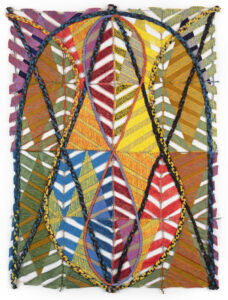
Julia Bland, Vision on the Water, 2022. Linen, canvas, dress, pants,
upholstery fabric, fabric dye and oil paint, 53 x 40 inches. Collection of the Tang Museum, Skidmore College, purchase, with funds from the Susan Rabinowitz Malloy ’45 Fund for Emerging Artists, 2024. Image courtesy Tang Museum.
Exposure: A Gallery Of SDA Members’ Work: “This edition of Exposure spotlights six SDA members who approach weaving in their own unique way. From sculptural installations to rich and dimensional wall hangings, our members continue to create stunning work.”
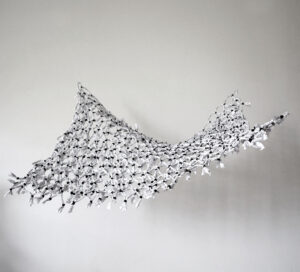
Megan Sharkey, Daily Affirmations, 2024. Off-loom woven with notepad paper and cotton thread, 33.5 x 47.25 x 9 inches.
In the Studio: Can a Weaver be a Nomad? by Monika Auch: “Weaving to me is a metaphor for time, to be filled with contemporary ideas. It is synonymous with an infinite line, or a thread and is about life, making connections and constructing beauty. Returning to the initial question: Can a weaver be a nomad? I argue, contemporary weavers are indeed nomads in a spiritual sense, grounded in the timeless, material nature and global importance of weaving.”
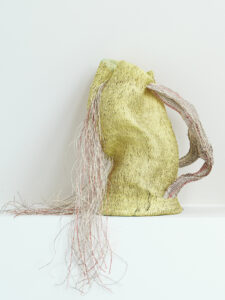
Monika Auch, Container series-green 1, 2020. 3D-woven paper
and fishing line, 31 x 18 inches. Photo: Wouter Stellwagen.
In Conversation: Old Weavers, Young Spirit – In Conversation with Inga Skripka by Elena Wise: “Inga Skripka is a Lithuanian artist and fashion designer. In 2019, she released the fashion collection My Historical Grandma’s Mode of Life, consisting of tailored garments made from traditional Lithuanian textiles handwoven by her grandmother. Skripka decided to make this collection when she discovered a wealth of fabrics her grandmother had woven over the course of her life.”
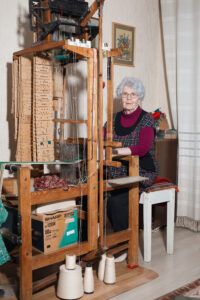
Inga Skripka, My Grandma’s Handicraft Allowed Me to Get to Know Her Better, 2023. Image featured in catalogue of weaver Vita Jadvyga Mataitienė at her loom in Klaipėda, Lithuania. Photo: Rasa Baltrimaitė.
First Person: Interwoven: The Mexican Jaspe Rebozo by Hillary Steel and Chloe O’Connor: “In the mid-1930s in the town of Tenancingo, State of Mexico, future master weaver Don Evaristo Borboa Casas—then a young boy—was sent from his family’s weaving workshop to that of his uncle, starched warps in hand. After ikat designs were drawn onto the warp, young Evaristo brought them back to his family’s workshop for resist-tying, dyeing and weaving, but not immediately. Fascinated by the drawn designs, he would pause on the way to study them and commit them to memory.”
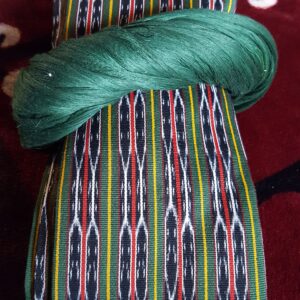
Evaristo Borboa Casas, Jaspe rebozo (detail), year unknown. Resist-dyed and handwoven cotton with warp ends wrapped around rebozo, awaiting a knotted fringe, designed and woven on a backstrap loom. Photo by the author.
Informed Source: Dealing With What’s in Front of You: The Work of Marcos Kueh by matt lambert: “At first glance, Borneo-born and Netherlands-based artist Marcos Kueh could be suspected of employing a streamlined, fully digitized production method. His large colorful weavings reference advertising posters for products, bodies, circuses and human zoos and captivate audiences with a visual bombardment of colors, patterns, text and symbols. His work pulls art enthusiasts in, allowing for the possibility of their intentions and messages to present and unfold themselves from a tension and complexity that Kueh himself grapples with.”
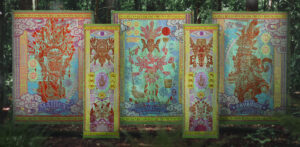
Marcos Kueh, Kenyalang Circus: Exotic Workers Series, 2023. Industrial woven recycled PET, dimensions vary. Photo by the artist.
Made Aware: Creating Textile Art in Norway: Digital Weaving as Evolving Art Form by Kristina Austi: “In a digitally dominated world, a growing trend in the arts involves translating visual and conceptual ideas into the language of thread. Prominent international artists such as Grayson Perry, Kiki Smith and Lia Cook have embraced the tactile and three-dimensional qualities of textiles, integrating digital weaving into their practice with compelling results. This transformation reflects a broader shift: the re-emergence of weaving as a dynamic, contemporary medium rather than a craft bound by tradition.”
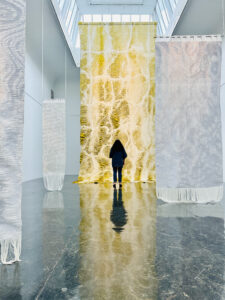
Pearla Pigao, Weaving Voices (installation view), 2024. Center: Woven on an industrial loom by VEVFT; Sides: Woven on a TC2 loom by artist. Kunstnernes Hus, Oslo, Norway. Photo: Uli Holz.
In Review: Weave a Tale reviewed by Julie Gladstone: “Nakahira, whose own grandmother was a traditional Kimono fitter, draws upon traditional Kimono weaving techniques to create work that is part tapestry, part contemporary sculpture and painting. Pieces from the ‘Crossing’ and ‘Interaction’ series are presented with the artist’s stated intention to ‘bridges distances we normally can’t cross and create opportunities to meet people we normally wouldn’t encounter.’”
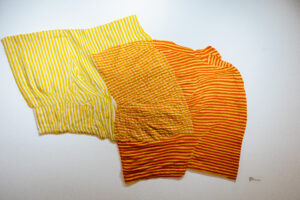
Misako Nakahira, Crossing, 2022. Woven wool ramie, 82.7 x 64.5 inches. Photo: Dave Decker. Courtesy of OXH Gallery.
Emerging Voices: Beatrice Atencah: “The idea of mixing hard and soft materials into sculpture and installation has been my focus in art since moving to the West. I investigate material complexities and visual languages through wrapping, weaving and sculpting, while I allow these materials to encounter my body as part of the making process. In the absence of female black bodies, like those I have engaged with for years at a bridal firm in Ghana, I am now forced to substitute my own body parts such as the waist, hips and bust, as the idea of such intimate interaction is unlikely here in the West.”
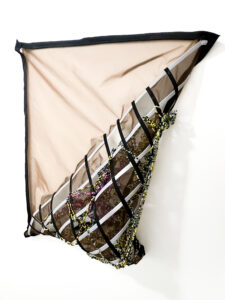
Beatrice Opokua Atencah, But A Burden, 2025. Sewn cotton and mesh with bong and seed beads, 43 x 24 x 13 inches. Photo by the artist.
To buy a copy of Modern Weavers / New Spirit, go to the SDA Marketplace, or you can check out a free digital sample on our SDA Journal page.