Transcorporeography by Theo Trotter
August 29, 2025
I am interested in using materials related to medical gender transition, exploring what it means to take up these tools for my own purposes, not as the doctor or surgeon, but as the individual on the other end of the syringe or scalpel. I am always thinking about the web I am caught in as a transgender person who relies on surgery and hormone therapy to live the life I want. Although I strongly believe that these technologies are unequivocally positive things, I must access them through a medical system that is built upon centuries of violence. Trans care in particular is inhumanely gate kept by design, often by cisgender doctors whose treatment of patients is informed by biased and insufficient knowledge of the subject.
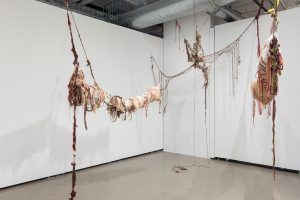
Theo Trotter, (left to right) Transsuturing II, Ensnared, Transsuturing I, 2024. Installation. Photo: Travis Roozée.
The Transsuturing series consists of several woven sculptures whose primary weft material is unraveled ACE and gauze bandages–with another conceptually significant material being silicone. I became interested in silicone due to its malleable, fleshy qualities, alongside its association with medical applications. In Transsuturing II, I soaked wool roving and bandages in silicone.Transsuturing I features a cotton warp, in reference to the cotton these bandages are made from. Transsuturing II has a silk warp, referencing surgical sutures, which are commonly made from silk. Like the Transsuturing series, my woven sculpture Ensnared involves unraveled bandage threads and silicone, along with handspun yarn.
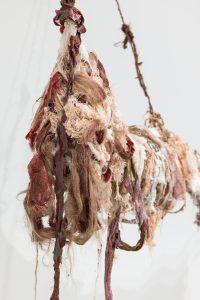
Theo Trotter, Transsuturing II, 2024. Unraveled, piled and soaked with silicone ace and gauze bandage threads, silk, roving and handspun yarn, 7 feet x 8 x 5 inches. Photo: Travis Roozée.
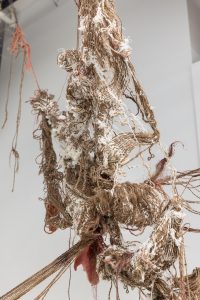
Theo Trotter, Ensnared, 2025. Handspun yarn, ace and gauze bandage threads, silicone, dimensions vary. Photo: Travis Roozée.
All these materials exist together as part of a single woven structure, where one element is never privileged above another, with lengths of unraveled bandage sitting alongside silicone resembling open flesh. Injury and healing exist together here, as part of one process. I have lost count of how many bandages I used, but it was a painstaking process whose texture became a constant background to my life for several years. As I pulled these bandages apart, they did not unravel perfectly into pristine lengths of thread. At many points, the thread tangled, or broke and had to be knotted back together. Alongside these knots left behind by the process, the bandage threads hold onto traces of their previous form.
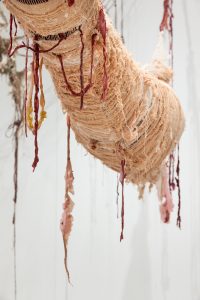
Theo Trotter, Transsuturing I (detail), 2024. Unraveled ace and gauze bandage threads, cotton, silicone, 6.5 feet x 7 x 5 inches. Photo: Travis Roozée.
In contrast to frameworks of pathologization, these three works defiantly embrace “incorrect” embodiment, having been formed as much through the woven structure itself, as through deviation from this structure. Although the unraveled bandages make up a large portion of the materials used, and are placed back into a woven structure like the one they originated from, the finished product is no longer recognizable as a bandage. A significant aspect of this are the selvedges. In both Transsuturing sculptures, I use a technique in which I put the shuttle into the middle of the weaving rather than entering through the side as is conventionally done, allowing the messy selvedge to extend through the structure, while still giving it enough structural integrity to stay intact. Although some segments of the weaving appear to be bundles of threads that could fall apart in seconds, every element is woven solidly in place. Ensnared, on the other hand, was woven in a conventional manner and then pulled apart once I removed it from the loom. Through my care towards these forms, which some may perceive as alien or abject, I question who we see as deserving of tender attention.
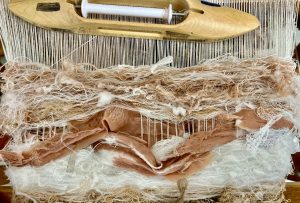
Theo Trotter, Transsuturing II (in progress), 2024. Photo by the artist.
–Theo Trotter (he/him) uses fiber and textile materials and practices, such as weaving and lacemaking, to create sculpture and installation. He recently received an MFA in fiber and material studies from the School of the Art Institute of Chicago. theotrotter.com | @theotrotter
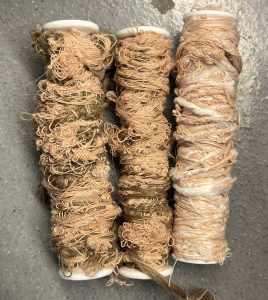
Bobbins with unraveled and plied bandage threads and handspun yarn. Photo by the artist.