SDA Book Club: Flows Like Water reviewed by Vivien Zepf
October 2, 2026
Flows Like Water: Under a Coal Charged Sky by Pam McKinlay
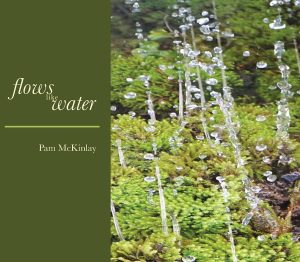
Earlier this year I traveled to Dunedin–the second largest city on the South Island of Aotearoa New Zealand—on a personal holiday. It has a robust arts scene, a cutting-edge science and research community, and strong ties to the indigenous Māori community. It’s the perfect place to explore science and the environment. As luck would have it, Pam McKinlay, author of Flows Like Water: Under a Coal Charged Sky, had time to speak with me while I was there.
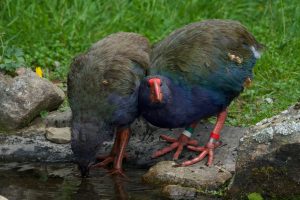
Takahē parent and chick (critically endangered and once thought to be extinct), 2026. Photo by the author.
McKinlay has been thinking about, reacting to, and creating art about global climate change and adjacent issues for years. As we sat together in a hotel lobby anteroom, she shared with me many of the topics she’s explored: dying coral reefs, rising ocean temperatures, the plight of native bees, hazardous air-quality. Sometimes she’s frustrated by the lack of progress or saddened by the visible evidence of human recklessness. “Confronting the decline of our planet can be overwhelming,” she shared. But there is hope. “It seems as if we are living in a narrow window of ‘useful consciousness’”(1), she writes.
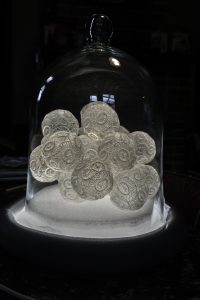
Pam McKinlay, James Perrelet, Lynn Taylor, and William Early, Too Hot to Handle at 20 warming (in-progress), 2022. 3D coccolithophore models, bell jar, and light table, 23.6 x 17.7 inches. Photo by the artist.
McKinlay believes that “the usefulness of art is to move people and to make an argument” (2). For a decade, she’s been connecting science and art in an effort to find ways to tackle thorny scientific topics, raise awareness, and engage the public in advocacy and solutions. She arranges speed-dating-like sessions to pair scientists with artists. Why? The meetings are a way to find compatible partners for a collaboration. An interdisciplinary dialogue ensues, with the scientific inquiry as the jumping off point. The goal is that, through an open-ended collaboration, the artist will create an artwork to convey the researcher’s topic in a way that a layperson can access and contextualize it. “The abstract symbols used to express scientific truths are sometimes too abstract for viewers from outside scientific disciplines, and we need to build a bridge back to the lived experience of the world through visuals and the telling of new and old stories.” The culmination of the joint project is presented alongside those of other teams with related subjects in public exhibitions, installations, and/or audience participation projects. These presentations are the bread and butter of the Art and Science Project.
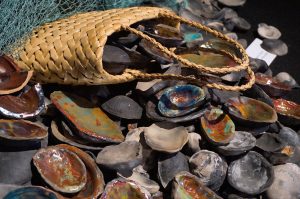
Pam McKinlay and Jesse-James Pickery, Where is the Line in the Sand?, 2018. Handwoven kete and whakatauki written on slips of paper, A1 size photograph on Hahnemuhle torchon matte paper, ceramic shells, beach shells, dimensions vary. Photo by the artist.
In Flows Like Water, McKinlay describes her personal journey as an artist, partner, curator, and lead of the Art and Science Project. The book is organized topically, with related content clustered together. McKinlay has been involved in an array of queries as diverse as space, genetics, oceans, air and earth. In conversation, McKinlay shares an infectious enthusiasm for all she’s learned and a fervent desire to continue her deep dives into ecology, geology, sociology, and climate sciences. Readers, too, have the opportunity to experience her abundant curiosity. While each chapter is focused on a particular topic with scientific descriptions to elucidate, for example, the surge of Chlamydomonas nivalis in arctic regions—a microorganism causing accelerated algal “pink snow” blooms due to rising temperatures—they also include McKinlay’s personal photos, reflections and creative process. As a result, Flows Like Water reads as both an artistic and scientific journal.
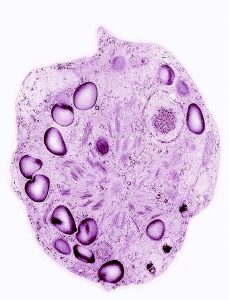
Chlamydomon nivalis. Photo: ARSUSDA Public Domain, Wikimedia Commons.
It’s fascinating to see how McKinlay’s art helps to illustrate a scientific concept. McKinlay’s woven pieces correlate beautifully with research into microbiology, glacial studies and fossilized tree cell structure. I was intrigued by the standalone artworks, but my appreciation was deepened by the additional layer of knowledge imbued and expressed in each. It’s hard to divorce the knowing from the seeing. Was I drawn to a piece because I’m intrigued by the science or entranced by the artwork? That’s part of the power of the Art and Science Project; the collaboration reaches people on multiple levels, strengthening the message(s).
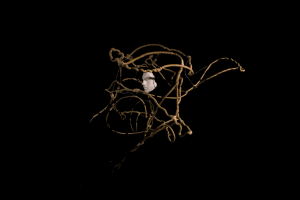
Pam McKinlay, Jesse-James Pickery, and E M Davidson, He puira hirahira (A Special Chromosome), 2017. Muehlenbeckia, hand-bound with muka (from harakeke), monofilament, and plaster mask, 67 x 59 x 71 inches. Photo by the artists.
The information within the book is so meaningful and on-point that it is now part of the coursework curriculum for a new major in Environmental Humanities / He Aronui Aotūroa at Te Herenga Waka Victoria University. And, while some of the topics are complex, McKinlay does an excellent job dissecting them, adding in thoughts and questions she asked along the way while sprinkling in quotes, excerpts and comments from relevant treatises, symposia, books and experts. This is a book we all can read and learn from. Simultaneously, Flows Like Water can be used as a guide for anyone seeking to stimulate creative dialogues between artistic and scientific communities, and with the public. Look no further than the banners created by participants in a local workshop, proclaiming the need for clean air, to see how it can be done.
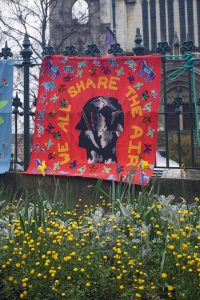
Pam McKinlay, We All Share the Air, 2022. Sewn upcycled fabrics, 39 x 39 inches. Photo by the artist.
Flows Like Water accepts that readers are intelligent and curious. As such, readers should approach the book with a sense of wonder and, perhaps, a notebook and pencil. There’s no doubt this book was a labor of love; corralling scientists and artists could be a bit like herding cats, McKinlay admitted. “There’s always another question to ask, but exhibition deadlines loom.” Flows Like Water encourages us all to explore hard questions, discover answers, and engage with one another. “We are living in a time of ecological grief and anxiety when many people are feeling helpless against the rising tide of climate change….The arts have never been more important than now, in expressing who we are and assisting in shaping positive actions towards a liveable and just future …” And, McKinlay reminds us, “Art moves us in a way that facts may not” (3). Flows Like Water provides ample evidence of how potent an antidote and messenger it can be.
(1) Ralph Chapman, Time of Useful Consciousness; Acting Urgently on Climate Change (Wellington: Bridget Williams Book, 2015).
(2) Lucy Lippard, The Pink Glass Swan: Selected Feminist Essays on Art (New York: The New Press, 1995), 147.
(3) The Artists, “Zaria Forman: Illuminating Climate Change through Art,” 19 June 2019, legionpaper.com
–Vivien Zepf
- buy it here
- Date: 2024
- ISBN: 9780473780944
- If you’ve read this book, leave a comment and let us know what you think!
Do you have a recommendation for a recent fiber-related book you think should be included in SDA’s Book Club? Email SDA’s Interim Editor, Lauren Sinner, to let her know!