SDA Book Club: From Plant to Pigment reviewed by Faith Hagenhofer
November 6, 2026
From Plant to Pigment: How to Make Your Own Vibrant Inks, Pastels, and Paints by Natalie Stopka
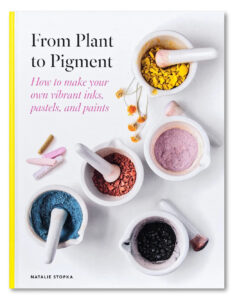
I am fortunate to have taken a few classes with Natalie Stopka over Zoom. These were on making one’s own watercolors, iron gall liquid ink, and madder red and sap green watercolor and lake pigments. When her book was released, I looked forward to seeing how she fine-tuned the instructions, particularly as they relate to making a dry pigment used in relief printing ink for paper or fabric.
The scope of this book is made clear in the subtitle so it is best to approach From Plant to Pigment as if it were a cookbook, something one wouldn’t generally read cover to cover. One would, however, understand the recipes in this book best by reading the chemistry sections that form the first third of the book. The same can be said for the discussions of pH, which occur for several colors.
Being familiar with some of the colors, I decided following the instructions would allow me to best assess the book. I used the madder recipe twice, referring to the general instructions for laking, and the purple petal ice maceration recipe once using black hollyhock instead of pincushion flowers (substitution is encouraged). I am very pleased with the results, and I credit Stopka’s precise and detailed instructions, which are accompanied by plentiful and simple step-by-step numbered photographs. I appreciate that the sap green recipe gives options beyond buckthorn, which doesn’t grow where I live, while cascara does. Dyers specifically will be interested in a 2–page comparative spreadsheet of dyestuff ratios, which goes a long way to explain color saturation.
There is a brief section on indigo, though it is my guess that someone who is serious about learning this process will use other sources for most of the instructions. Here, the highlight is the instruction for extracting dry pigment, which follows the instructions for dye making. The final section outlines using your pigment on a variety of media—watercolor, ink, pastels, and their binding materials. Supplemental instruction is needed to use the pigments for relief printing ink, whether it is on paper or on fabric.
Throughout, Stopka encourages scientific experimentation in plant materials. She also acknowledges differences in local water, and allows for recipe adjustments accordingly. This is a fabulous science of art book! I’m sure it will get a lot of use and not spend much time on my reference book shelf.
–Faith Hagenhofer
- Publisher: Thames & Hudson (buy it here)
- Date: October 2025
- ISBN: 9781837760671
- If you’ve read this book, leave a comment and let us know what you think!
Do you have a recommendation for a recent fiber-related book you think should be included in SDA’s Book Club? Email SDA’s Interim Editor, Lauren Sinner, to let her know!