SDA Book Club: Louise Bourgeois Bibliographic Essay reviewed by Faith Hagenhofer
May 1, 2026
I have a favorite t-shirt, which reads “Name Five Women Artists.” A lot of people have risen to the challenge, invariably naming Georgia O’Keefe and Frida Kahlo, both of whom have arrived at a place of pop culture familiarity, both painters. Louise Bourgeois’ name rarely comes up, perhaps because images of her work aren’t as commodifiable as O’Keefe’s and Kahlo’s are. Peoples’ lists differ—Faith Ringgold, Louise Nevelson, Mary Cassat, Agnes Martin, more recently Amy Sherold, Kara Walker, or Artemisia Gentileschi. Robert Storr, Bourgeois’ most thorough biographer, long-time friend, and frequent interviewer, has called her “The artist everybody has heard about but nobody knows.”
Though recognition and interest in Bourgeois’ work came late in her life, many published works are now available. This essay covers four show catalogs and five picture books. My introduction to Louise Bourgeois came through the novel Take What You Need, by Idra Novey. In it an aging rurally based multimedia artist repeatedly finds inspiration in Louise Bourgeois’ words and art. Not reviewed here is what is considered the definitive work on Bourgeois by Storr, Intimate Geometries: the Art and life of Louise Bourgeois.
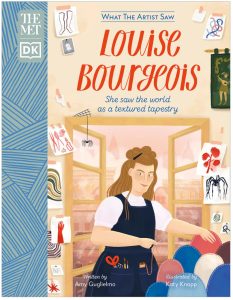
Starting with the picture books, I wonder how they come to be in the hands of children. Each book reveals some of the basics of her long life (She was born in 1911 in France to parents who operated a tapestry repair studio), but chooses a slightly different focus. The most biographical information comes from Amy Guglielmo’s Louise Bourgeois: She Saw the World as a Textured Tapestry and Maria Isabel Sanchez Vegara’s Louise Bourgeois. The first is overwhelmed by prescriptive questions to engage a reader. Unfortunately neither shows enough images of her work.
Half of Louise Bourgeois is reductively simple with single sentence textbook-like pages, leading only to Bourgeois’ enormous Spider, Maman, and no photographs, which is disappointing. Fausto Gilberti’s Louise Bourgeois Made Giant Spiders and Wasn’t Sorry was—for me—the most engaging with red and black illustrations, odd vignettes of a long life, and a final image of Maman, in situ-London. Amy Novesky’s Cloth Lullaby: The Woven Life of Louise Bourgeois attempts to present textiles, but links everything to inspirations Bourgeois may or may not have had from water. Other writings don’t show this connection to water symbolism or metaphor. Biographical information throughout is thin, but is addressed with a two page author’s note.
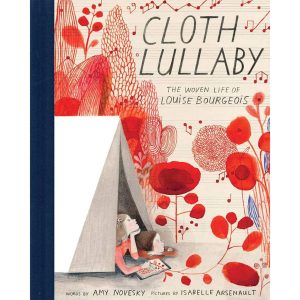
Cloth Lullaby tries to connect the spider work with the later textile work—showing photos of both a metal spider and a tapestry bodied spider, as well quoting Bourgeois: “If you bash into the web of a spider, she doesn’t get mad. She weaves and repairs it” (1). This interview took place in 1998 and the entire quote reframes its meaning: “I came from a family of repairers. The spider is a repairer. If you bash…” (2). In short, a child might get a much more rounded and inviting view of this amazing artist by reading all the books.
Bourgeois’s first major show was at MoMA in 1982 when she was 70 and had not yet returned to textile practices.The number and range of books about her that were published in subsequent years fed her productivity for the rest of her life. After the MoMA show, she became a much-honored international artistic presence. Had her life and work stopped there we wouldn’t necessarily frame her work as relating to her relationship with a textile-engaged loving mother, whose business was in tapestry. The preponderance of that exploration shows up in her last thirty years. In all, she worked productively and prodigious for over 75 years.
Show Catalogues, by their nature, focus on specific bodies of work. In these, I’ve chosen to look at those that cover the fibers and textiles, in chronological order.
Louise Bourgeois: Stitches in Time (2005) includes many images of metal and stone sculptures. The catalog plates appear to focus predominantly on textile or textile adjacent work, and prints. Frances Morris writes, “This exhibition calls the viewer to return to the present and what is new in Bourgeois’ career. Her exploration of needlecraft after decades of experiment in a host of modernist and post-modernist idiom (carving, casting, assemblage, installation…) is also a return to the original aesthetic impulse that she first experienced as draughtswoman and seamstress at her mother’s side. Like the fabric of these pieces, the fabric of Bourgeois’ life and career is woven by thousands of distinct yet repetitive gestures, moving forwards and back over themselves in an intricate web of industry to create a grand and coherent tapestry from astonishingly varied parts.”
Louise Bourgeois: The Fabric Works (2010), at 331 pages, presents mostly plates. They show her geometric fabric pieces, as well as pieced and stitched heads and bodies, whose “every person” (mostly female) quality is haunting.
Louise Bourgeois: A Woman Without Secrets (2014) presents a show whose theme has been used to organize other artists’ work at the Scottish National Gallery, the ARTIST ROOM. At the age of 80, through these monumental installations, she addresses sexuality from a woman’s point of view. This is work from the last quarter of her very long life. It would appear that she is also coming to terms, finally, with family trauma.
Louise Bourgeois: The Woven Child (2022) offers four very brilliantly different essays that give someone who is curious about Bourgeois’ long life, diverse skills, and range of materials, a comprehensive view. The works in this show are some of the best from her many stages and iterations. There is no shortage of her textile work. An observer can also see the influence of fabrics and textile skills even when they’re not front and center. The catalog is a beautiful presentation of the oeuvre of a pioneer of serious textile art and one of the masters of the 20th century.
This list represents just a tip of the iceberg. At each new encounter with Bourgeois’ work I see something I haven’t before, and every time I look I marvel at the handwork skills she employed for her entire life.
1) Coxon, Ann. Louise Bourgeois. London: Tate Publishing, 2010, taped interview with Cecillia Blomberg–1968 (sic).
2) Louise Bourgeois, quoted in Frances Morris (ed), ‘Louise Bourgeois’, exh cat, Tate Publishing, London, 2007, p 272.
- Louise Bourgeois: Stitches in Time. Published for an exhibition of the same name at Museum of Contemporary Art, North Miami. Texts by Bonnie Clearwater and Frances Morris. August Projects and Irish Museum of Contemporary Art, Dublin. 2003, 106 p.
- Louise Bourgeois: The Fabric Works. Published for an exhibition of the same name at Fondazione Emilio e Annabianca Vedova, Venice, Italy & Hauser & Wirth, London. Text by Germano Celant. Skira. Milan, 2010. 335 p.
- Louise Bourgeois: The Spider and the Tapestries. Bourgeois, Louise. Hatje Cantz Verlag, Berlin. 2015 (reprint edition) 88.p.
- ARTIST ROOMS Louise Bourgeois: A Woman without secrets. Catalogue for show at the Scottish National Gallery of Modern Art, Edinburgh. Includes essays by Anthony d’Offray and Lucy Askew. The Trust of the National Galleries of Scotland.
- Picture book Cloth Lullaby: the woven life of Louise Bourgeois. Novesky, Amy and Isabelle Arsenault. Abrams Books for Young Readers, NY. 2016
- Picture book Louise Bourgeois. Vegara, Maria Isabel Sanchez and Helena Perez Garcia. Frances Lincoln Children’s Books, Beverly MA, 2020. Series title “Little People, Big Dreams”
- Picture book Louise Bourgeois. Peh, Laura and Sienny Septibella. Cinnamon Art Publishing, 2021.
- Louise Bourgeois: the Woven Child. catalogue for show of the same name- Hayward Gallery, London & Gropius Bau, Berlin. Includes essays by Ralph Rugoff, Stephanie Rosenthal, Lynne Cooke, Rachel Cusk, Julienne Lorz. Hayward Gallery Publishing. London, 2022, 207 p.
- Picture book Louise Bourgeois: She saw the world as a textured tapestry. Guglielmo, Amy and Katy Knapp. DK/Penguin Random House, NY. 2022. Series title “What the Artist Saw”.
- Picture book Louise Bourgeois Made Giant Spiders and Wasn’t Sorry. Gilberti, Fausto. Phaidon Press, Inc, NY. 2023.
- Museum of Modern Art, NY has a website of Bourgeois’ illustrated books and has categorized her work by themes, not necessarily by media and materials.
- Take What You Need. Novey, Idra. Viking. 2023. 242 p
Do you have a recommendation for a recent fiber-related book you think should be included in SDA’s Book Club? Email SDA’s Managing Editor, Lauren Sinner, to let her know!