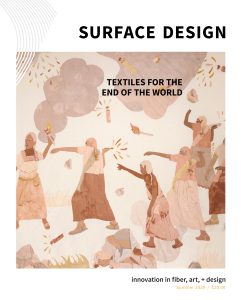
Textiles for the End of the World – Out Now!
July 20, 2026
Surface Design Association is excited to announce Textiles for the End of the World, our Summer 2026 edition of Surface Design Journal. We are living in a period rife with conflict, inequality, and various forms of insecurity, both locally and globally. This Journal examines how contemporary makers are using their craft to adapt the role of textiles as tools for resilience, knowledge-sharing, community-building, and survival in order to find new ways to thrive and improve quality of life as we look ahead toward an uncertain future.
“I’ve been thinking about how textile and fiber practices carry knowledge and practical skills that could be instrumental to our survival, giving us the tools to live through the crises we face today… Fiber practices bring together disparate forms of making, knowing and imagining, assembling a shared toolkit for navigating uncertainty… This issue was conceived during the socio-political crises that occurred in rapid succession in early 2026 in the United States. This was right around the time when immigration officers were deployed across the country, leading to fatal shootings in Minneapolis and the detention and harassment of immigrants and people of color nationwide. The grief and anger felt by communities were palpable, and the way people came together in resistance was incredible. Textiles frequently appeared in protests against the violence.” –Elena Wise, Guest Editor
Here’s a preview of what you’ll discover:
In Conversation: Faith, Hope and Climate Change by Saberah S. Malik and Joanna Rogers: “A Sense of Urgency: Malik: Addressing climate volatility, my work aims to inform industrialized perpetrators about the effects of economic ruin and social trauma on distant victims. Looking at the work means witnessing oneself reflected in floodwater images; viewers become complicit in the crisis, hence responsible for regenerative remedial mitigation. Rogers: As devastating floods, drought, wildfires and hurricanes occur more frequently and intensely, we, as textile artists, can use the potential of our medium to encourage viewers to repair climate-induced damage and to transform our eco-grief into forward momentum.”
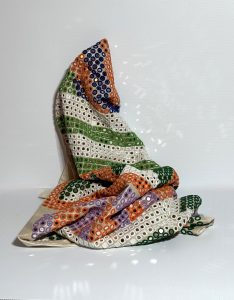
Saberah S. Malik, Collapsed Pixels of a Land of Everything, 2026. Hand-embroidered linen with mirrors and cotton thread on linen, 34.5 x 68.5 inches. Photo by the artist.
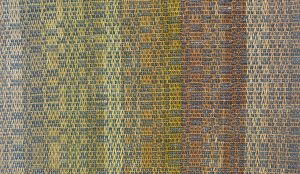
Joanna Rogers, I Will Arise (detail), 2023. Hand-woven and natural-dyed silk and cotton with horsetails, lichen, bracken, willow leaves, daisies, carrot tops, blackberry leaves and canes, Japanese maple leaves, marigolds, Saint John’s wort flowers, hawthorn leaves and twigs, red cedar boughs, heather flowers and indigo, 13 x 180 inches. Photo by the artist.
Hazmatters: For Holding Hands at the End of the (Human) World by Madelaine Corbin: “Hazmat suits are designed to create distance between a body and the world around it. They are made to separate skin from exposure, self from environment. In “Hazmatters,” that logic folds inward when we realize: we are our environments.”
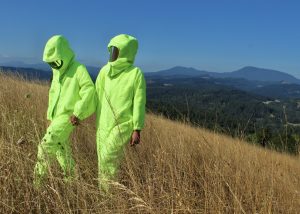
Madelaine Corbin, Hazmatters, 2023. Handwoven cloth with glow-in-the-dark thread. Photo by the artist.
In The Studio: Into the Weeds by Eliza Faulkner Guion: “My studio process is led by an instinctive interest in material; I am largely focused on working with weedy or abundant plants and waste stream objects. In doing so, I question how attending with care to overgrowing, undesirable or polluting material might shape perceptions of home, place and belonging.”
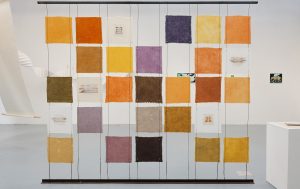
Eliza Faulkner Guion, Map 2. In the family of things, 2025. Waxed Irish wool and linen dyed with nettle, daisy, dock, seaweed, bolete mushroom, blackberry, bracken and hazel with linen weavings, found materials and salvaged pipe, 114 x 4 x 96 inches. Photo: Tom Flanagan.
The Persistence of Henequén by Ashley Newsome Kubley: “Henequén is a hard fiber, unruly and coarse. It is extracted from the plant by crushing, scraping and combing to straighten and align the long, white, strong and lustrous fibers. It takes four to seven years for leaves to reach harvest maturity, and the plant blooms once per lifetime, putting all its energy into producing a spectacular flowering bloom that shoots up from its center. Before it fades away, offshoots appear around its base, ensuring the continuation of its legacy, a poetic testament to its resilience and perseverance.”
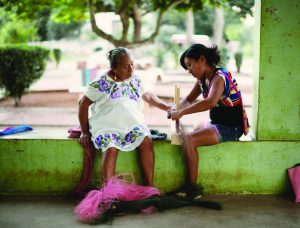
Dońa Marcelina Yam Euan and Delmy Ávila Moo preparing their henequén fiber warp, Hocabá, Yucatán. 2019. Photo: Anne Scherrer.
Threading Habitability: Textiles as Interfaces of Care, Memory, and Resilience by d-o-t-s (Laura Drouet and Olivier Lacrouts): “By engaging with ecological change, social conditions and material histories, Dayrit, Ogisi, Laposse and Neve Insular articulate plural futures grounded in ecological interdependence and situated knowledge. Rather than proposing fixed trajectories, their textile practices approach the future as an open and collective process shaped by present actions and relationships.”
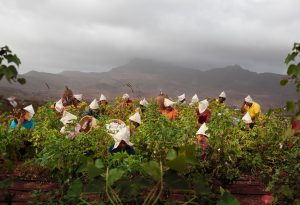
Neve Insular, 100% Cotton, 2020. Cotton harvest. Photo: Diogo Bento.
Made Aware: Sheep Herding is Resistance by Siihasin-Hope A. Alvarado: “Black Mesa Resistance Camps have been in existence for more than 25 years to support Diné elders in continuing to resist relocation. We sustain the resistance through underground economies that directly support locals by selling weavings and wool. Land stewardship and sheepherding stand in the way of mining and contamination. I am the first in my family to relocate back to my ancestral homelands and support my community. ”
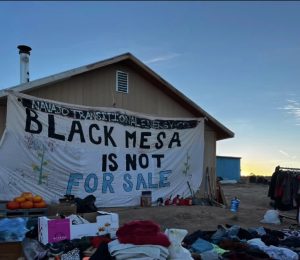
Black Mesa Is Not For Sale Community Feed & Mutual Aid Distribution, Glenna Begay Homesite, 2024. Photo by the author.
Exposure: A Gallery of SDA Members’ Work:
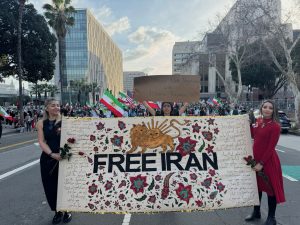
Katayoun Bahrami and Shaghayegh Cyrous, Free Iran Banner, 2026. Painted and
embroidered banner, 45 x 103 inches. Photo by the artists.
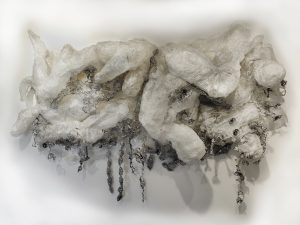
Alysn Midgelow-Marsden, The Inheritors, 2024. Reclaimed soft plastic, wire, latex and enamel paint, 51.2 x 70.9 x 13.8 inches. Photo by the artist.
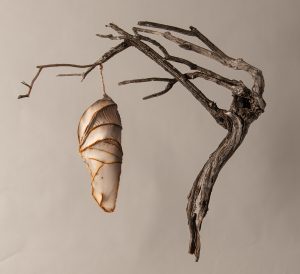
Sarah A Uys, REFUGUA: THRESHOLD, 2026. Wire armature, pattern drafted, hand-stitched, corsetry and structural textile techniques, rigged and suspended, chemical oxidized, eco-dyed and rust transferred, 30 x 41 x 26 inches. Photo: Mike Legg.
Banner: Noun, Verb, Adjective, Form, Medium by Riley Gunderson: “Banners are employed by people who refuse to be silenced. They take up space. They embody the politics which they represent. They make demands, plead, and proclaim. Banners are weathered because they are used; their function defines them. A banner may be strung from a ceiling, displayed on a wall, hung across a street. It can be found in a church, a temple, a university, an elementary school, a bedroom, an archive, a festival, a business, a doorway, a home. We can visualize a banner folded and unfolded, rolled up and tucked away, hung and carried and worn.”
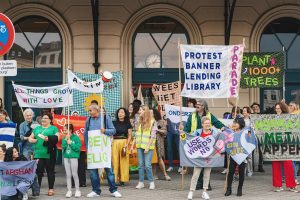
Aram Han Sifuentes, Protest Banner Lending Library, (2016–ongoing). Mixed media, dimensions vary. Protest Zeeuws Museum, Middelburg, Netherlands, 2023. Photo: Viorella Luciana.
Informed Source: Tending to Solidarity by Rachel Breen and Lauren Callis: “We understand solidarity as an acknowledgement that our freedom is bound to that of others. Fabric itself—an interwoven form—can be viewed as a symbol of this: sewing, embroidery, weaving and mending are practices of care and reciprocity. We are two artists and activists based in Minneapolis who are inspired to bring intention to our work with textiles for the good of the planet and to be in solidarity with people who make our clothing. Our work with textiles facilitates and supports the building of community networks and resilience.”
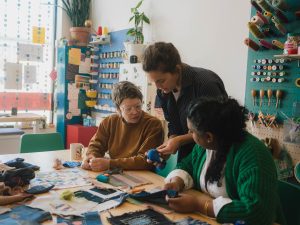
Scotch Darning workshop with Lauren Callis, Curiosity Studio, 2026. Photo: Graham Tolbert.
Held In Common: Maggie Thompson and the Craft of Collective Care by Topher Gent: “[Maggie Thompson’s] work is also deeply personal, often rooted in her own experiences of loss, family and identity. Her most recent project, The Hospital Gown Project, works at a more intimate scale, though it reaches just as far. It began after Thompson sat with a family member struggling with addiction, wanting to honor that experience and to reach people who shared it.”
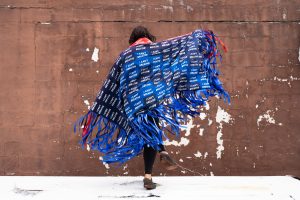
Maggie Thompson, I Can’t Breathe Shawl, 2020. Screen-printed and sewn fabric and ribbons. Photo by the artist. Model: Mary Le Garde.
Made Aware: The Wrapper-Wearers by Kosisochukwu Nnebe: “Àdìrẹ eleko, a resist-dyeing technique developed by Yoruba women, relies on indigo and cassava starch, among other resists, to produce patterned cloth. This practice sustained a significant network of women traders and artisans in the early decades of the twentieth century, even as imported British textiles and Dutch wax prints intensified competition within local markets.”
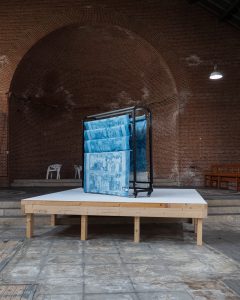
Kosisochukwu Nnebe, Guaranteed Nigerian Àdìrẹ–Available By The Yard!, 2025. Indigo resist-dyed cotton and ready-made fabric rack, 63 x 67 x 17.7 inches. Photo by the artist.
Stitch as a Practice of Hope, Support and Presence in a World of Turbulences by Gabrielė Navickaitė and Dr. Jelena Škulis: “In understanding past craftwork that sustained life under oppression, can manual practices and tactile engagement with material can still offer hope today? In a world flooded with industrial textiles, can thread and needle once again become instruments of soft power, helping people endure war and gather communities?”
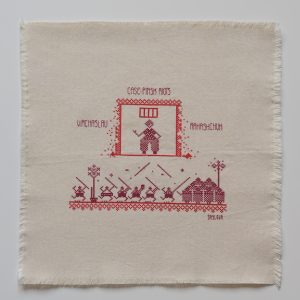
Rufina Bazlova, Project #framedinbelarus, 2021–ongoing. Cross-stitch embroidery on canvas. 11.81 x 11.81 inches. Photo: Anonymous.
Informed Source: Net Making as a Wartime Cultural Form in Ukraine by Dasha Lohvynova: “Across Ukraine and around the world, people gather in schools, cultural centers, libraries, churches and basements to produce camouflage nets. Mesh is stretched and then filled with thousands of fabric strips knotted into irregular density. The net is designed to disrupt landscape outlines and confuse aerial vision, but… the practice is difficult to categorize. As an object, the net is tactical. As a durational and collective practice, it resembles what theory often names as socially engaged or participatory art: forms where time, cooperation, and shared authorship become central materials.”
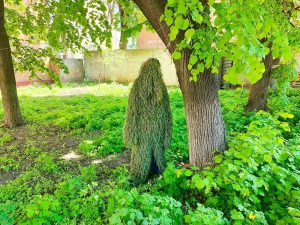
Volunteer Community Zakhyst, Untitled, 2025. Nylon cord, recycled and dyed textiles. Photo by the artist.
In The Studio: Bark Baskets After the World Collapses by Jessica Kaufman: “Humans have always needed containers. Vessels are as intrinsic to our survival as clothing. Bark strips can be shaped as we need, into practical shapes or expressively wild patterns or both. Once harvested, our bark needs processing. Find water: a pond, creek or spring. Soak it. Wait. Test it. Is it pliable? Can it bend without cracking?”
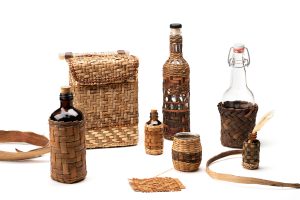
Jessica Kaufman, Bark Baskets 1, 2026. Twined, twill, bias plaited, waled, hex-woven wild-harvested outer and inner barks of willow, kudzu, cedar and hickory with waxed linen thread, privet wood hinge, found/upcycled glass bottles and jars and corks, 2 through 13 inches tall. Photo: Cami Leisk.
In Print: Textile Fine Art: Conversations with Artists Creating By Hand, reviewed by Faith Hagenhofer: “Textile Fine Arts presents fifty illustrated interviews with living textile artists. The artworks are exquisitely constructed and beautifully photographed, and it is fascinating to have artists speaking in their own words. The artists reflect on their origins, training, choice of materials and practices.”
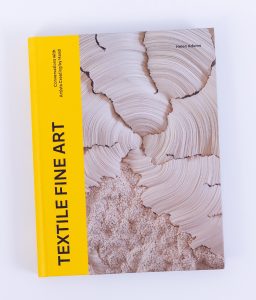
Textile Fine Art cover.
To buy a copy of Textiles for the End of the World, go to the SDA Marketplace, or you can check out a free digital sample on our SDA Journal page.