The Tank You Didn’t Know Was Empty by Marilyn Heywood Paige
September 11, 2026

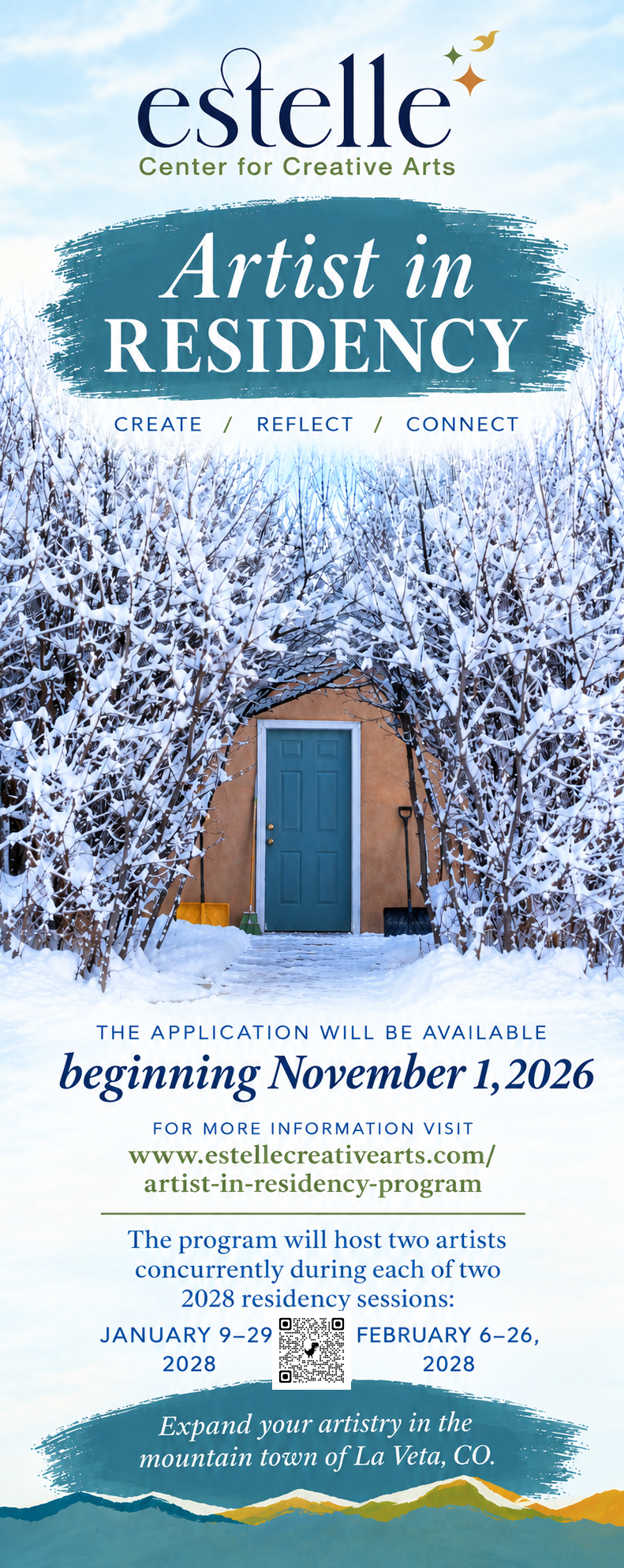
Jennifer Peterson, founder of the Estelle Center for Creative Arts, has watched a curious situation play out across dozens of fiber art retreats. A group of strangers arrives, and within hours—sometimes minutes—something shifts. The roster of guest teachers at her center in La Veta, Colorado spans the textile and fiber arts world, but the same peculiar trend happens each time. “My favorite thing about hosting a retreat,” she says, “is getting glimpses into the lives of all the fascinating women who attend. They make connections with each other immediately. And I believe those relationships, even if they only exist for that week, propel their artistry as much as the instruction does.”
It’s an observation that artists and researchers keep arriving at from different directions: creativity, for all its reputation as a solitary pursuit, may be fundamentally social. Research out of UC Berkeley suggests that “creativity emerges not simply from accumulated influences, but from the particular configuration of social and cultural exposure artists experience.” Put more simply: who you’re around shapes what you make. A growing body of voices in the textile and fiber arts world would say the same thing—and they’d say retreats are one of the most powerful ways to put that principle into practice.
Safety First
Carolina Oneto, a Chilean quilt artist and teacher, starts every retreat the same way: before threading a needle or considering a pattern, she addresses the room directly, saying, “We need to build a safe place together.” What she’s building isn’t just a comfortable classroom—it’s a specific relational container. She asks participants to show respect, kindness, and empathy. She instructs them on how to speak about each other’s projects using specific terms, such as proposing alternative placements for a focal point or suggesting more contrast, rather than just stating, “I don’t like it.” When people learn to articulate what they’re seeing rather than react to what they’re feeling, the entire room opens up. “What happens in a group can be fantastic,” Oneto says, “because we are giving feedback that really helps and not feedback that makes you feel bad.”

Carolina Oneto, quilt artist and teacher.
Filling the Tank
Elaine Poplin, known for her intuitive approach to color in quilting, offers a more personal window into why community matters. She was in a slump. A long one. She was showing up to the sewing room, technically working, but not discovering—not experimenting, not finding the edge of what she could do. “I’m not discovering,” she says simply, when asked to describe what a slump feels like from the inside.” What she’d noticed over years of teaching and making is that she needs other creators around her to do her best work—not necessarily while she’s working, but somewhere in the cycle. “I have to fill the tank,” she says. “I have to be around people who create, who get excited about creating, in order to find the ability to do it when I get home.”

Elaine Poplin, quilt artist and teacher.
Her longtime collaborator, Karla Overland, reaches for a similar remedy. When the commercial demands of running a fabric business flatten her creative energy, she takes a brief, solo retreat. She doesn’t necessarily sew; she may read, do stitchery, or something else to step outside her usual medium. “When I can’t separate Karla the artist from Karla the owner of Cherrywood Fabrics,” she says. “I have to do things like this.”

Karla Overland, quilt artist, teacher, and owner of Cherrywood Hand-Dyed Fabrics.
What Retreats do that Studios Can’t
Jane Sassaman, celebrated quilt artist and designer, has spent years traveling to teach. “It’s therapy for me as much as going to learn something new is,” she says. “It’s where I have to go to grow with others.” What makes a retreat different from a class, Overland suggests, is the totality of it. “I’ve seen people form friendships at a five-day retreat that last a lifetime,” she says. “You can personalize it to what your needs are.” Poplin distills it: “A retreat is a non-threatening way to learn, because you can disappear into your work when you get overwhelmed by the people.”

Jane Sassaman, quilt artist and teacher.
Sashiko artist and teacher Atsushi Futatsuya frames it through the Japanese concept of ibasho—a word that roughly translates to “a place where one belongs; where one can simply be.” He’s observed it consistently across his years of teaching. “When people gather around sashiko, they often find more than a technique; they find a space where they can simply be themselves.” The creativity that emerges from that state, he argues, is categorically different from what’s possible in isolation. “The creativity that emerges from humility, curiosity, and the willingness to keep learning is something that can only happen in a community.”

Atsushi Futatsuya, sashiko artist and teacher.
All of their observations track with researchers’ discoveries, too. Collaborative creative environments don’t just support belonging; they actively enhance social connection and self-expression—and the two reinforce each other in ways that neither produces alone.
The tank, it turns out, isn’t a metaphor; it’s how creativity actually works.