Traditions and Techniques in Lace – Out Now!
May 4, 2026
Surface Design Association is excited to announce Traditions and Techniques in Lace, our Spring 2026 edition of Surface Design Journal.
“Exploring vast historical and material contexts, our Traditions & Techniques journals are always some of our most inspiring issues. Lace is no exception. The history of lace is one rich in luxury, ornamentation and skill. Like many textile techniques, lacemaking has seen a significant resurgence in conceptual and material recontextualization.” –Lauren Sinner, Surface Design Journal Managing Editor
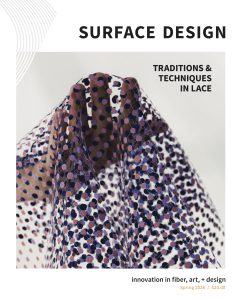
Here’s a preview of what you’ll discover:
Liminal Threads: Towards a Global Definition of Laceby Elena Kanagy-Loux: “The question of how to define lace is deceptively simple, yet the deeper one delves into the recesses of lace research, the more difficult it becomes to answer. Unlike woven textiles, for example, which vary widely but are unified by the perpendicular warp and weft, lace does not refer to any one technique or structure. Rather, lace is an umbrella term for openwork textiles made using a range of methods that are associated with one another for primarily aesthetic reasons. Many definitions of lace are characterized by absence, including my own, which is that lace is a textile in which the pattern is defined by the spaces between threads.”
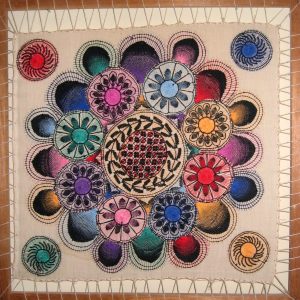
Maker unknown, Handmade ñandutí lace, acquired in 1986 in Asunción, Paraguay. Polychrome thread on cotton fabric. Photo: Trey Jones. Source: Wikimedia Commons.
Reframing Lace: From Ornament to Discourse by Asia Graziano: “In contemporary art, however, lace has been reactivated as a critical medium, one capable of addressing questions of power, embodiment, labor and cultural memory. Artists such as Ghada Amer, Anne Wilson, Cal Lane and Piper Shepard—all women—engage lace not merely as material or motif, but as a conceptual framework through which inherited hierarchies of gender, craft and value can be examined and reconfigured.”
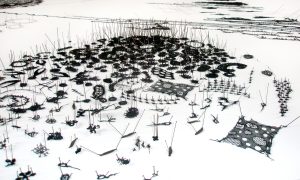
Anne Wilson, Topologies (3-5.02) (detail), 2002. Lace, thread, cloth, pins and painted wood support, 31 x 74 inches x 18 feet long. Photo courtesy of Anne Wilson Studio and Whitney Museum of Art.
Lacebark: Historical Overview and Contemporary Exploration by Keren Alfred: “Lacebark (Lagetta lagetto) is a tree that has only been found in Jamaica, Cuba, Haiti and the Dominican Republic. Its inner fibers create a lace-like material when teased apart. Lacebark grows in wet limestone forests, including in a region in Jamaica called the Cockpit Country, which is one of the largest areas of primary forest in the island and is habitat for endemic flora and fauna.”
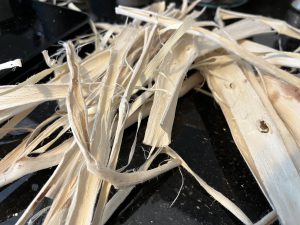
Keren Alfred, Preparing lacebark for processing, 2023. Photo by the artist.
Adventures in Making a Lace Community by Jane Atkinson: “Makers from across the globe have for the past five years congregated monthly, in two time zones, on Zoom in an explosion of creativity known as The Adventurous Lacemakers. TAL mentors publish original contemporary courses, with the culmination being ‘Masterclass,’ supported by a lively private Discord forum, where members present creative dilemmas, question assumptions and support each other through uncertainty.”
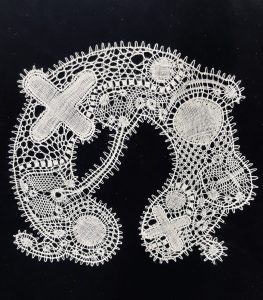
Madeline Thoman, A Bobbin Lace Collar, 2025. Bobbin lace with linen, 12 x 12 inches. Photo by the artist.
Exposure: A Gallery Of SDA Members’ Work: “This edition of Exposure spotlights twelve SDA members who work in a wide variety of lace techniques and styles”
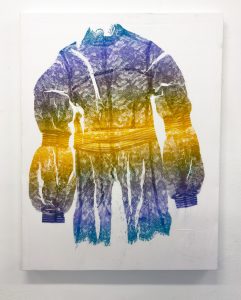
Sok Song, Soft Quiet Strength, 2026. Monotype transfer pressure print on muslin with Charbonnel ink, 30 x 48 inches. Photo by the artist.
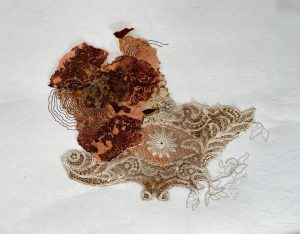
Bénédicte Blanc-Fontenille, The bird, 2025. Lace, paper, thread, biomaterials and encaustic, 21 x 17 inches. Photo by the artist.
First Person: Silver Lining: Chanakya International Revives Chaand Jaal in Mumbai by Katerina Knight: “In Mumbai, one embroidery studio is working to revive techniques like the Chaand Jaal. Chanakya International was founded in 1984 by Vinod Shah and is now led by his children, Karishma and Nehal Swali. At the core of the studio’s ethos is the preservation of Indian handcraft, with a particular emphasis on safeguarding traditional embroidery techniques to ensure their longevity and prosperity.”
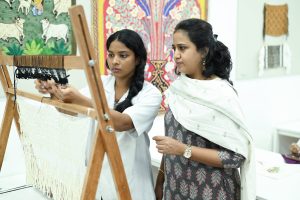
Student and teacher in the Chanakya School of Craft, 2023. Photo: Chanakya School of Craft.
First Person: Knots and Syllables by Damla Tamer: “Made through a type of needle tatting, oya is built knot-by-knot from a single thread that loops back onto itself. The thread gradually forms small figures that cling to the fabric’s edge or are created separately and later sewn on as trimming. In my practice, oya moves beyond its usual place on scarves, becoming an independent form within framed pieces, suspended arrangements and sculptural compositions which still carry the logic of an edge.”
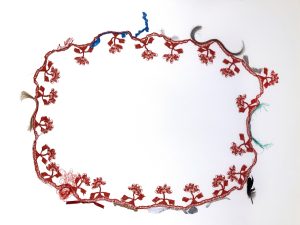
Damla Tamer, Red Garden, 2023. Oya on string with fragment from garbage bag, silver-colored wires, my mother’s hair, fragment of cotton rope, frayed green plastic clothesline, pigeon feather, aluminum foil, copy of the last page from my sister’s journal, adhesive bandage from son’s knife cut, red ribbon, marine rope from a beach in İzmir, white rope untied from the gate between the front garden and backyard of of my childhood apartment building, broom fibres, silver wire and bracelet fragment, 29 x 23 inches. Middle: detail. Photos by the artist.
First Person: Between Spaces: Contemporary Lace as a Material Language by Magdalena Sophie Orland: “Lace provides a lens through which technology can be reflected and translated into a textile medium. Through its inherent interplay of filled and empty spaces, materiality and immateriality, analog and digital, lace serves as a prime example of duality in society. It is understood not as a historical quotation but as a medium for examining perception, space and material.”
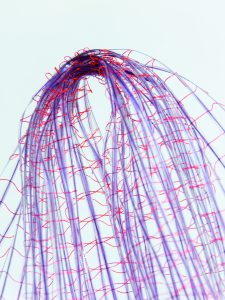
Magdalena Sophie Orland, BETWEEN_SPACES, 2019. Contemporary lace made from constructive technique using heat and pressure, manual extrusion process and punch work with nylon, viscose, transfer film, acrylic, CoreCoat yarn and recycled leather, approximately 16 x 16 inches. Photos by the artist.
First Person: Simplistically Complicated: The Work of Rowan Panther by matt lambert: “Using muka for lacemaking is unconventional. A demanding fiber, its length is determined solely by the length of the leaves it is harvested from. Muka fiber cannot be wound into spools like cotton or linen and is prone to breaking when used too firmly. However, if manipulated too gently, the intended pattern of the lace becomes distorted, requiring a greater sensitivity while working. Panther views muka as a material that is not used, but rather worked with in collaboration. It can’t be readily bought in a store; working with it demands an understanding of the lifeforce of the plant itself and a need to recognize it as a taonga (treasure) that supersedes its use value.”
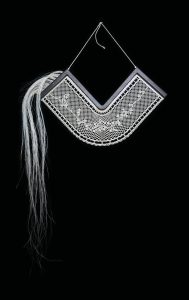
Rowan Panther, Pohuehue, 2022. Bobbin lace made from muka, European Beech and sterling silver, 14 x 16 inches. From the Kohumaru Collection. Photo by the artist.
In the Studio: The Multitudes of Laceby Maggie Hensel-Brown: “Although it is impossible to extricate lace from its associations and its history, I have a strict ‘nothing useful’ policy when it comes to lacemaking: nothing you can wear and nothing with a functional purpose. This brings everything back to the basic formula of positive and negative space. Every stitch will be met with the viewer’s memories and feelings, and every stitch corresponds to a centuries-long lineage of lacemakers.”
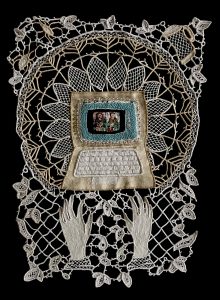
Maggie Hensel-Brown, Zoom, 2021. Needle lace made from silk thread with glass beads, 5.5 x 7.5 inches. Photo by the artist.
In the Studio: A View of the Window by Olivia Valentine: “Coming to this architectural opening from a photographic background, I consider the window as an opening, a place between inside and outside, and a mediating force between them. I made a series of windows between 2010 and 2024, with my most recent work being a hybrid of weaving and bobbin lace, which includes both frame and view. Lace, which historically defined the edges of garments, here was used to define the architectural edge between interior and exterior.”
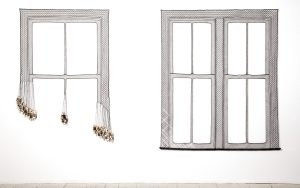
Olivia Valentine, Guest Room at the Drake, 2012. Handwoven cotton bobbin lace with plexiglass rods, wood and pins. 72 x 111 inches. Photo by the artist.
In the Studio: Lacing Together by Jin Choi and Thomas Shine: “People are at the center of our work: making, installing and experiencing the art. When a visitor occupies the work, they become an integral part of the art. The process of engaging the community requires perseverance, empathy and sincerity and is a moving, powerful experience. It makes the act of creation as important as the work itself and empowers everyone in the process. It is humbling, and we are truly grateful.”

Jin Choi and Thomas Shine, The Lace, 2016. Polyester cord, 30 x 45 feet. Amsterdam, The Netherlands. Photo: © 2016 Janus van den Eijnden.
In Conversation: Connecting with Devon Thein by Ellyane Hutchinson: “Devon Thein…is a writer, lacemaker, analogue influencer and mentor. Her passion for lace has had a significant impact on the now blossoming contemporary lace world. She curated the 2018 Hunterdon Art Museum exhibition Lace not Lace: Contemporary Fiber Art from Lacemaking Techniques. Thein also curates the IOLI Lace Lecture Series and volunteers at the Antonio Ratti Textile Center.”

Devon Thein with poster Gems of European Lace ca 1600-1920, 2009. Necklace: Lauran Sundin, Garden Party. Photo: Gary Thein.
Spotlight on Education: Teaching Bobbin Lace Through “The Bachelor” by Sasha Baskin: “A final rose recipient on The Bachelor becomes a modern Helen of Troy when she tries to flee the show and break the structure of the past 23 seasons. When she is trapped in her hotel room and forced to resume the season, she is (as was Helen) a prisoner of forces she cannot see or control. She is both powerless in the moment while extraordinarily powerful: Helen of Troy started the Trojan War; Cassie from Season 23 of The Bachelor changed the nature of the franchise and redefined the structure of reality television.”
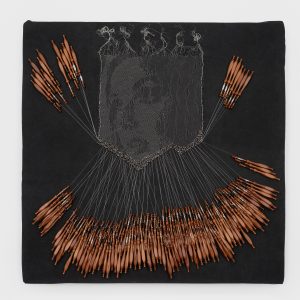
Sasha Baskin, Persephone II (As Reese Unraveling), 2025. Bobbin lace, silk thread, digital still from America’s Sweethearts, wooden bobbins and brass pins, 24 x 24 inches. Photo: Vivian Doering.
Emerging Voices: The Silent Process of Reclaiming by Sonia Rucci: “Synthetic plastics are designed to survive time; lace is created slowly to be handed through generations. Somehow, they belong together. The rhythms of industrial production try to erase previous methods; they shrink lengthy processes to the blink of an eye in order to devalue them, to erase duration, but meanwhile pursue the myth of ‘forever.’ Time is compressed in new eternal materials, in ‘always-new’ ephemeral products that now haunt the invisible side of modernity: the shameful one that grows in the Global South, on the outskirts, in seas, rivers, oceans and landfills.”
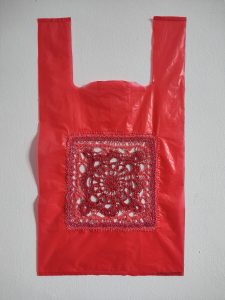
Sonia Rucci, Ce Urmează (What Follows), 2026. Hand-cut and heat-glued shopping bag, crocheted doily, hand-stitched low-density polyethylene, 20 x 11.4 inches. Top: detail. Bottom: in progress. Photo by the artist.
To buy a copy of Traditions and Techniques in Lace, go to the SDA Marketplace, or you can check out a free digital sample on our SDA Journal page.